
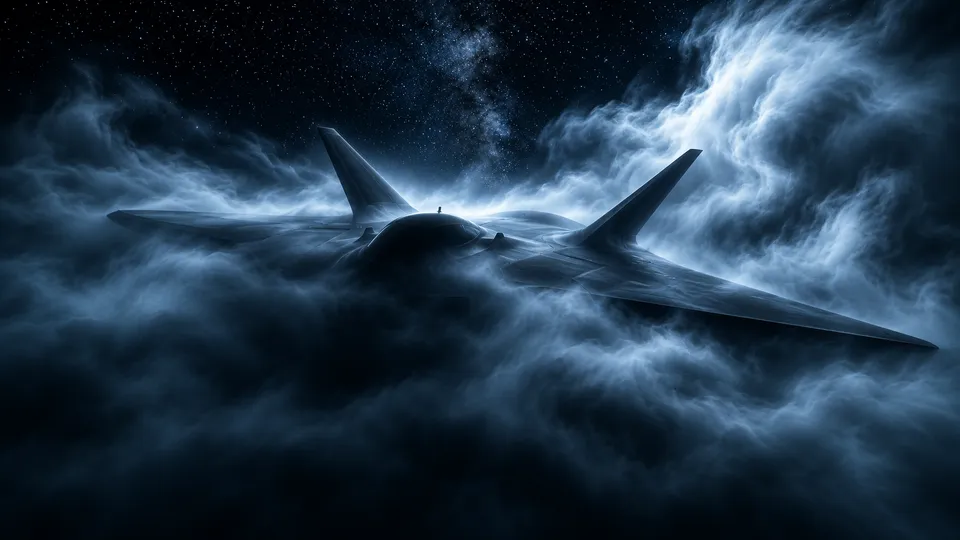
On 4 November 2026, at the Kennedy Space Center on Florida’s Atlantic coast, where the American state has spent decades sending its machines upward, NASA administrator Jared Isaacman announced a new aircraft to the UP.Summit. It has a name, the X-70 Fractal. It has a number in the long line of American X-planes. It has specifications. So far as the public has been told, it does not yet have a body.
The only picture NASA released came with its press release. As Jeremy Hsu reported for Ars Technica, it appeared to be AI-generated. It showed a dark silhouette, vaguely like a military fighter jet, half hidden in smoke. AvBrief called it a fuzzy image of a V-tailed hull shrouded in mist. A government agency once showed its aircraft with a wind-tunnel model or a photograph of a prototype on the ramp. Now it can show a machine’s rendering of a machine, at a time when such image generators are themselves a subject of argument.
The arithmetic of an idea
What NASA did provide was numbers, and they are exact. According to the agency’s announcement, the X-70 will carry a crew. It is designed to cruise at Mach 0.75 and reach altitudes of up to 45,000 feet, with an operational range of more than 1,726 miles (2,778 kilometres), which NASA also gives as 1,500 nautical miles. It will take off at 10,000 pounds (4,536 kilograms) and carry up to 2,000 pounds (907 kilograms) of experimental payload, both inside the aircraft and outside it.
The agency’s main claim concerns flight control that can be reconfigured quickly. NASA says this will let researchers explore aircraft maneuverability in ways never before shown in crewed flight. It also describes a modular design, so payloads can be taken out and replaced from one experiment to the next. Isaacman put it in the language of momentum:
“The X-70 Fractal gives NASA a crewed, high-performance platform to test advanced flight-control, maneuverability, and other cutting-edge technologies in real flight. Its modular design and ability to rapidly swap internal and external payloads will keep our teams flying, learning, and moving quickly from one experiment to the next.”
Mach 0.75 is below the speed of sound. Aviation Week described the program as subsonic. This is a laboratory with wings, built to carry other people’s experiments into the air, and not a record-breaker.
What was not said
The list of what the agency left out is longer than the list of what it gave. The press release named no manufacturer helping to develop the aircraft. As Flying magazine noted, NASA has also not said what the X-70 will cost or which technologies it will test first. Isaacman said the plane could fly within two years, but the agency has not given a date. Ars Technica said it had asked NASA for more details.
In an announcement like this, a reader may reflect, the specifications are the easy part. Speed, ceiling and weight are promises a pen can make. Who will build the aircraft, who will pay for it and when it will fly are the questions that decide whether a program becomes a machine or stays a press release, and those were the questions without answers.
Another plane
Isaacman made clear that the X-70 is meant as the start of something larger. “Know that X-70 is just one part of this new beginning for aeronautics,” he said, according to Aviation Week. “I promise you, there will be more.”
The trade press reported that the next one was expected within two days. Aviation Week said another X-plane would be announced at the UP.Summit on 6 November, the same day President Donald Trump was scheduled to appear at the event. Fox 35 Orlando reported that he was expected at about 5:30 p.m. on Friday. So the agency’s aeronautics revival will be presented in two parts, and the second part will be in the president’s hands.
This set off talk of the Blackbird, the SR-71 that NASA once flew for research. AvBrief reported that the X-70 does not appear to be connected to the widely repeated rumours that a NASA SR-71 could return to service. Whether Friday’s aircraft is connected to them, nobody has said on the record.
For now, then, the agency has two planes. One is known only through its numbers and a smoky picture. The other is known only through a promise. A crowd at a summit on Merritt Island has been told that both will fly. When they do, someone will have to say who built them.