
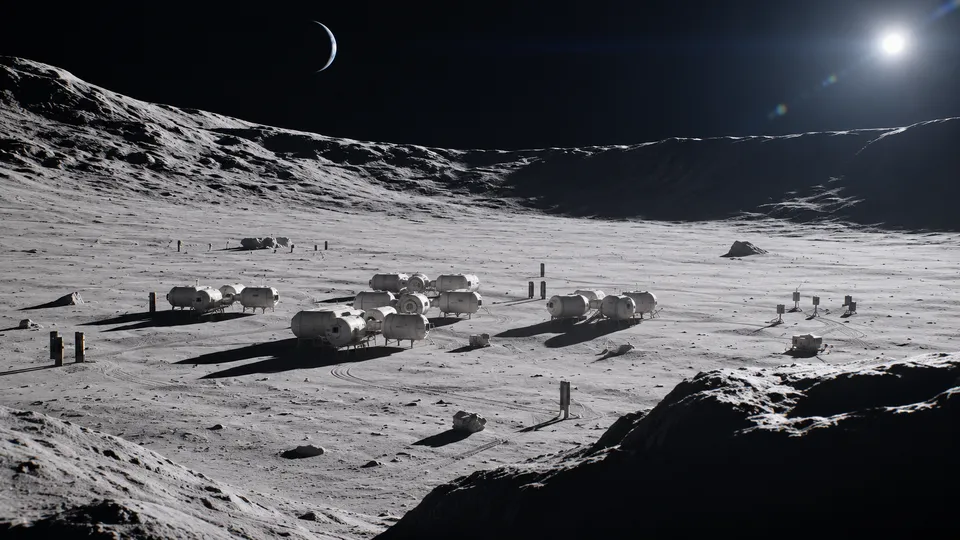
When NASA announced its Moon Base in March, at an event called Ignition, you probably assumed the hard parts would be the rockets, the landers, the keeping-astronauts-alive parts. Reasonable assumption. But Eric Berger reports at Ars Technica that the thing impressing industry most — at least judging by Gold, whose company Redwire is in the running for pieces of the work — is the procurement strategy. NASA’s secret weapon in the lunar space race may be the way it writes its request-for-proposal paperwork. This is the most NASA sentence imaginable, and also, I think, a genuinely interesting one.
To see why, you have to understand the traditional cost of bidding on government space work. Under a conventional procurement, NASA writes down precisely what it wants — every requirement, every specification — and interested companies respond with detailed proposals that routinely run dozens or hundreds of pages and absorb extraordinary amounts of engineering time. Notice the incentive this creates: if you are a big prime contractor with a whole proposal department, fine, that is a moat you already paid to dig. If you are a startup with thirty engineers and one good idea, the price of admission to the competition is a significant fraction of your company’s annual capacity, spent before you know whether anyone will ever read past page three. A lot of good ideas simply never get submitted, because the bidding itself is too expensive to lose.

NASA’s new approach, borrowed from the Defense Advanced Research Projects Agency, has two parts. First, instead of writing detailed specifications, the agency has largely used Broad Agency Announcements: it asks for a capability — say, providing power on the surface of the Moon — rather than a precisely specified object. NASA asks industry what it can do, instead of telling industry what to build. This flips the expertise problem the right way up; the companies that actually build things get to propose the thing they know how to build, rather than reverse-engineering whatever a program office happened to write down years earlier.
Second, there is a two-step proposal process, and this is the part that directly attacks the bidding-cost problem. Step one: a company submits a short white paper sketching its solution. NASA reviews these quickly and picks the concepts it wants to pursue. Only those companies then invest the time and money to produce the full, detailed proposal. Gold said Redwire looked at several lunar opportunities and submitted initial proposals on them, but only had to gear up for full proposals on the ones NASA actually wanted — including a variant of Redwire’s roll-out solar arrays, adapted to generate power on the Moon. “We were able to focus the lion’s share of our resources in what the agency really wanted and what we were best at,” he said.

Everyone gets an invite
The combined effect is a shift in what NASA thinks its job is. Rather than micromanaging every individual lunar-base subsystem — designing the power system, the comms, the logistics, then hiring contractors to execute its designs — the agency is positioning itself as a coordinator of independently developed commercial capabilities. And it is casting the net about as wide as a net can be cast: the sources include major contractors like Lockheed Martin, SpaceX, Blue Origin and Northrop Grumman, alongside relatively new startups such as Impulse Space, ispace-US, Voyager Technologies, Quantum Space and more.
There is an economics-of-procurement story underneath all of this that I find satisfying. Every dollar a company spends writing a proposal it will lose is a dollar the government eventually pays for anyway — folded into the overhead rates and prices of the contracts the company does win. Expensive bidding processes do not save the government money; they launder the cost into fewer bidders, higher prices and worse ideas. Cheaper bidding means more entrants, more competition for each piece of the base, and a NASA that sees options it would never have specified into existence on its own.
None of this lands anything on the Moon by itself; at some point someone still has to build hardware that works in a place famously hostile to hardware. But the history of big government programs is, in large part, a history of the paperwork around them, and someone at NASA appears to have read that history. The race back to the Moon may yet be decided by rockets. It will definitely be decided by who could afford to show up and bid.