
Adding a personalized mRNA vaccine to Keytruda left an estimated 82.2 percent of patients alive without melanoma returning at two years, compared with 70.0 percent on Keytruda alone, Moderna and Merck announced on Oct. 22.
The difference is 12.2 percentage points, or about 12 additional patients in every 100 alive without recurrence at that point. The companies’ other headline number, a 42 percent reduction, measures the relative hazard of recurrence or death during follow-up. It does not establish that the vaccine prevents 42 percent of deaths.
The companies’ phase 3 announcement supplies evidence that adding the vaccine reduces recurrence and distant spread beyond what Keytruda achieves after surgery. What it cannot yet answer is how many patients live longer because of it. That requires more deaths to be counted over longer follow-up, rather than treating an avoided recurrence as proof of an avoided death.
The result comes from 1,137 patients in a randomized, double-blind trial, a much larger test than the earlier study that brought the treatment to attention. The vaccine, intismeran autogene, also called mRNA-4157 or V940, remains investigational. The companies reported discussions with regulators, not an approval or a filing date.
What the numbers mean
Median follow-up in INTerpath-001 was 24.6 months. Patients had high-risk stage IIB–IV cutaneous melanoma that surgeons had completely removed. Investigators randomly assigned them, two to one, to vaccine plus pembrolizumab, Keytruda’s generic name, or placebo plus pembrolizumab.
That comparator matters. The study did not test a vaccine against no treatment. It tested whether personalization could improve on an established postoperative immunotherapy. Both groups received active cancer treatment, and neither patients nor investigators knew who received the vaccine rather than placebo.
The primary outcome, recurrence-free survival, counted the time from randomization until melanoma returned at any site or the patient died from any cause. Combining those events lets a trial measure treatment failure sooner than a trial waiting for deaths alone. But the combined outcome does not reveal, by itself, how much of the difference came from fewer recurrences and how much from fewer deaths.

The primary analysis produced a hazard ratio of 0.58, with a 95 percent confidence interval of 0.45–0.75 and a p-value below 0.001. Subtracting 0.58 from one gives the reported 42 percent reduction in the recurrence-or-death hazard. A hazard compares event rates among people still being followed without an event, rather than simply comparing the percentages who have had one by a fixed date.
The two-year estimates answer the more direct question of how many patients were alive without recurrence: 82.2 percent with the vaccine and 70.0 percent without it. Their respective 95 percent confidence intervals were 79.3–84.8 percent and 65.0–74.5 percent. These are estimates from follow-up, not guarantees for a new patient.
Beth Mole’s account in Ars Technica reported the recurrence-free figures rounded to 82 percent and 70 percent. The companies’ more precise figures put the absolute difference at 12.2 percentage points. The absolute difference and the hazard reduction describe the same trial, but they are not interchangeable measurements.
Distant spread and death
At two years, an estimated 88.5 percent of vaccine recipients were alive without distant metastasis, compared with 80.2 percent in the control group. That is an 8.3-percentage-point difference on an outcome that counts spread to a distant site or death.
The corresponding hazard ratio was 0.62, with a 95 percent confidence interval of 0.45–0.85 and a p-value of 0.002, according to the sponsors. The reported relative reduction was 38 percent. The distant-spread result supports the recurrence finding: the difference was not confined to events at or near the original cancer site.
Neither group’s median recurrence-free or distant metastasis-free survival had been reached. That does not mean follow-up was complete or that patients would never relapse. It means the estimated proportion remaining free of the relevant event had not fallen to half during the observed period.
For overall survival, the sponsors reported a favorable direction but provided no numerical estimate. Their written statement drew the distinction plainly.
Overall survival (OS) data are not yet mature
A patient can experience a recurrence and remain alive for years. Conversely, a recurrence-free patient can die from another cause. Fewer recurrences are a benefit in their own right, but a trial must count deaths separately to establish that treatment extends life.
Nor does two years without detectable melanoma establish a cure. The immediate finding concerns how long patients remain alive without recurrence during observation. Whether the vaccine permanently prevents some relapses, postpones them or does both will become clearer with longer follow-up. The announcement does not settle that distinction.
A patient-specific treatment
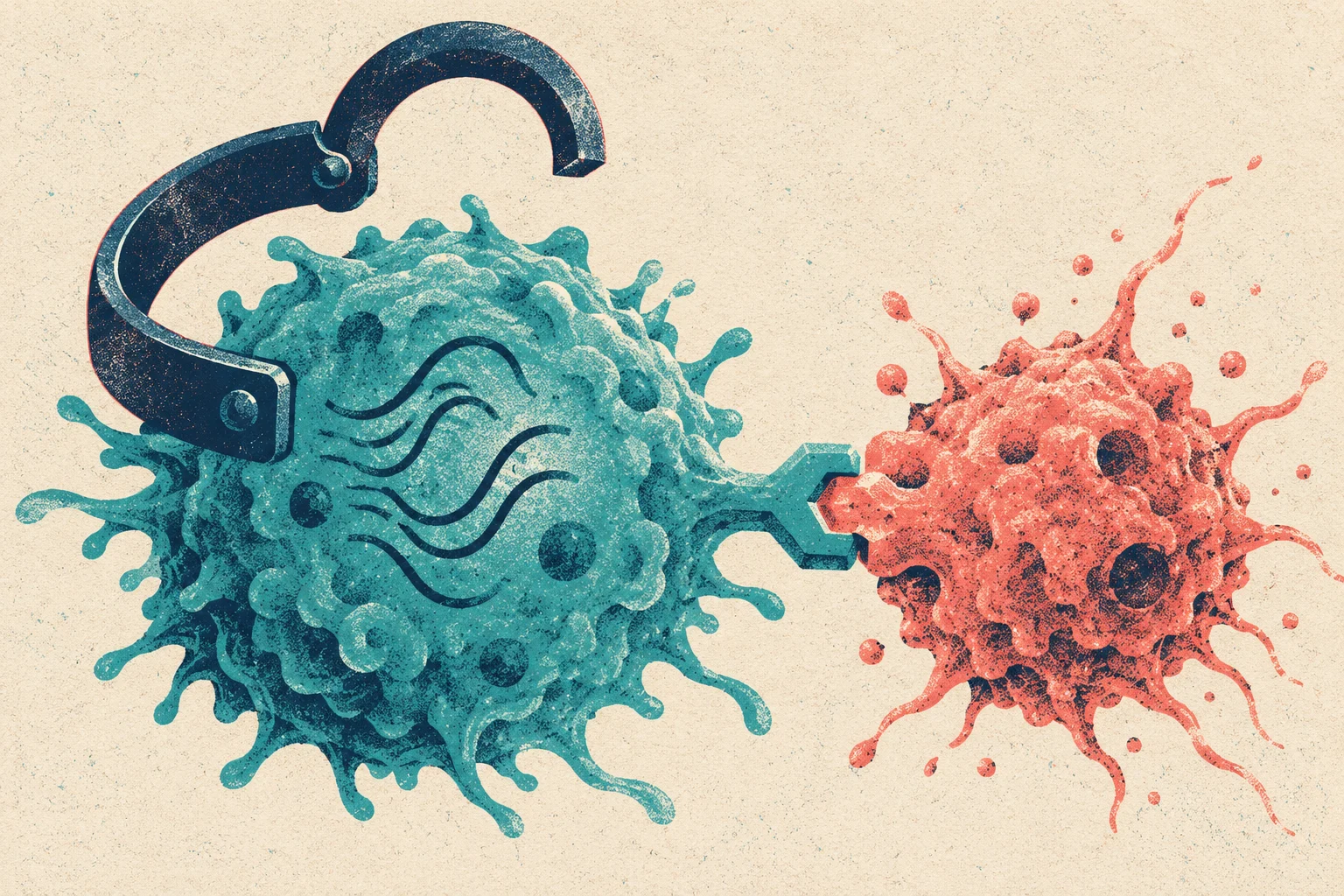
Intismeran can encode up to 34 targets selected from mutations in a patient’s cancer. Researchers compare genetic information from tumor and healthy cells, then choose mutations intended to direct an immune response toward the cancer rather than normal tissue.
The synthetic messenger RNA carries instructions for those targets, called neoantigens. The aim is for cells to produce and present them so that T cells learn to recognize the cancer. This is treatment for someone who has already had melanoma, not vaccination of healthy people against an infection.
The National Cancer Institute’s account of cancer treatment vaccines describes the broader approach: some vaccines use material from a patient’s own tumor to stimulate recognition of cancer-associated targets. Personalization changes which targets the immune system is asked to recognize.

Pembrolizumab works differently. It blocks PD-1, an immune checkpoint that can suppress T-cell activity. As the National Cancer Institute explains, interrupting that signal allows T cells to attack cancer cells. The combination therefore pairs tumor-specific instructions with a drug that reduces an inhibitory signal. The mechanism makes the pairing plausible. Randomization tests whether it works.
Patients in INTerpath-001 received 1 milligram of vaccine every three weeks for up to nine doses. Both groups received 400 milligrams of pembrolizumab every six weeks for up to nine cycles. Treatment stopped for recurrence or unacceptable toxicity, with an overall limit of approximately 56 weeks.
The benefit did not appear uniformly over that time. During the first six months, the recurrence-or-death hazard ratio was 0.99, with a confidence interval of 0.66–1.49: no clear difference. After six months, a prespecified analysis estimated a hazard ratio of 0.42, with a confidence interval of 0.30–0.58.
The sponsors associated the later separation with completion of the immunization course. An immune response that takes time to develop is consistent with that pattern, but timing alone cannot prove the explanation. It also means the overall 42 percent figure should not be read as an identical reduction at every point after treatment begins.
The earlier evidence
In April 2023, the first detailed phase 2b announcement described just 157 patients: 107 assigned to vaccine plus pembrolizumab and 50 to pembrolizumab alone. Unlike phase 3, that study was open-label. It enrolled patients with stage III or IV melanoma, not the broader stage IIB–IV population.
The initial recurrence-or-death hazard ratio was 0.56. Its 95 percent confidence interval, 0.309–1.017, crossed one, the value corresponding to no difference. The sponsors reported a one-sided p-value of 0.0266. Those qualifications belong with the initial result, rather than disappearing behind the reported 44 percent hazard reduction.
Longer observation strengthened the recurrence evidence. In the June 2024 update, median follow-up had reached 34.9 months. Estimated recurrence-free survival at two and a half years was 74.8 percent with the combination and 55.6 percent with pembrolizumab alone, a 19.2-percentage-point difference.
The five-year update, released June 1, reported median follow-up of 60.3 months. The recurrence-or-death hazard ratio was 0.51, a 49 percent relative reduction. For distant metastasis or death, it was 0.411, a 59 percent reduction.
Those figures are numerically larger reductions than phase 3’s 42 percent and 38 percent. They do not establish that the treatment lost effectiveness. Disease stages, sample sizes, blinding and observation time differed. Comparing separate trials cannot substitute for a randomized comparison within one trial.

The five-year study also shows why waiting longer does not automatically resolve survival. Its exploratory overall-survival hazard ratio was 0.471, but the 95 percent confidence interval ran from 0.165 to 1.345. That interval accommodates a large benefit and no benefit. Five years of follow-up in a small trial still left too much uncertainty to establish longer life.
The objections that hold
All 1,137 randomized patients belong in the main phase 3 comparison, including those who did not receive their planned first vaccine or placebo dose. The sponsors reported that intention-to-treat result as the primary analysis. It preserves the comparison created by random assignment.
A prespecified modified analysis excluded patients who never received that first planned dose. It produced a larger apparent reduction in recurrence or death, with a hazard ratio of 0.51 rather than 0.58. The exclusion rule and both results were disclosed in the trial announcement. The primary estimate is the firmer basis for describing the benefit of assignment to the treatment strategy, without first removing people who did not start their assigned injections.
The objection that recurrence is not survival is correct. The conclusion that the recurrence result therefore has no value does not follow. At the two-year estimate, more patients were alive without melanoma returning, and more were alive without distant spread. Those outcomes are narrower than longer life, but they are the outcomes the randomized trial measured.

Treatment burden also belongs in the comparison. Treatment-related adverse events occurred in 95.8 percent of combination recipients, 723 of 755, versus 90.0 percent of controls, 342 of 380. Grade 3–5 treatment-related events occurred in 14.2 percent versus 13.4 percent. Those safety denominators describe treated patients, not the full randomized population.
The most frequent reported events in the combination group were fever, at 52.2 percent, injection-site discomfort, at 51.0 percent, and fatigue, at 38.5 percent. The sponsors said they found no new safety concern. Their announcement did not separately enumerate treatment-related deaths, treatment discontinuations or immune-mediated event rates for this trial.
Pembrolizumab itself can cause immune inflammation that damages organs, according to the National Cancer Institute. Because both trial groups received it, the comparison measures what the vaccine adds to that existing treatment burden. Similar aggregate rates of higher-grade events do not answer every question about which events occurred or how long they lasted.
The remaining tests
Merck research president Dr. Dean Y. Li said the study was the first phase 3 trial to demonstrate improved recurrence-free and distant metastasis-free survival over Keytruda in resected melanoma. That statement concerns the postoperative comparison. It is not a finding that patients live longer.
The companies said detailed findings would be presented in Presidential Symposium I at ESMO Congress 2026, as abstract LBA1, and that the results had been accepted by The New England Journal of Medicine. Their announcement did not provide a journal publication date or a numerical overall-survival result.
The detailed results will allow closer examination of the sponsors’ statement that benefit was broadly consistent across prespecified subgroups. The announcement did not provide the subgroup estimates or interaction tests needed to assess whether effects differed by disease stage or other patient characteristics. The overall result cannot supply an exact benefit for every subgroup.
A personalized treatment also has to reach the patient. Merck’s description of individualized neoantigen therapies lays out tumor analysis and target selection, but the phase 3 announcement gives no manufacturing turnaround, production-success rate, capacity or cost. Those omissions do not negate the randomized efficacy result. They leave access and delivery unanswered.
For longer survival, the remaining requirement is different: continued follow-up, a reported overall-survival analysis and enough information to judge its uncertainty. The earlier trial’s five-year confidence interval demonstrates why a favorable numerical estimate alone is insufficient.
At the latest phase 3 analysis, median follow-up was 24.6 months. Overall survival remained immature.