
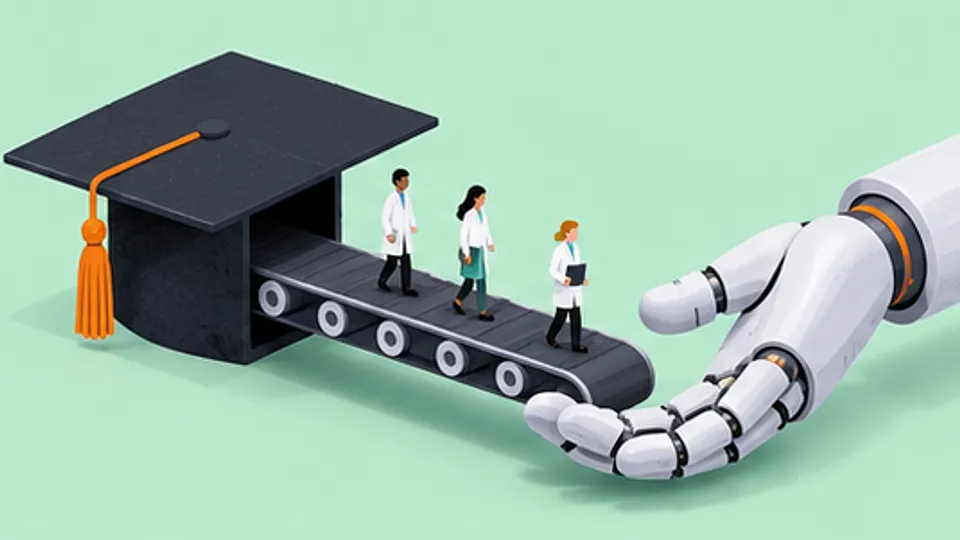
For decades the big advances in robotics came out of university laboratories. Now the money has moved. Billions are going into physical AI, and the researchers who did the laboratory work are going with it, into startups of their own or someone else’s.
The latest to recruit from the academy is Microagi, a German startup. The company has hired Animesh Garg, a Georgia Tech professor and former Nvidia researcher, as its chief research officer, it told Business Insider exclusively. Garg will lead its work on post-training, the job of turning general-purpose robotics models into machines that can do specific tasks. He is bringing seven members of his research group with him. They arrive through Microagi’s acquisition of a startup the group had been building in stealth. Garg and the company declined to give the terms of the deal.
Microagi raised $55 million this summer, the largest seed round ever raised by a German startup, Business Insider previously reported. It works with manufacturers in the automotive, logistics and food industries, training robots for factory jobs. It adapts general-purpose models to each customer’s operations using data collected from workers.
The money going into robotics is driven by plain forces. AI has improved. Hardware has got cheaper. Labor is short. Companies are under pressure to automate and to bring manufacturing home. The professors have noticed. Deepak Pathak and Abhinav Gupta of Carnegie Mellon cofounded Skild AI, which has raised more than $2 billion to build a general-purpose AI brain for robots. Chelsea Finn of Stanford and Sergey Levine of UC Berkeley cofounded Physical Intelligence, which has raised more than $1 billion for general-purpose robot models. This summer Russ Tedrake of MIT brought Walden Robotics out of stealth. Nvidia, which trained many of these people, has been losing its robotics researchers quite deliberately.
Garg said he joined Microagi because robotics is moving fast from laboratory demonstrations to deployment at commercial scale.
The technology has crossed a threshold. We have gotten to a point where we can create sustainable businesses.
Garg has spent more than 15 years on how robots learn. He took his Ph.D. at UC Berkeley, did a postdoc at Stanford, and held faculty posts at the University of Toronto and Georgia Tech. From 2024 to 2025 he was chief scientific officer at Apptronik, which builds humanoid robots. At Nvidia he worked on simulation technology that ended up inside Isaac Lab, the company’s open-source platform for training robots virtually. His recent research has been about teaching robots from human demonstrations and letting them improve through experience.
That is close to Microagi’s own method. The startup collects data from people doing physical tasks, workers wearing cameras and gloves fitted with sensors, and uses it to train the robots. The work is already pointed at the factory floor, where the established names are moving too — Boston Dynamics has just given its backflipping Atlas a job sorting car parts inside a Hyundai plant in Georgia.
The company’s chief executive, Bercan Kilic, told Business Insider the plan is to deploy at least 10 million robots for customers over the next five years.