
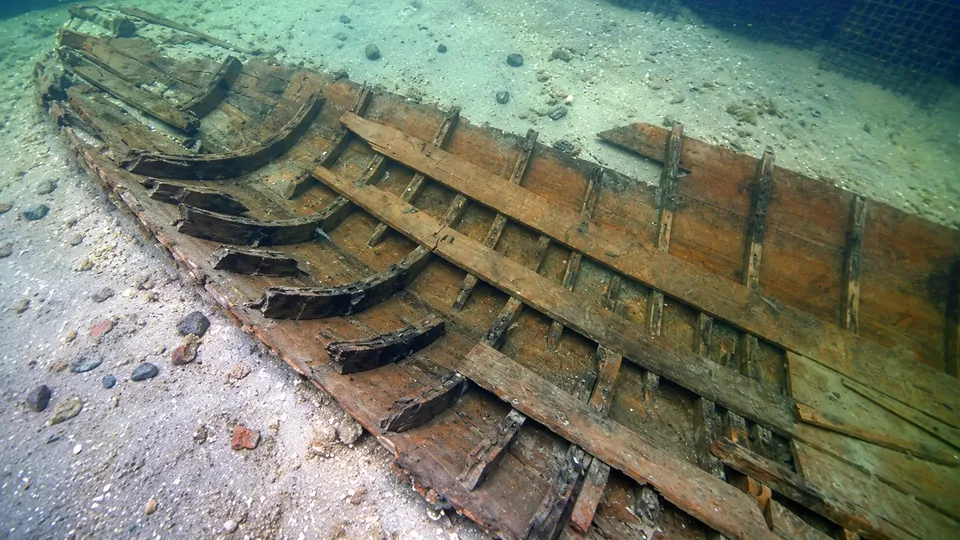
A study of metal recovered from a 2,000-year-old warship on the floor of the Black Sea shows that its builders invested in durability, fastening the hull with copper and copper alloys rather than the cheaper iron already available, according to research reported this week by Arkeonews.
Underwater archaeologists found the vessel’s surviving bottom section in the harbor of Phanagoria, an ancient city on the Black Sea, in 2012. About 16 meters of hull lay beneath more than 1.5 meters of seabed deposits, enough to recognize construction features of a Hellenistic warship. Radiocarbon analysis dated the timbers to around the middle of the first century B.C., and a bronze ram decorated with five-pointed stars and crescents tied the ship to Mithridates VI Eupator, king of Pontus.
Mithridates was one of Rome’s most persistent enemies, a king who built a kingdom around the Black Sea and fought Roman expansion for decades. His wars, which began in 88 B.C., drew in the commanders Sulla, Lucullus and Pompey, and he leaned heavily on sea power, sending forces aboard triremes and merchant ships. The Institute of Archaeology of the Russian Academy of Sciences connects the Phanagoria ship to 63 B.C., when a vessel from his fleet is said to have burned about 120 meters from shore during a revolt against the king; excavation at the city has also found destruction from that uprising.
The new research examined 23 metal objects from the wreck, 22 of them nails or nail fragments and one a small strip of gray metal pierced by a nail, at the Kurchatov Institute. The ram was studied separately in the conservation laboratory of the Phanagoria Historical and Archaeological Museum-Reserve. The nails ranged from about 8 to 14 centimeters, with shafts tapering toward the point, and corrosion had altered them so heavily that the team combined scanning electron microscopy, X-ray techniques, X-ray diffraction and neutron-radiation analysis to separate original metal from corrosion products and trace elements.
One nail told the story of that corrosion in miniature. It had swollen to nearly three times its original thickness, but neutron analysis let the team reconstruct an original shaft diameter of about 0.34 centimeters, close to the hole preserved in a lead plate recovered from the ship.
The nails split into two groups. Some were essentially pure copper. Others mixed copper with lead, antimony or zinc in various combinations, though the researchers cautioned that the samples are small and exact alloys hard to pin down. Some added elements may be deliberate. Others, nickel, cobalt, iron and silver among them, could have arrived with the ore or survived repeated cycles of melting and reuse, hinting at workshops that recycled metal and picked different fastenings for different tasks. Iron nails were the cheaper option, and the builders rejected them, a choice the researchers read as part of a strategy for a long service life, reinforced by evidence of careful repairs.
The small gray strip turned out to be mostly oxidized lead, apparently a patch that covered or reinforced part of the hull, possibly hiding a nail head. Earlier research at the site had identified a protective coating of realgar, resin and wax on the outer surface, and the new study found no sign of continuous lead sheathing on the accessible hull. Taken together, the evidence suggests a flexible system: chemistry protecting the wood, lead plates strengthening joints between timbers, parts replaced as the vessel aged.
The ram, the most striking object from the wreck, measures 89 centimeters long and 44 centimeters high and weighs 15.6 kilograms. Analysis put its composition at roughly 91 percent copper, 4.7 percent tin and 4.3 percent lead, a tin-lead bronze that casts well and resists wear, cast for a ship built to take a hit.