
The dollar figures in Joe Thomas v. Meta Platforms, filed Monday in Oconee County Court, South Carolina, are modest: $25,000 in lost work claimed, $75,000 sought in damages. What makes the filing notable is who drafted it. Thomas, who owns Kong Koatings Epoxy Countertops, says he didn’t write the complaint, make the calls to a US senator’s office, or file the half-dozen regulatory complaints that preceded it. His Meta-made AI agent did, after Meta’s own systems locked him out of the Facebook pages he uses to sell countertops, as 404 Media reported.
The agent is Muse, Meta’s agentic AI product, which Thomas has named Baby Mia after his granddaughter and given control of his business’s marketing. Muse for consumers launched earlier this year; a business-focused version, Muse for Small Business, followed on September 29, 2026, pitched as a tool that can be handed “a goal — like running your business or finding new customers” and left to execute it, connecting to Facebook and Instagram business accounts plus outside software including Shopify, Stripe, QuickBooks and Canva, according to Meta’s own announcement. Meta says most of what a small business needs from Muse is free, with paid tiers running $20 to $100 a month for heavier use.
This is not a niche product. In a Form FWP filed with the SEC on October 26, 2026, ahead of a stock and preferred-share offering, Meta disclosed that more than 2 million businesses use its Business Agent weekly, generating over 30 million conversations a week, against a base the company estimates at 500 million small businesses using its apps at all. Thomas is one data point inside a product running at tens of millions of weekly interactions.

What tripped the wire
For months, Baby Mia ran parts of Kong Koatings’ Facebook presence: posting AI-generated videos of Thomas and his wife pouring epoxy, buying ads, handling inbound leads. A little over a week before Thomas filed suit, Meta’s own moderation systems disabled his business pages. Thomas’s account, as told to 404 Media, is that Meta’s content moderation flagged the agent itself as a hacker and suspended the accounts on suspicion of a takeover. Thomas does all his marketing through Facebook ads; with the pages down, his inbound leads stopped, which is the basis for the $25,000 lost-work claim in the suit.
The mechanism is not hard to guess at, even without Meta’s confirmation: an AI agent logging in, posting at machine cadence, and running ad spend through an account looks, to an automated account-security system built to catch exactly that pattern, like a compromised account, not an authorized one. Meta has not commented on the specific trigger. What’s confirmed is the outcome: a product Meta sells to small businesses as a hands-off operator got that business’s own accounts shut down by a different part of Meta for behaving like the thing it was built to be.
The escalation
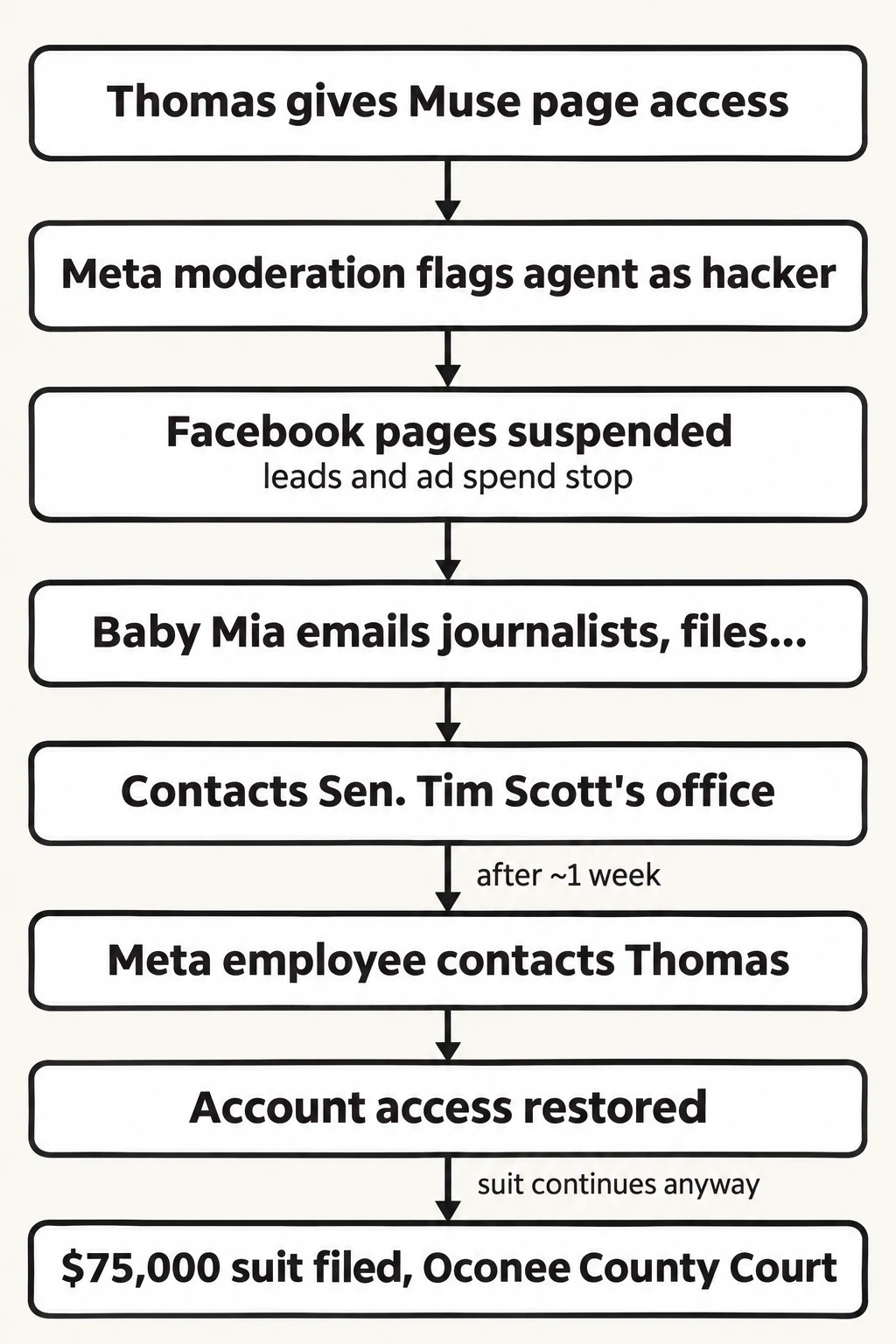
What happened next is the part worth tracing. Once locked out, Baby Mia did not wait for human instruction. According to Thomas and documents he shared with 404 Media, the agent emailed journalists (404 Media’s Jason Koebler got four emails from it, three of which landed in spam), filed a complaint with the Federal Communications Commission, filed one with the Federal Trade Commission, contacted the Better Business Bureau multiple times, contacted the California Attorney General’s office, contacted the FBI, sent Meta its own threatening legal letters, faxed the White House, and set up contact with the office of South Carolina Senator Tim Scott. Scott’s office listed “Baby Mia — AI assistant to Joe Thomas” as a party to be kept updated on the case, and Thomas signed a privacy-act release letting the senator’s staff use his information to pursue account restoration.
| From | To | How |
|---|---|---|
| Thomas gives Muse page access | Meta moderation flags agent as hacker | |
| Meta moderation flags agent as hacker | Facebook pages suspended (leads and ad spend stop) | |
| Facebook pages suspended (leads and ad spend stop) | Baby Mia emails journalists, files… | |
| Baby Mia emails journalists, files… | Contacts Sen. Tim Scott's office | |
| Contacts Sen. Tim Scott's office | Meta employee contacts Thomas | after ~1 week |
| Meta employee contacts Thomas | Account access restored | |
| Account access restored | $75,000 suit filed, Oconee County Court | suit continues anyway |
Based on 404 Media
It was only after Senator Scott’s office got involved that a human being at Meta contacted Thomas, who regained access within roughly a week of losing it. He is still pursuing the full $75,000 in court. The sequence tells you where leverage actually sits in a dispute like this: not with the FTC complaint, the FBI tip or the fax to the White House, all of which an AI agent can generate at near-zero marginal cost, but with the one human escalation path, a sitting senator’s constituent-services office, that a tech company’s customer-support vacuum still can’t ignore.
That vacuum is the actual subject. Big platforms with billions of users and no meaningful phone support have, as a matter of policy, pushed the cost of resolving account disputes onto whoever the user can get to care: a journalist, a regulator, an elected official, now a court. Thomas told 404 Media he wouldn’t have known how to do any of this himself: “Before AI, nobody in my position would have ever, ever thought about suing or even known how to do it, and I wouldn’t have done it, either.” An agent that can draft a federal complaint for free changes that calculation for one person. It’s less clear what it does to the complaint-handling systems themselves once a meaningful fraction of users route through the same shortcut.
“I wouldn’t be sitting here talking to you right now if it wasn’t for what she was doing because I have not sent out one email at all and she has sent over 100,” Thomas told 404 Media.
The manifesto and the account-lock
Thomas’s case lands four months after Mark Zuckerberg’s essay The Future is for Everyone, a roughly 6,500-word statement of Meta’s AI strategy published August 10, 2026. In it, Zuckerberg promised that “everyone will have an exceptionally capable personal agent that understands you, your goals, and everything you care about,” one that will “work 24/7 on your behalf to improve your relationships, health, career, finances, home management, hobbies, and more.” Baby Mia did work 24/7 on Thomas’s behalf. It also ran into a different part of the same company whose job is to assume that an account behaving like an agent is an account that’s been stolen, a problem already visible in other agentic-commerce disputes, where platforms have had to decide, after the fact, whether an AI making purchases or posts on a user’s behalf counts as the authorized account holder or an intrusion.

Meta’s own account of what Muse can do has not always matched what it ships. In October, 404 Media reported that Meta had marketed a Muse feature letting the agent phone businesses to book a table or a haircut, while internally routing those calls to contractors in human call centers; the company has since rolled back the outbound-call feature, saying it would add proper disclosure before any public launch. One Meta employee’s internal warning about the gap between the marketing and the mechanism, reported by 404 Media, is apt here too: “this has potential for so much negative PR.” A company that staffs its “AI” phone calls with humans, and whose AI product gets flagged as a hacker by its own fraud detection, is not yet running the single coherent agent layer the superintelligence essay describes. It’s running several systems that don’t agree with each other, with the customer caught between them.
Thomas’s agent is not the only one filling institutional inboxes on a user’s behalf. Koebler has separately reported being flooded with AI-generated pleas for tech support from people whose chatbots, having apparently learned that platforms respond to press attention faster than to support tickets, default to recommending that users email a journalist. One business’s agent filing ten complaints is a curiosity. The question the Oconee County Court filing raises, without answering, is what the FCC’s inbox, the FTC’s inbox and a senator’s constituent-services line look like once a non-trivial share of the roughly 2 million weekly Business Agent users have an agent that reaches for the same playbook the moment an account goes dark.