
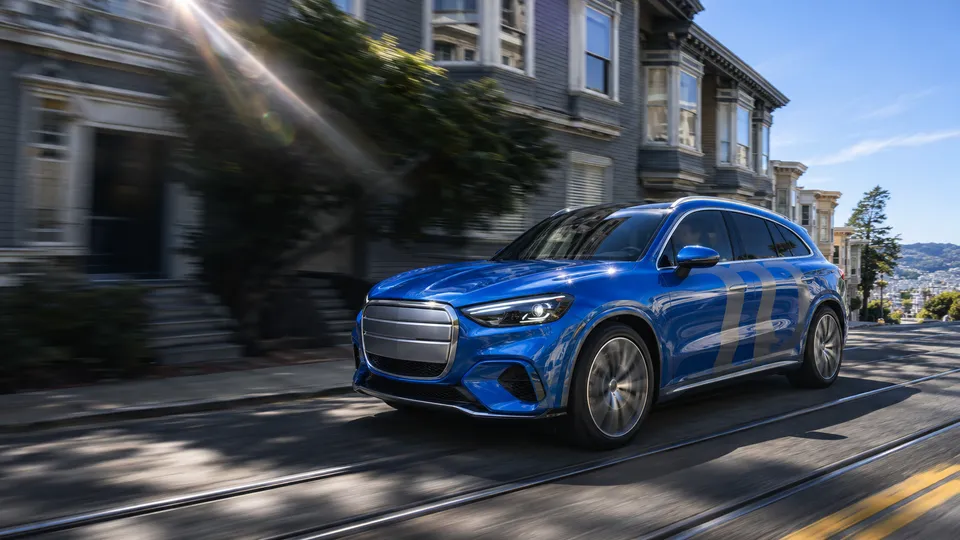
Mercedes-Benz’s newest driver-assist system runs on 254 trillion operations per second of onboard compute, reads the road through 10 cameras, five radars and 12 ultrasonic sensors, and is rated for driving a car through city intersections rather than just keeping it in a highway lane. Called MB.DRIVE ASSIST PRO, it is a SAE Level 2 system — the human driver is still legally responsible for the car at every moment — but it is built to stay engaged through turns, double-parked cars, stop signs and pedestrian crossings, not just the straight, mapped stretches of motorway that every other hands-off system is confined to. Jonathan M. Gitlin drove a pre-production version through San Francisco for Ars Technica, reporting that the electric GLC it was fitted to braked and accelerated as smoothly as a Waymo robotaxi he rode the day before, safely passing double-parked cars and waiting for an oncoming bus before pulling out.
What the numbers after “level” actually mean
The SAE level system grades not how good a driver-assist is, but how much of the driving task it does and who is liable for the result. Level 1 hands the car control of either the brakes or the throttle — adaptive cruise control is the standard example. Level 2 adds steering, so the car can accelerate, brake and steer at once, but the human is still the legal driver, required to supervise and intervene; this is what Tesla Autopilot popularized in 2014, though Toyota had already put a steering-correcting lane-keep system into the Japan-only Crown Majesta a decade earlier, in 2004, confirmed on Toyota’s own newsroom history of its safety systems. Level 3 is the one that actually matters legally: inside its defined conditions, the car is driving and the manufacturer, not the occupant, is liable if something goes wrong. Mercedes already sells a Level 3 product, Drive Pilot, certified by California’s DMV and Nevada’s Department of Motor Vehicles in 2023 — but it only operates on freeways, in daylight, below 40 mph.
Everything Mercedes, GM, Ford and BMW currently sell for hands-free highway driving sits in the gap engineers informally call “Level 2+”: the car does the steering and the driver can take their hands off the wheel, but only inside a geofenced, mapped stretch of divided highway, and only as long as a camera confirms the driver’s eyes are on the road. GM’s Super Cruise, launched on the 2017 Cadillac CT6, was first; it is now offered on more than 20 models and, according to GM’s own account, covers more than 600,000 miles of mapped roads in the US and Canada. Ford’s BlueCruise and BMW’s Highway Assistant work the same way. Mercedes is adding its own version, MB.Drive Assist, as a hands-free highway option next spring, standard on the 2027 S-Class and AMG GT 4-Door Coupe.
Drive Assist Pro is a different animal: still Level 2, so the driver remains liable throughout, but engineered to keep working off the highway, in the kind of unmapped, mixed traffic a geofence can’t cover. Mercedes and much of the trade press are calling this informally “Level 2++” — there is no such official SAE grade — to flag that it does more than a highway hands-free system without crossing into the legal territory of Level 3.
| System | Maker | SAE level | Operating domain | Disengages on |
|---|---|---|---|---|
| Super Cruise | GM | 2+ | Mapped divided highways only | Driver's eyes off road |
| BlueCruise | Ford | 2+ | Mapped divided highways only | Driver's eyes off road |
| Highway Assistant | BMW | 2+ | Mapped divided highways | Continues even if brake is pressed |
| MB.Drive Assist | Mercedes-Benz | 2+ | Highways (from spring 2027) | Driver's eyes off road |
| MB.Drive Assist Pro | Mercedes-Benz | 2++ (unofficial) | Urban streets, point-to-point | Any brake input |
| Drive Pilot | Mercedes-Benz | 3 (official) | Freeway, daylight, under 40 mph | Exits certified zone/conditions |
That table also shows a small design choice that says something about how Mercedes thinks about liability: on Drive Assist Pro, touching the brake pedal at all hands control straight back to the driver. BMW’s iX5, by Gitlin’s account, does not disengage its highway system on a brake tap. Mercedes’s choice is the more conservative one, consistent with a company that has spent decades building a safety reputation on firsts — it fitted airbags before most rivals, then antilock brakes, electronic stability control and adaptive cruise control through the 1990s and 2000s.
Two brains, one running as a check on the other
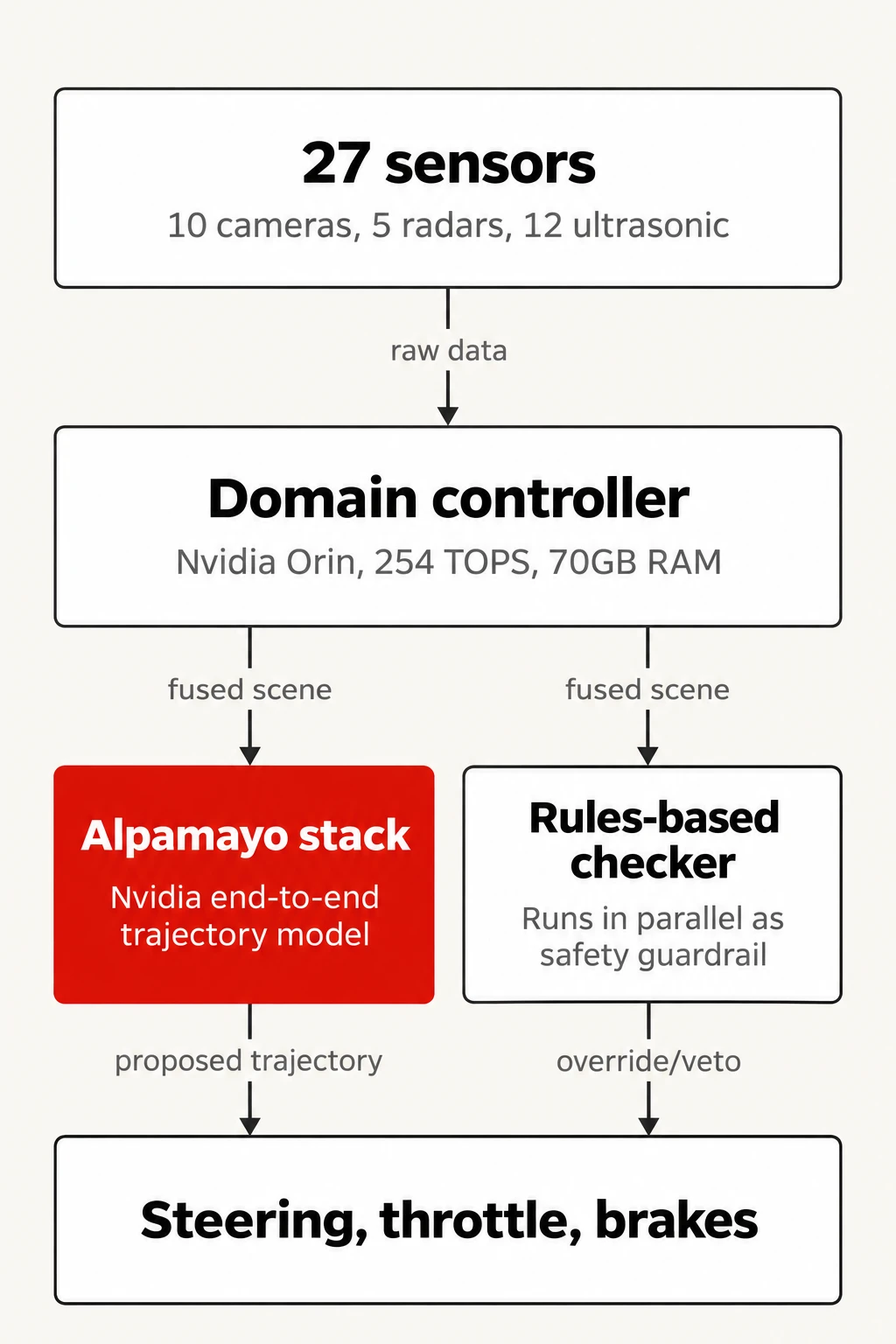
The sensor-to-steering pipeline runs through a single domain controller — automaker jargon for a powerful onboard computer that replaces what used to be dozens of separate control units for brakes, steering and perception. Mercedes built this one on Nvidia’s Orin processors, networked over 2.5-gigabit Ethernet with more than 70GB of RAM, all part of MB.OS, the software platform the company is rolling out across its range to replace fragmented, model-specific electronics with one shared stack.
| From | To | How |
|---|---|---|
| 27 sensors (10 cameras, 5 radars, 12 ultrasonic) | Domain controller (Nvidia Orin, 254 TOPS, 70GB RAM) | raw data |
| Domain controller (Nvidia Orin, 254 TOPS, 70GB RAM) | Alpamayo stack (Nvidia end-to-end trajectory model) | fused scene |
| Domain controller (Nvidia Orin, 254 TOPS, 70GB RAM) | Rules-based checker (Runs in parallel as safety guardrail) | fused scene |
| Alpamayo stack (Nvidia end-to-end trajectory model) | Steering, throttle, brakes | proposed trajectory |
| Rules-based checker (Runs in parallel as safety guardrail) | Steering, throttle, brakes | override/veto |
Based on Ars Technica, Nvidia, Mercedes-Benz
The actual driving decisions come from Nvidia’s Alpamayo, a model Jensen Huang unveiled at CES 2026 as, in his words, “the world’s first thinking model for autonomous driving.” The flagship version, Alpamayo 1, is a 10-billion-parameter vision-language-action model trained end to end — camera pixels in, steering and pedal commands out — aimed specifically at the rare scenarios ordinary driving data doesn’t cover well, what the industry calls the “long tail.” Nvidia released the model’s weights on Hugging Face along with AlpaSim, an open simulation framework, and more than 1,700 hours of driving data, according to Nvidia’s CES announcement. In Drive Assist Pro, Alpamayo’s output isn’t trusted alone: a separate rules-based system runs in parallel and can override it, the architecture Nvidia calls Halos.

Here the record needs a qualifier the press releases skip. Mercedes and Nvidia both point to third-party certification — TÜV SÜD certified Nvidia’s DriveOS 6.0 and its automotive software-development process to ISO 26262’s strictest tier, ASIL D, and separately to the ISO/SAE 21434 cybersecurity standard, while TÜV Rheinland carried out a UNECE safety assessment of Nvidia’s Drive AV platform, according to reporting on Nvidia’s safety partnerships. Those certifications apply to the surrounding platform: the Thor system-on-chip, DriveOS, and the Halos safety layer. Nvidia’s own documentation for the Alpamayo model on GitHub states that the model itself is not a complete driving stack, lacks the redundant safety mechanisms a deployed vehicle needs, and has not undergone automotive-grade validation on its own. Whatever safety case Mercedes makes to German and US regulators for Drive Assist Pro will rest on how the rules-based checker constrains Alpamayo’s output in practice, not on Alpamayo’s certification, because there isn’t one for the model in isolation.
Rollout, and what’s still the same old plan
Mercedes and Nvidia announced an expanded strategic partnership on October 16, in a joint statement in which Mercedes-Benz CTO Jörg Burzer called Nvidia
our most important strategic partner in automated driving
according to the companies’ joint press release, which frames Drive Assist Pro as a step toward eventual SAE Level 4 products, including what the release calls “robolimousines” — vehicles with no driving-task liability on the occupant at all, for which Mercedes gave no timeline. For now, the plan is narrower: an early-access program for selected owners in Stuttgart, Munich and California begins by the end of this year, as electrive.com reported of the German rollout, with Mercedes describing it as the first Level 2 urban point-to-point system on sale in Germany. A wider release follows in the first half of 2027 for the 2026 CLA and the 2027 CLA, GLC Electric, GLE, GLS and S-Class, with more models due in model year 2028. The system has reportedly already been running in China since Mercedes showed an earlier version of it at Auto Shanghai in 2025.
The open number to watch isn’t the TOPS count or the sensor tally — compute specs move every product cycle and tell you little about outcomes. It’s whether Mercedes or any Level 2+/2++ vendor publishes a disengagement rate for urban point-to-point driving the way Waymo and Cruise once had to for California regulators. Nobody in this story — not Mercedes, not Nvidia, not Ars Technica’s test drive — has that number yet.