
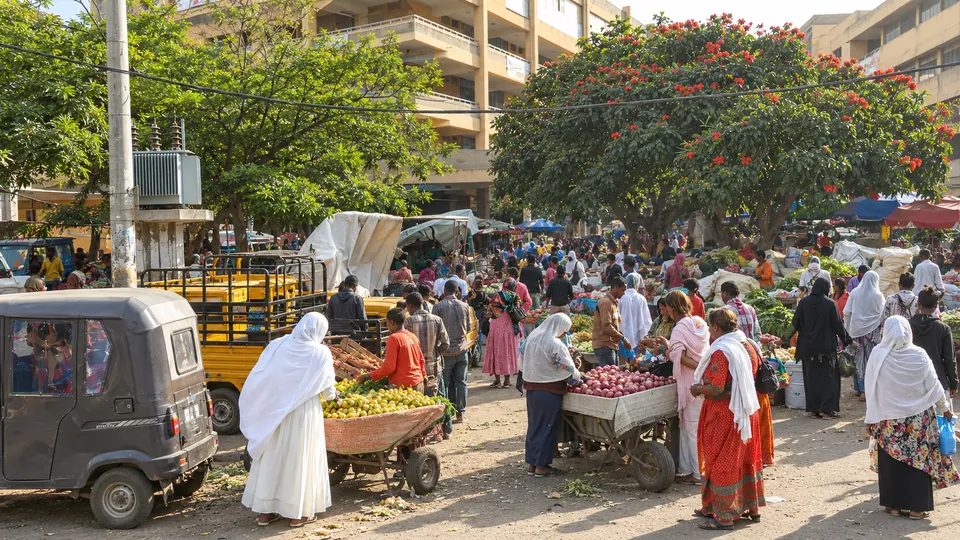
In Mekelle, the capital of Ethiopia’s Tigray region, shops are reopening and banks are offering services again. That is real progress, and Al Jazeera’s reporting from the city is careful not to oversell it. Federal forces and allied fighters retook Mekelle on October 4. The region had not finished recovering from the 2020–2022 war between federal forces and the Tigray People’s Liberation Front (TPLF), its dominant political movement, and people there now face fresh uncertainty about jobs, school, safety and whether the fighting spreads across the border into Eritrea.
The economic problem is easy to state. A shop that reopens only helps if customers have money to spend there. In Tigray a large share of the people with steady incomes work for the government, and the government has not been paying them on time. Public employees with delayed salaries are struggling to pay for food, rent and school fees, and years of conflict have used up whatever savings families had.
“Things may be reopening, but that does not mean our problems are over. We still have expenses every day, and without our salaries, it is difficult to know how we will manage,” said Gebregziabher, a public servant in Mekelle.

The mechanism behind this is a transfer that didn’t arrive. Tigray’s regional administration pays its staff largely with money from the federal budget. In March the interim administration said it could no longer cover monthly salaries for about 137,000 civil servants because the federal transfers it expected had not come through. In April the regional finance bureau reported an 8.5-billion-birr shortfall that was affecting salary payments and development projects. According to the Eastleigh Voice, the bureau’s letter to Ethiopia’s Ministry of Finance said Tigray had been allocated 23.6 billion birr for the fiscal year, of which 17.1 billion was supposed to have arrived by March. The gap was therefore about half of what was due. The bureau’s letter also put the number of affected civil servants at more than 141,000, a bit higher than the March figure.
A small arithmetic detour. Al Jazeera converts 8.5 billion birr to “about $52,000.” That can’t be right. Split across 137,000 civil servants, $52,000 comes to roughly 38 cents each, which would be an inconvenience, not a fiscal crisis. The Eastleigh Voice put the same shortfall at Sh7.1 billion in Kenyan shillings, which is in the region of $55 million. The dollar figure is probably missing a “million.” In birr, 8.5 billion across 137,000 employees is about 62,000 birr per person, and for a household that has already spent its savings, that is a lot of rent.
It has happened before. In early 2024 the interim administration sought a five-billion-birr lifeline from the federal government during an earlier salary crisis. Tigray’s payroll has been unreliable for a while, and the latest fighting arrived on top of that.

School, again
For students, the renewed fighting brings back a familiar fear: losing more time. Many already lost years of study in the last war. In Adigrat, Shewit, a grade 10 student, said: “I have already lost so much time because of the war. I am afraid that if our education is disrupted again, I will lose another year and fall further behind.”
Some university students have gone to Addis Ababa to try to transfer. Ethiopia’s Ministry of Education announced temporary placements at universities elsewhere in the country for students enrolled at institutions in Tigray, and according to reporting on the programme, more than 5,000 returning students had applied by September 17–18. Abel, a third-year student at Axum University, was one of the people who made the trip. “I didn’t want to leave, but I also can’t keep putting my education on hold. I came to Addis to see if I can transfer to another university and continue my studies. I just want to finish what I started,” he said. A lost year at university means graduating later and looking for work later, in an economy that is not hiring much.
The border
Near Eritrea, the accounts don’t line up. On October 8 the Associated Press reported claims by a commander allied with the Ethiopian government that Eritrean troops had entered Adigrat earlier that week and Idaga Hamus the next day. The AP said it could not independently verify those claims. The conflict monitor ACLED separately reported Eritrean troops crossing the border at Zalambessa. On October 13 Reuters, citing people in contact with residents and other sources, reported that Ethiopian government forces had advanced into Zalambessa. It said it was unclear whether Eritrean troops or Tigrayan opposition fighters were still in the town. In this war, it has been hard to say who controls a particular town on a particular day.
Also on October 8, Ethiopia’s foreign minister, Gedion Timothewos, accused Eritrea of sending troops as far as 60km (37 miles) into Ethiopian territory in several parts of Tigray and asked the UN Security Council to respond. As Anadolu reported, Ethiopia told the Council it had no choice but to defend itself. Eritrea denies invading. Its government said Ethiopia’s accusations amounted to a declaration of war and asked the Security Council to take action against Ethiopia, so each side now accuses the other of starting a war.
During the 2020–2022 war, the two countries fought on the same side, with Eritrean forces backing the federal government against the TPLF. That alliance has now broken down, and the war in Tigray has become a regional problem. In Zalambessa, a resident who asked not to be named said it was hard to know what the coming weeks would bring.
Six months
On October 16 Prime Minister Abiy Ahmed announced a six-month caretaker administration for Tigray. Its job is to restore public services, help displaced people return home and prepare the region for elections. The federal government says the arrangement will restore stability and lead to an elected regional leadership. The TPLF opposed the federal advance, and it is not yet clear how much of the region the new administration will actually be able to run.
Residents’ priorities are simpler: whether salaries will be paid, whether schools and clinics will work, and whether displaced families can return safely. “People are worried because we know what war means for this area. We have already suffered enough, and nobody wants to see things reach that point again,” said Gebrehiwot, in Zalambessa.
For most of this year, the argument over Tigray’s payroll ran between a regional administration saying the money hadn’t arrived and a federal government that controlled the money. With a caretaker administration installed from Addis Ababa, the federal government now effectively controls both the sending and the receiving end of that transfer. That at least narrows down who is responsible if the salaries still don’t come.