
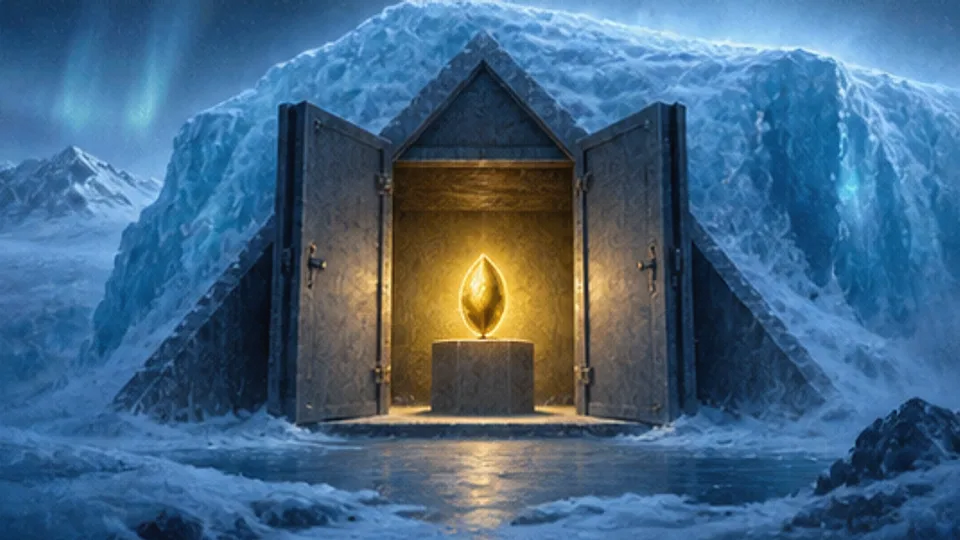
Under a mountain a short commute from the North Pole sits a warehouse whose door opens three times a year and whose contents nobody is permitted to touch. The press calls it the Doomsday Vault, sometimes the End of the World Vault, which is the sort of branding you get when your job is insuring the human food supply against catastrophe. Fuad Gaši, who has coordinated the Svalbard Global Seed Vault since June, would rather you pictured something more hopeful: a repository of knowledge that keeps the biodiversity of the planet’s crops safely on file.
Gaši, 46, is a professor of genetics and plant breeding, born in Bosnia-Herzegovina. He emigrated to Sweden as a refugee during the Bosnian War in the 1990s, then went home, studied agricultural sciences and genetics, and took a teaching post at the University of Sarajevo. Seeds found him through SEEDnet, a network that helps build gene banks in Eastern Europe, and in 2008 he launched the first plant gene bank in Bosnia and Herzegovina.
That bank nearly didn’t survive its own era. During the COVID-19 pandemic it ran into financial difficulty, and Åsmund Asdal — then Svalbard’s coordinator — encouraged Gaši to send duplicate seeds to the BOLD project and to lodge a second set in the famous Norwegian vault. Gaši told EL PAÍS he could not have imagined, as he packed off his backups, that he was effectively applying for Asdal’s job.
The actual application was stranger. In 2024 Gaši took a sabbatical from teaching, decided he wanted something completely different, and went to work for the pharmaceutical company Novo Nordisk on the raw materials used in medicine. He was happy there. Then Asdal mentioned he was retiring after 12 years — and that his own predecessor had also stayed at the vault until retirement. “I thought that a job where everyone seems to want to stay until retirement must be special,” Gaši said.
His first look at the place came back in 2024, when he visited as a guest to deposit the Sarajevo seeds — and saw only the outside. “I thought I should pay close attention to everything because, realistically, that was going to be my only chance to visit Svalbard,” he recalled. The inside had to wait until June of this year, because, as he puts it, no one goes into the vault unless they have something specific to do. Even the boss, apparently, needs a reason.
That reason comes rarely: the door is opened three times a year, so the work of shelving seed boxes is an event. “If you stop for a second to think about what you’re doing, about these seeds, which are the result of careful selection and generations of farmers who have been doing this for thousands of years,” Gaši said, “or about being under a mountain very close to the North Pole, it’s all pretty impressive.”
The vault’s job description also needs correcting. “It’s not a seed bank in the traditional sense,” Gaši explained. “Instead, we serve as a backup for other seed banks around the world.” The real biodiversity work — growing the seeds, keeping them viable — happens at those gene banks; Svalbard is the spare key under the mat. Speaking at the 8th ftalks Food Summit in Valencia recently, Gaši warned that the loss of crop diversity makes food production systems vulnerable and shrinks the diversity of our diets, and pitched the vault as a toolbox for adapting future crops to new climates.
The spare-key drawer is filling steadily. The vault — also known as the “Noah’s Ark of Seeds” — has been operating since 2008 and now holds more than 1.4 million samples, over 6,500 varieties from more than 100 countries. Each of its three storage chambers can hold 1.5 million samples; one is full and the second is under way. Depositors are asked not to send anything that isn’t unique, Gaši said, to be efficient, even though there is still plenty of space. His summary of the collection: “we’re preserving the history of agriculture.”
Getting into the drawer takes paperwork. Each country signs a deposit agreement — the vault is a collaboration between the Norwegian Ministry of Agriculture and Food, the Global Crop Diversity Trust and the Nordic Genetic Resource Center — and before Svalbard will accept anything, the depositor must already have duplicated those seeds at another gene bank. However secure Svalbard is, Gaši said, they don’t want all the seeds “in one basket.” The material must also stay in the public domain, available to researchers, educators and breeders: “conservation isn’t possible without use.”
Once inside, the seeds receive the world’s most neglectful five-star treatment. “We’re like a black box,” Gaši said. “We don’t touch the seeds; we only store them at a temperature of -18°C (-0.4 °F)” — cold enough to keep them for a very long time. Checking that they still sprout is someone else’s chore: the depositing banks must periodically plant their seeds and confirm they’re alive.
And a lost seed is not just a lost plant. “We lose potential,” Gaši said — a variety that might have shrugged off some future disease or thrived in a climate we haven’t met yet. “Each seed is precious because it has taken generations to develop,” he said; it’s a living organism that has adapted to particular conditions and carries all its genetic material. Gene banks also preserve the traditional knowledge attached to each variety, tracing its traits whenever they regenerate seeds. “I often say that the richest seed bank isn’t the one with the most diverse material; rather, it’s the one that best understands what it preserves.”
Is the vault itself ready for climate change? Someone thought of that early. The entrance sits 130 meters (426 feet) above sea level, so even melted ice caps and significantly risen seas would leave the doorstep dry. Gaši’s bigger worry is what’s happening outside: “It’s appalling that we’re losing biodiversity,” he said — and seeds stored in the vault shouldn’t stay there forever, because, in his words, “it should be out in the fields.”
Which leaves the Doomsday Vault in a curious position: built for catastrophe, run with the calm of a rare-books room, staffed by people who simply never leave. Every coordinator in its history has stayed until retirement. For a facility whose nickname assumes the worst, that may be the most reassuring statistic on file.