
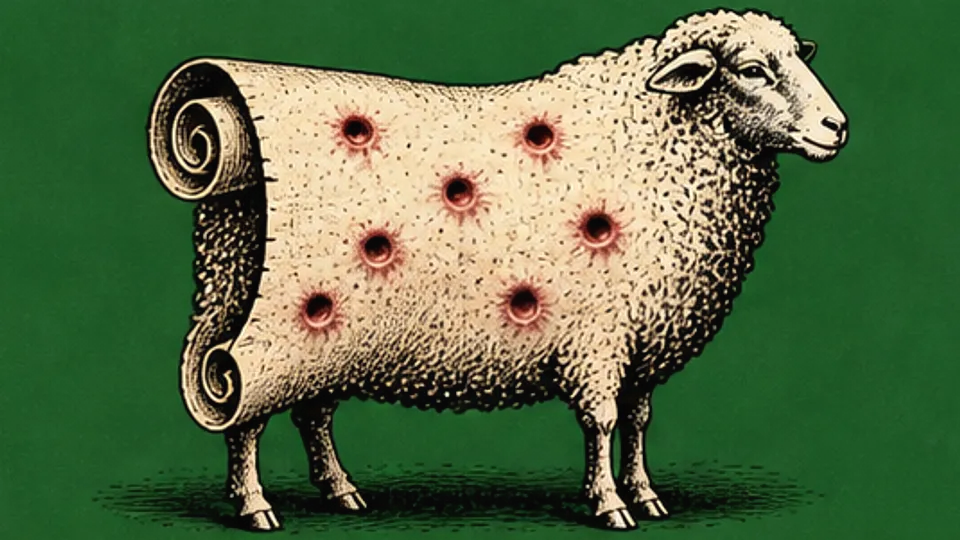
Before paper was cheap, Europe wrote on animals. Parchment—skins soaked in quicklime, scraped, stretched and smoothed—carried scripture, law and memory; it also preserved DNA from the beasts killed to make it, sometimes for more than a thousand years if storage was kind. Researchers examining genetic data from parchment held by the University of York and Oxford’s Bodleian Library found an unexpected stowaway: sheeppox virus, the ovine relative of smallpox.
The material came mainly from central and western Europe, dated roughly AD700-1400 and mostly used for religious documents. Of the parchments screened, 32 folia showed at least a hint of the pathogen. Three pages of the York Gospels, a rare survivor of the Reformation produced around AD990, carried viral DNA, including a legal document appended centuries later; sampling required only erasers lifting a minimal surface layer. Traces also appeared in the Corpus Glossary, a Latin and Old English dictionary probably made around AD800, and in 15th-century paper from Clairvaux that may have been sized with animal collagen or parchment scraps.
Sheeppox is considered eliminated in Europe today but remains endemic across large parts of Africa and Asia. It is highly infectious and often fatal, especially in young sheep, with a few cases in goats, leaving survivors covered in pox scars. The parchment record shows the disease pressed on medieval herds for centuries. Older genomes pushed the story further back: two sheep teeth from the Eurasian steppe, about 3,700 and 3,200 years old, contained pathogen DNA alongside animal DNA.
Roman farmers may have known the same enemy. Columella’s De Re Rustica, written in 60-65BC, describes a “pusula” disease of sheep now assumed to be sheeppox. Using ancient viral genomes, researchers estimate when sheeppox split from other Capripoxviruses that infect goats or cattle. Models gave a wide range, from 11,500 to 3,500 years ago, but clustered around a median of 5,000 years—roughly when domestication and pastoralism brought cattle, sheep and goats into sustained proximity, perhaps creating the conditions for pathogens to hop hosts.
One finding refuses to sit quietly. Sheeppox DNA turned up in many cattle- and goatskin parchments. Cross-contamination during preparation could explain some cases, but others may mean the virus once infected animals it no longer infects today. As it adapted to sheep more efficiently, it may have become worse at infecting other species. The practical point is not antiquarian: outbreaks have returned to southern Europe since 2024, and understanding how Capripoxviruses evolve could improve interventions and clarify how future pathogens might find new hosts. The archive, it turns out, was also a laboratory notebook.