
For most of two decades, an American wounded in Afghanistan or Iraq lived inside a promise measured in minutes. Somewhere a helicopter would come, and within roughly an hour he would be lying in a defended hospital with surgeons and blood. The promise was never written into the laws of war. It was written into the air, and the air belonged to the United States.
Now the Marine Corps has said, plainly, that it does not expect to keep that promise in the next war. Throughout the post-9/11 wars, the military planned on getting the wounded to advanced care within an hour, Navy Capt. Shari Gentry, the Corps’ deputy medical officer, told reporters at a media event near Quantico, Virginia, as Kelsey Baker reported for Business Insider. Then she added the sentence that matters: “And we do not foresee that being the case.”
An hour, bought with helicopters
The hour was a political decision before it became a medical doctrine. On June 15, 2009, Defense Secretary Robert Gates ordered that critically injured casualties be moved from the call for help to a treatment facility in 60 minutes or less, cutting the earlier two-hour goal in half. A 2015 study in JAMA Surgery found that median transport time in Afghanistan fell from 90 minutes to 43 after the mandate, and estimated that 359 lives were saved between June 2009 and March 2014.

Those numbers rested on a condition nobody needed to say aloud: that no enemy could touch the helicopters. The fighting in Ukraine, with its swarms of drones and other new weapons, has made American planners doubt that condition will hold. They now assume that a sophisticated opponent will likely be able to badly disrupt casualty evacuation, resupply and communications. rews has already traced how casualty care built for the IED wars met a drone war unprepared, and how one answer has been to send a drone to fly a wounded soldier out.
A reflection, then, and no more than that: an army’s tenderness toward its wounded has always depended on its power over the ground and the sky around them. When that power shrinks, the hospital must crawl forward toward the wound.
That is what the Corps is now trying to do. Hours, perhaps days, may pass before a casualty reaches a hospital, and the new equipment is meant to store blood, find internal injuries and treat the wounded nearer the fighting, with lighter kit and less dependence on heavy medical infrastructure. The service has already begun handing the systems to medical units, and some have reached troops deployed in the Middle East. In June, the Corps’ program office for combat support systems said it was fielding a fully modernized medical capability for the first time in 20 years, a lightweight Role 2 surgical and medical set designed for dispersed, contested battlefields.

Thirty units of blood
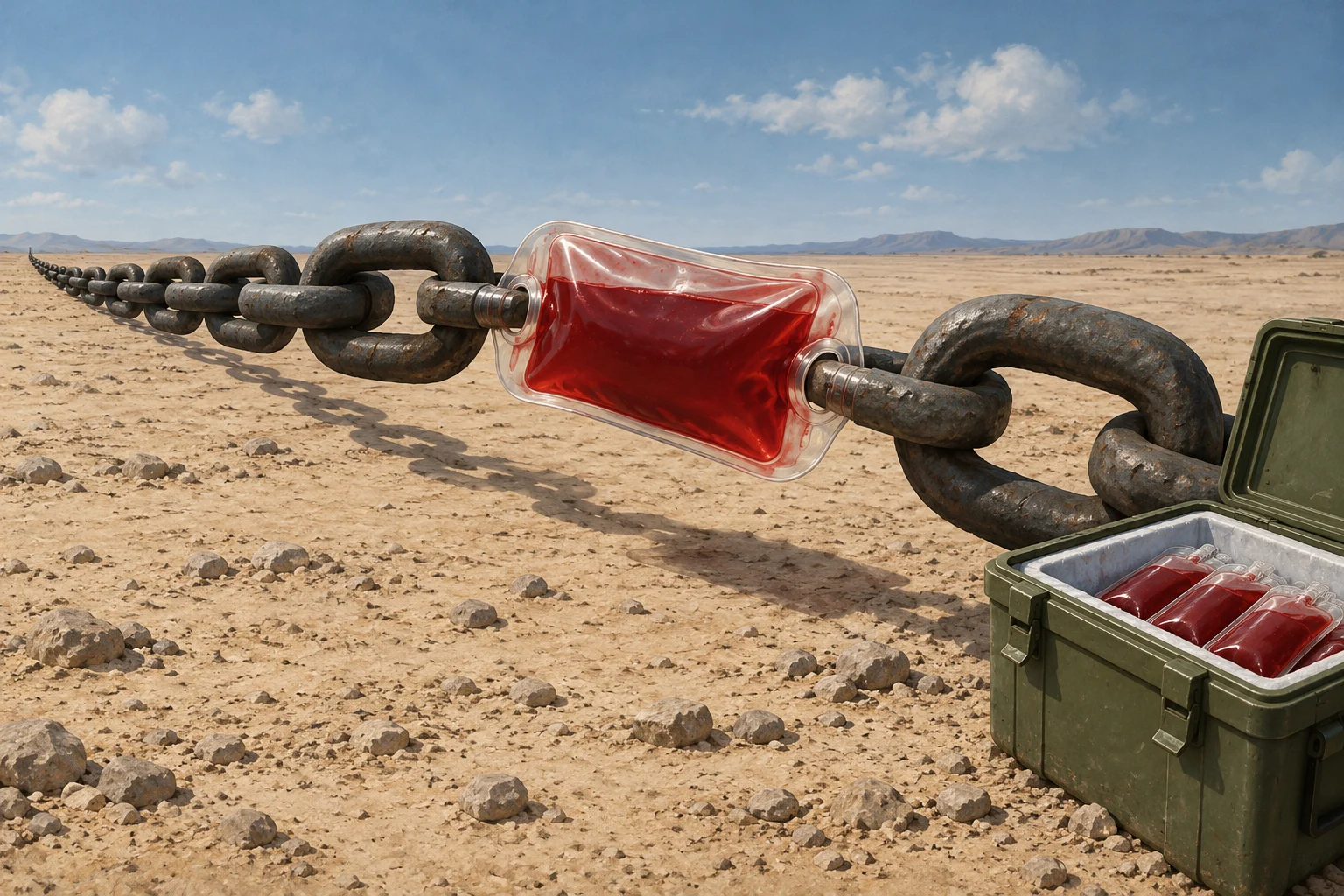
The centrepiece is a refrigerator. It holds about 30 units of blood, which military medical guidance suggests could be enough for four seriously wounded Marines. Each battalion aid station is to get one. It weighs about 60 pounds, less than half the system it replaces, and runs on rechargeable batteries already common across the Corps, so that a medical team can keep blood cold without a constant diet of generator fuel, according to Navy Cmdr. Kyleigh Hupfl, the Corps’ clinical lead for Expeditionary Medical Systems.
Small swings in temperature can spoil blood and other pharmaceuticals. “We need to be able to bring cold chain distribution forward without relying on heavy generators, and we need to be able to do that in a sustainable way,” Hupfl said.
The fridge did not arrive on schedule; it arrived early, because units in the field had complained that their existing refrigeration was unreliable. One unit told Hupfl the new device let it keep a ready supply of blood for its entire deployment. Defense One reported that the refrigeration unit and a new mobile blood warmer went to U.S. Central Command this year, where a unit ran a continuous mobile blood bank and sent its notes back to the Corps on how to improve it. Military photographs show the gear being issued to a Marine medical logistics company.
Blood, too, has a supply line. And supply lines are exactly what the planners expect the next enemy to cut.
Warmth
The second device is humbler. The new portable warmers run blood through a tube, heating it before it enters the patient’s veins, and they deliver warmed fluids faster than the equipment they replace. Warmth matters because hypothermia is a serious complication for the injured.
“Who should I get out?”
The third change moves a machine down the ladder of care. Portable ultrasound with AI-assisted imaging used to sit only at higher echelons. It is now going to Role 1, the lowest level of tactical care, where Navy corpsmen and physicians give wounded Marines their first life-saving treatment. Defense One identified one of the devices as the KOSMOS point-of-care ultrasound.
The software helps the user pick out anatomical structures on the screen, so that a provider without much ultrasound experience can spot signs of internal bleeding and other injuries that are hard to see. That, in turn, helps decide which casualties most urgently need surgery or evacuation, said Navy Chief Petty Officer Matthew Brown, chief biomedical equipment technician for the Corps’ Expeditionary Medical Systems.
Here the new war shows its plainest face. The machine does not bring the helicopter back. It helps a medic decide who gets the seat when there is one, and who waits.
“I have 10 people that are hurt. Who should I get out? And at the end of the day, that’s what’s going to save their life.”