

Cambrian sandstone dated to about 538 million years old sits, in many places, directly on crystalline basement rock that is 1.2 billion to 1.8 billion years old, with nothing recorded in between. That boundary is the Great Unconformity, first mapped in the Grand Canyon by the geologist John Wesley Powell in 1869, and depending on location it erases somewhere between 200 million and more than a billion years of strata. A paper in Nature, picked up this week in 404 Media’s science roundup, puts a tested mechanism behind one of several competing explanations: not glaciation alone, not rifting alone, but the slow vertical motion of whole continents driven by mantle convection.
A Mantle-Deep Elevator
Santosh Dhungana and Nicolas Flament, at the University of Wollongong, built six versions of a global mantle-flow model on Gadi, the supercomputer run by Australia’s National Computational Infrastructure, feeding in reconstructed plate motions and the positions of subducted ocean floor going back roughly a billion years. Running the mantle forward is expensive: each 100-million-year interval of simulated flow cost up to 15,000 CPU-hours on Gadi, and the total compute for a single model run has been put at about 75,000 CPU-hours, according to the university’s own account of the work. Four of the six model variants reproduced the uplift signal the team was looking for at two cratons, Baltica and North China; a fifth, built on an alternate reference frame for past plate motion, failed even to lift the third, Laurentia, and was dropped.
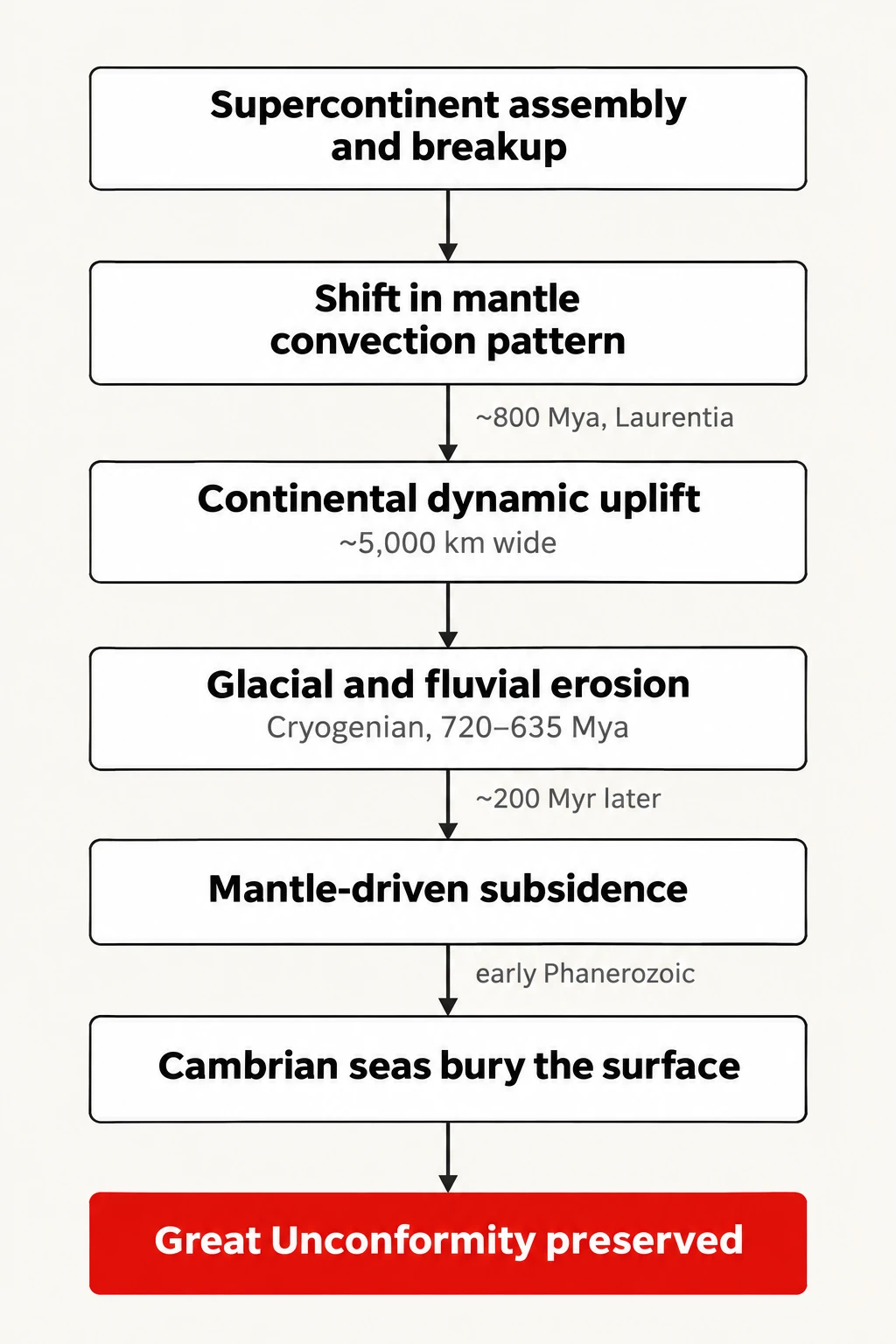
| From | To | How |
|---|---|---|
| Supercontinent assembly and breakup | Shift in mantle convection pattern | |
| Shift in mantle convection pattern | Continental dynamic uplift (~5,000 km wide) | ~800 Mya, Laurentia |
| Continental dynamic uplift (~5,000 km wide) | Glacial and fluvial erosion (Cryogenian, 720–635 Mya) | |
| Glacial and fluvial erosion (Cryogenian, 720–635 Mya) | Mantle-driven subsidence | ~200 Myr later |
| Mantle-driven subsidence | Cambrian seas bury the surface | early Phanerozoic |
| Cambrian seas bury the surface | Great Unconformity preserved |
Based on Dhungana & Flament, Nature (2026)
The uplift each surviving model produces, a phenomenon geophysicists call dynamic topography, isn’t a sharp step. It spans roughly 5,000 kilometres, wider than the continental United States, which is the signature of a convecting mantle rather than a fault or a plume. The method is also known to overstate the height of this kind of deformation by about a factor of two, so Dhungana and Flament report the timing and direction of vertical motion rather than a number of metres, a caveat flagged in coverage by La Brújula Verde.
For Laurentia, the craton under most of North America and, per the paper, the place the Great Unconformity is best preserved because of its size and relatively undeformed margins, the mantle pushed the surface upward starting around 800 million years ago and held it elevated for roughly 200 million years. That overlaps the Cryogenian glaciations of Snowball Earth, 720 to 635 million years ago, when glacial erosion is estimated to strip rock roughly ten times faster than rivers do on the same slope. The authors’ own models show mantle uplift alone produces only gentle tilting, not the steep slopes fluvial erosion would need to account for the Great Unconformity’s scale; it takes both the lift and the ice. They checked the result against Macrostrat, a public database of more than 33,000 mapped rock units, and found preserved sediment volume through time tracks the modeled uplift-subsidence cycles specifically for Laurentia, Baltica and North China, not for every craton in the simulation.
The mantle flow then reversed: through the early Phanerozoic the same three cratons subsided, Cambrian seas rose over the scoured rock, and the sediment that followed sealed in what we now read as the Great Unconformity. The Grand Canyon’s own version of the gap, covered here earlier this week, is this same mechanism working on one especially well-exposed craton margin, not a rival explanation.
As Flament summarized the contribution:
Many explanations for the Great Unconformity had been proposed but few had been tested against how the Earth actually behaves over time.
Three smaller studies turned up in the same week’s journals, each with a number worth keeping.
Octopus Arithmetic
Wenci Xin, now at the National University of Singapore, worked with Michael Kuba’s group to measure exactly how far a soft-bodied animal can compress. They built individual boxes for young common octopuses (Octopus vulgaris) and Mayan octopuses (Octopus maya), each with an escape hole sized against the animal’s eye-to-eye distance, a proxy for the width of its one rigid structure, the cartilage case protecting its central nervous system. Some holes matched that span exactly; others were cut 5 millimetres narrower. Through the wider holes, octopuses ran a three-step routine: probe the opening with the arms, pass one to five arms through, then anchor two of those arms by their suckers on the far side and haul the rest of the body, mantle and head last, across. Through the narrowest holes they added a fourth step, splitting that final haul into pulling the trailing arms through and then separately compressing the mantle to follow. Common octopuses managed the 5-millimetre-narrower holes; Mayan octopuses, given the identical setup, ignored them and left through the wider opening every time, a difference the study in the Journal of Experimental Biology attributes to habitat: Mayan octopuses shelter under rocks in sandy terrain and rarely need to pass through anything narrower than their own skull.

A Latin Suffix and a Bare Chest
Miles Russell, an archaeologist at Bournemouth University, argues in a piece for Current Archaeology, timed to his forthcoming book Caratacus: Great King of Britain (Bloomsbury, January), that Verica, the Atrebatic ruler whose appeal to Rome after being deposed around AD 40 is one of the stated pretexts Claudius used for invading Britain in AD 43, was a woman. Russell’s case runs on two kinds of evidence, laid out in Bournemouth University’s own account: the name itself ends in ’-a’, the feminine suffix shared with the attested queens Cartimandua and Boudica, and Verica’s coinage shows a slender, bare-breasted figure on horseback, unlike the armoured male warriors on coins issued by contemporaries such as Tasciovanus and Caratacus. The Latin title rex on those coins doesn’t resolve it either way: Rome used the word for female rulers too, Cleopatra among them.
The field hasn’t converted. The claim rests on a forthcoming book rather than a peer-reviewed paper, Iron Age coin portraiture is small and stylized enough to support competing readings, and the Roman historian Cassius Dio’s Greek text renders the name as the masculine-looking ‘Berikos.’ Verica’s Wikipedia entry, for now, still runs on male pronouns.
Fifty-One Mountings
University of Pisa researchers surveying gelada baboons on the Debre Libanos plateau in Ethiopia’s Oromia region recorded, incidentally, 51 mountings between a bull named Achille and a male donkey named Patroclo over 13 days in March 2026, 34 of them with penetration, according to the study published in Current Biology. Patroclo routinely presented his hindquarters and nipped at Achille to initiate contact. The only two times researchers saw Achille mount a different male donkey sharing the same pasture, that animal flattened its ears and tried to pull away, behavior Patroclo never displayed across his 51 mountings. Achille courted the cows grazing alongside them but never mounted one, and the team recorded no comparable cross-species contact among any of the other animals present. ‘The sexual interactions between Achille, the bull, and Patroclo, the male donkey, were not isolated events,’ said senior author Elisabetta Palagi; lead author Martina Francesconi framed the finding as less about the mounting itself than its selectivity, given that both animals had same-species and opposite-sex alternatives on the same field and used neither.
Same-sex mounting between males turns up across vertebrates widely enough that biologists usually reach for social bonding, mistaken identity, or a shortage of opposite-sex partners to explain it; none of those fits a pasture that had cows and other donkeys standing in it the whole time. What happens to the bond once Achille or Patroclo is moved to separate grazing, which working livestock usually are, is the number the Pisa group doesn’t have yet.