
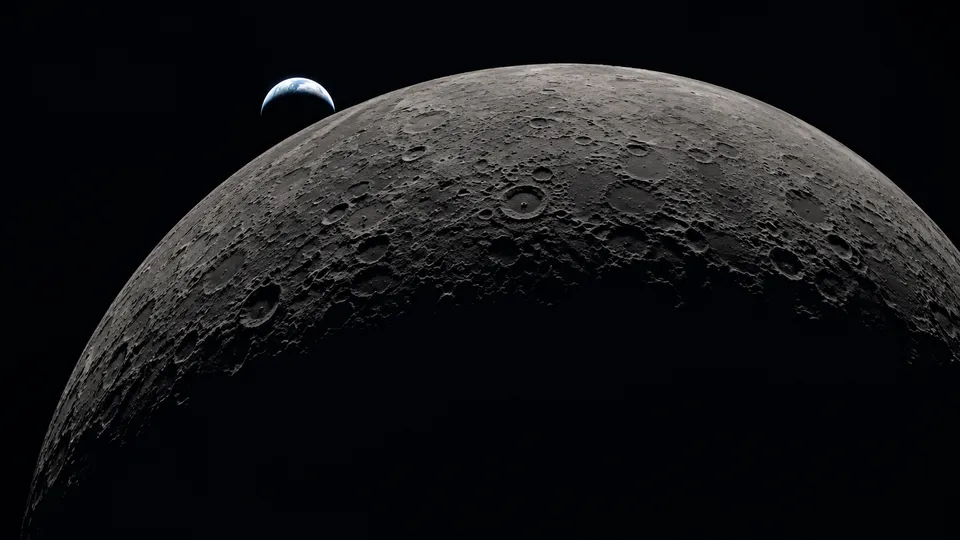
A dense, strongly magnetized rock formation buried on the far side of the moon provides new evidence that the moon generated its own magnetic field about 4.2 billion years ago, according to a study published September 23 in the journal Science Advances.
The rock body, about 60 kilometres wide and around 9 kilometres deep, may be an ancient volcanic complex that became magnetized when magma rose from the moon’s interior and solidified before reaching the surface, the authors wrote. The field at the time was likely between one-fifth and one-third the strength of Earth’s magnetic field today.
Earth’s field, generated by molten metal churning in its outer core, shields the atmosphere from solar wind and radiation. The moon’s interior cooled and its field weakened significantly about 3.2 billion years ago, according to NASA, and solar radiation stripped away its atmosphere.
Whether an early lunar dynamo existed at all has been debated since the Apollo missions returned magnetized rocks in the 1970s, said study co-author Anna Mittelholz, a lecturer at ETH Zurich. The field was long thought to have been active from roughly 4.25 billion to 3.5 billion years ago, but some recent analyses of Apollo samples found no magnetic signal in parts of that period, she wrote in an email, “and some researchers have gone as far as questioning whether an early dynamo existed.”
The new study supports the early dynamo without relying on Apollo samples. The researchers instead combined orbital magnetic and gravity data in a single model to analyze the Dewar region, which is not visible from Earth, using measurements from NASA’s Lunar Prospector, launched in 1998; Kaguya, launched in 2007; and GRAIL, launched in 2011. Gravity data described the rock’s density and magnetic data its magnetization, which “let us pin down an actual buried structure rather than just a signal that could be produced by many magnetized rock configurations,” Mittelholz said.
Orbital data also avoids a problem with samples, she said: their magnetic record “can be disturbed quite easily through heating, shock, or even routine handling and storage in a lab,” so similar samples can give different answers for reasons unrelated to the field itself.
Researchers could not estimate how long the dynamo lasted or explain how the moon’s small core could generate a field as strong as some earlier studies suggest, but the authors said the findings shift the debate from whether the moon had a dynamo to how it worked. “Analyzing the magnetic field of the moon is a good way to estimate how the moon looked like early on,” said co-author Adrien Broquet of the German Aerospace Center in Berlin.
The team also found that lunar swirls, unusually bright patches on the surface, are often paired with magnetic anomalies. “The leading hypothesis is that these magnetic anomalies deflect solar wind and protect the surface from getting weathered by it,” said lead author Xi Yang, a doctoral student at ETH Zurich, adding that the swirls might one day help identify areas better protected from solar wind for future lunar missions.
Outside scientists welcomed the findings. Claire Nichols, an associate professor at the University of Oxford who was not involved, said the study supports an intense early dynamo but that more work is needed on how long it ran. “Overall, I think this study provides further motivation to keep adding to our observations during upcoming missions such as Artemis and Chang’e,” she said, referring to the NASA and Chinese lunar programs. Isaac Narrett, a Massachusetts Institute of Technology doctoral student who led an unrelated 2025 study, said the work lays groundwork for similar analysis of the moon, Mercury and Mars.