
Paris – On the eve of another weekend of unrest, Emmanuel Macron has agreed to do what he had not done in six weeks of revolt: sit down with the students themselves. On Friday, Al Jazeera reported, the president will receive representatives of the secondary-school groups whose movement, born in September, has been demanding the overhaul of an education system they say no longer works. It is the first such meeting. The country, meanwhile, braces for further protests over the weekend.
In the calendar of power this is a concession, and concessions have their own smell. A palace that receives an eighteen-year-old delegate from the banlieue has already admitted, without saying it, that the street outside its gates can no longer be managed by the police alone.
One classroom, then four hundred
The revolt began in a single building. On September 17, students at the Lycée Antoine-de-Saint-Exupéry in Créteil, a suburb of Paris, walked out of class to protest teacher shortages and crumbling school conditions, according to an account of the uprising by Georgetown University’s School of Foreign Service. From that doorway in Créteil the contagion travelled the way it always travels in France: by imitation, by indignation, by rail.
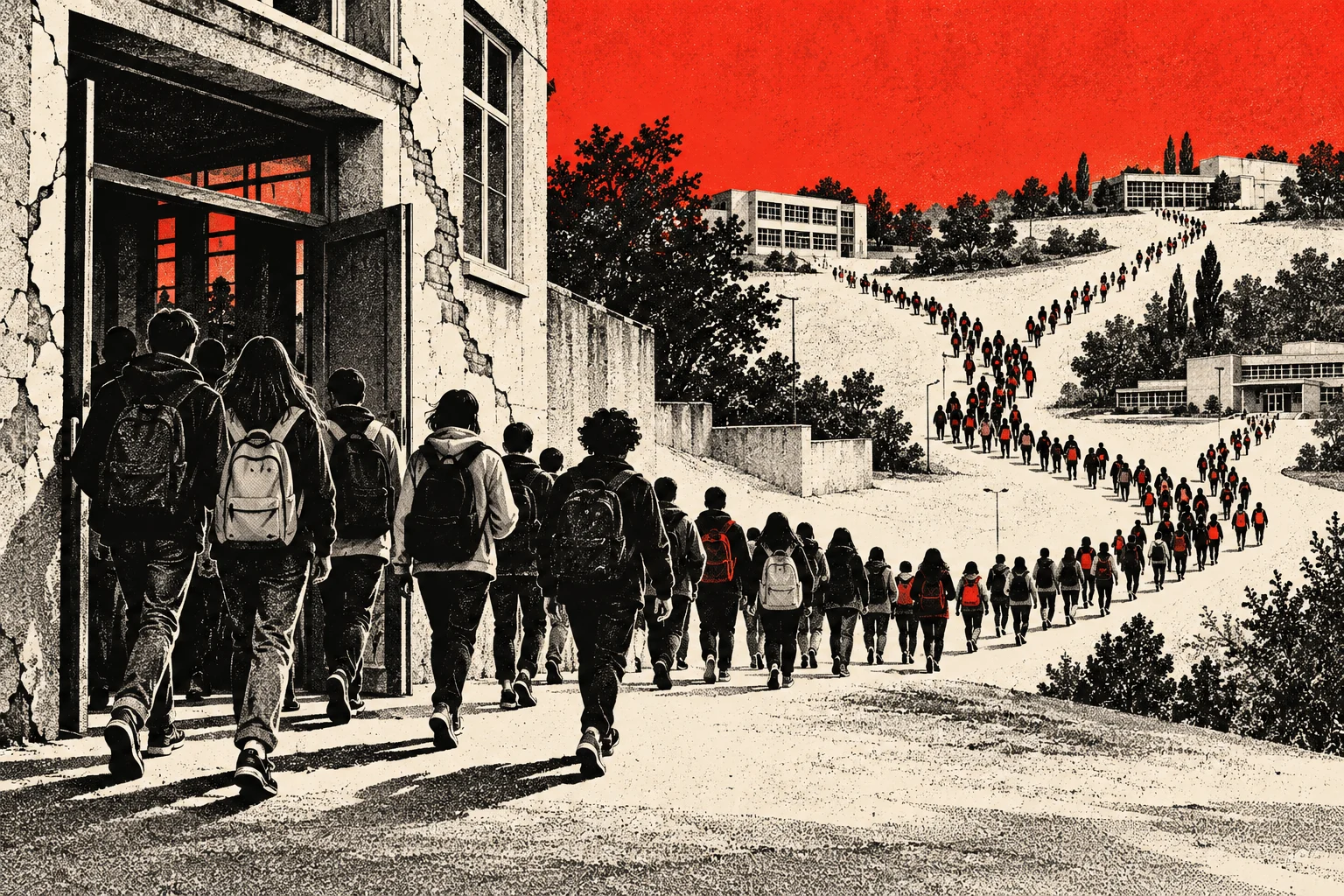
It did not stop at the hexagon’s edge. A chronology compiled by Wikipedia records students in French Guiana blockading the Félix Éboué high school in Cayenne over miserable learning conditions, and parents, teachers and students in Mayotte blocking access to a lycée in the island’s north. An empire’s former outposts, reading the same lesson as the metropolis.
The education ministry’s own count, cited by Al Jazeera at the end of September, put the affected schools at about 400 of France’s 3,700 lycées. By early October the movement had reached more than forty cities, The New York Times reported. The government has accused France Unbowed, the left-wing party that backs the protesters, of fomenting the unrest — an accusation the party denies.
The arithmetic of the street remains contested, as it always is: on one October Tuesday the Interior Ministry counted 161,500 marchers while the unions said 480,000. Between those two numbers lies the whole history of official counting in France — the state counts heads, the movements count grievances.

The palace and the street
The students have not marched alone. Their revolt overlapped with a public-sector strike against the government’s budget plans, and it has matured in the shadow of next year’s presidential election, into which every one of its slogans now feeds. Prime Minister Lecornu has already tried the older remedies — a consultation, a televised appeal, an offer on diesel — and the barricades returned the next morning.
There is an old pattern here that every French ruler learns and every French ruler forgets. The young are not, in the end, protesting a timetable or a syllabus. They are protesting the suspicion that their future has been spent elsewhere — on budgets, on wars, on vanities. A state may ignore that suspicion. It may also, as the republic teaches every generation, meet it at the school door.
Friday’s delegation will go into the Élysée with a demand distilled bluntly in Al Jazeera’s own headline: we want promises backed by results. Whether the president carries back out anything more than promises will be measured, as always in this country, on the cobblestones this weekend.