
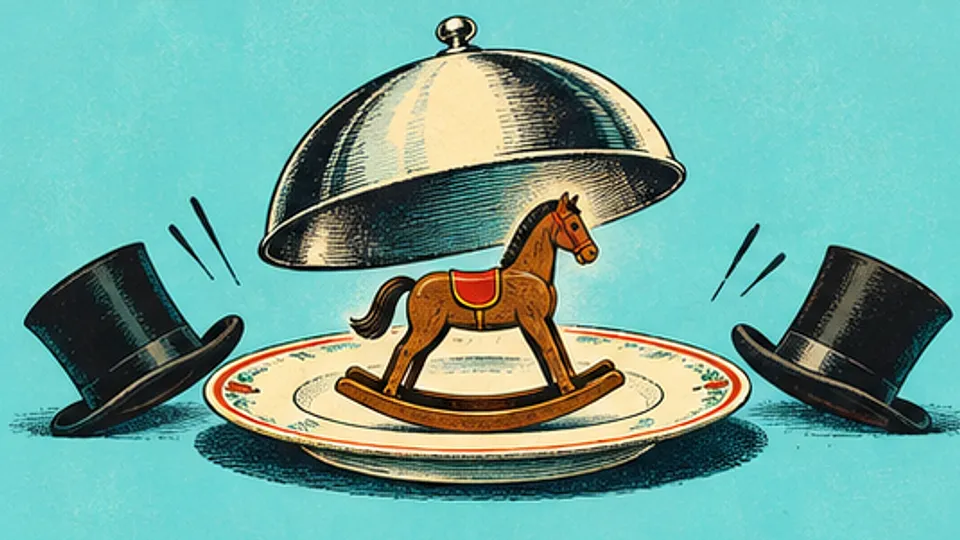
One evening in February 1868, some of the most powerful men in London sat down in the dining room of the Langham Hotel to a six-course banquet in which every dish, soup included, was made of horse.
The point of the dinner, hosted by William Forsyth, a prominent lawyer and member of Parliament, was to settle once and for all whether horsemeat was a fitting food for Britain. But the real guest of honor was Algernon Bicknell, whose manifesto that year, Hippophagy: The Horse as Food for Man, put the case bluntly: “Why should millions of pounds of excellent meat be wasted, when there are millions of men who cannot obtain it?”
The menu opened with a horse soup and moved on to ‘terrines de foie maigre chevaline,’ which one diner allowed “we may describe as potted horse liver” and judged “decidedly the most horsey food at the dinner,” with “a strong and unmistakeable flavour of horse sweat.” The horse sausages fared better. So did a joint weighing 280 pounds, “borne in on the shoulders of four stout servitors, its advent being announced by a herald in a tabard.” Even the fish, a sole, had been cooked in horse oil.
Charles Dickens had a stake in the question. His magazines, Household Words and its successor, All the Year Round, had run articles on horse-eating, or hippophagy, for years, so he sent his eldest son, Charles Jr., to sample the fare and a journalist, Joseph Charles Parkinson, to report on the guests’ reactions. As each plate was tentatively tried, Parkinson recalled, “men looked at each other curiously while eating,” trading puns and matching every mouthful against beef, mutton, hare, reindeer or roebuck. More unsettling than the food were the photographs passed around of the three horses whose flesh the diners were eating.
The case for hippophagy rested on taste, cost and what to do with the urban horse. Industrialization had filled cities with workhorses hauling goods, mail coaches, omnibuses and cab fleets; the London General Omnibus Company alone used 10,000 horses to run 1,000 vehicles carrying more than 110 million passengers a year. Many ended their working lives in the ‘knacker’s yards,’ and their meat was sold cheap to the cat’s meat man, who sold it from a barrow as food for city pets. One writer in the magazine London Society calculated in 1871 that “the cats and dogs of London demand for their sustenance a weekly allowance of as much flesh as 250 horses yield.”
Price was the stronger card. With butcher’s meat beyond the means of many working families, horsemeat looked like affordable nutrition, and even The Times told its wealthier readers before the banquet that “with beef at 10d a pound we may do worse than eat horse at 2d.”
Some pressed further, pitching horse-eating as kindness. In Household Words in 1856 the food writer Edmund Dixon argued that a working horse deserved six or seven weeks of rest and good feeding before slaughter — “if it will pay to fatten an ox who has served his time in the plough, or a cow who has fulfilled her contributions to the dairy, it would also remunerate the grazier to fatten a horse past work.” Driven mainly by the prospect of better meat at better prices, he still concluded that “all the animals’ friend societies must vote with the hippophagists.”
National pride raised the stakes. Two years before the banquet, a Paris butcher had won France’s first permit briefly to sell horsemeat, and similar shops soon opened in Denmark, Belgium, Austria and Sweden; shortages during the Siege of Paris in 1870-71 made it more ordinary still in France. Britons who called the idea revolting were answered with charges of narrow-mindedness. “What prevents it?” Dixon wrote. “Prejudice, and nothing else! The same prejudice which makes the English refuse to taste frogs and escargots, though both are esteemed and expensive dishes on the continent.”
Reporters at the Langham declared the meal “An explosion of satisfaction!” and some diners begged to take slices of horse home. It didn’t matter. Hippophagy never caught on in Britain. When the First World War drew civilian horses into military service, the horse was reimagined again, too valuable and too noble to eat, and while horsemeat was quietly sold and consumed into the 1930s, it then fell thoroughly out of fashion. It has never been legally banned.