
A third of the cost, 100 percent of the data. That is how Ira Thorpe, the gravitational-wave astronomer at NASA’s Goddard Space Flight Center who leads the US science team on LISA, prices the deal: NASA contributes roughly a third of the mission and receives every bit of its science return. His back-of-envelope figure for a US-built equivalent is $3 billion; NASA’s actual stake in the Laser Interferometer Space Antenna is expected to run about $1 billion, though the agency has not set a firm budget commitment. ‘We are in the era of people interested in having good deals, and LISA is a very good deal for the US,’ Thorpe told the National Academies’ Committee on Astronomy and Astrophysics, as Ars Technica’s Stephen Clark reports.
The European-led numbers check out against Thorpe’s estimate. ESA approved LISA for development in 2024 with a budget of €1.75 billion, about $2 billion, and that excludes contributions from NASA and from individual ESA member states — so a $3 billion all-in US replication cost is in the right range, not an exaggeration. Thorpe calls it the largest science mission ESA has ever attempted, full stop.
What $1 billion buys
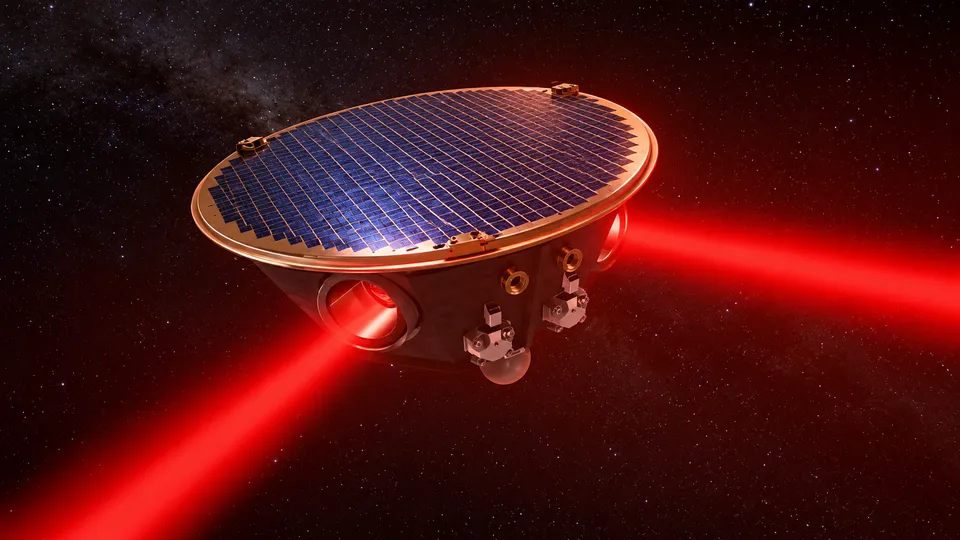
LISA is the first space-based gravitational-wave observatory, scheduled to launch around 2035. Three spacecraft will fly in a triangle in heliocentric orbit, separated by about 1.6 million miles (2.5 million kilometers) — compare that to the 4-kilometer arms of the ground-based LIGO detectors that made the first gravitational-wave detection in 2015. The arm length sets the frequency band: spreading the detectors over millions of kilometers instead of kilometers opens the low-frequency regime ground instruments cannot reach.
The measurement mechanism is worth stating precisely. Each spacecraft carries two free-floating gold-platinum cubes inside a Faraday cage that shields them from everything except gravity: thruster noise, spacecraft vibration, solar radiation pressure, interplanetary dust. The spacecraft flies formation around the cubes rather than the other way around, and inter-satellite lasers measure the distances between the test masses. A passing gravitational wave changes those distances by less than the width of an atom, and the laser ranging has to resolve exactly that.
The division of labor maps onto what each side builds well. NASA supplies the laser transmitters and telescopes, charge-management devices to bleed electric charge off the proof masses, and ground-side data analysis to localize the wave sources. ESA builds the three spacecraft, launches them, and operates the mission. NASA has no competing program of its own and, per Thorpe, likely could not fund one if it wanted to.
The leverage, and the political physics
The deal framing is not incidental. NASA under Administrator Jared Isaacman has told international partners that cooperation now requires ‘meaningful contributions’ — hardware or capability NASA does not already have, delivered on schedule. The casualties show what fails the test: the Lunar Gateway station is gone, Mars Sample Return was cancelled after its budget passed $10 billion, and Isaacman earlier this year rejected an ESA proposal to build a cargo lander for the Moon Base, a role NASA expects American landers to fill. The programs that pass — Japan’s pressurized lunar rover, Italy’s probable first Moon Base habitat — contribute complete, self-contained systems. LISA fits that pattern: ‘We are giving them this flagship. For a fraction of [$3 billion], we are getting the same science,’ as Thorpe put it.
The risk to the arrangement is lopsided by design. The White House proposed cancelling NASA’s LISA participation in last year’s budget and again in the fiscal 2027 request released earlier this year; Congress rejected the first attempt and restored funding for FY2026. ‘That caused some concern in Europe, which I think is understandable,’ Thorpe said, noting the project has met every deliverable commitment to ESA so far. A mission with concepts dating to the 1970s has ‘bounced back and forth, depending on how the political winds have shifted on both sides of the Atlantic,’ he said, but the current configuration — ESA clearly leading, NASA as critical partner — is the most stable it has been.
Congress is expected to hold the line. LISA was one of a handful of future NASA science missions with its own funding line in the 2026 appropriations bill, and its patrons sit in the right seats: Sen. Chris Van Hollen of Maryland, top Democrat on the subcommittee that writes NASA’s budget, represents Goddard’s constituency and would chair the subcommittee if Democrats take the Senate; Rep. Glenn Ivey, whose district also covers Goddard, sits on the House counterpart. Shawn Domagal-Goldman, who oversees NASA astrophysics, says the signed FY2026 bill is the signal to ESA that Washington is committed: ‘As long as we have a continuing resolution or anything at our current funding levels, we will maintain our commitment to the LISA mission.’
The number that will settle the argument is the FY2027 appropriation. The administration has already proposed, for a second time, zeroing out a contribution that buys all of a $3 billion mission’s science for around $1 billion. Whether Congress restores it a second time is the test of whether ‘good deals’ was ever the actual criterion.