
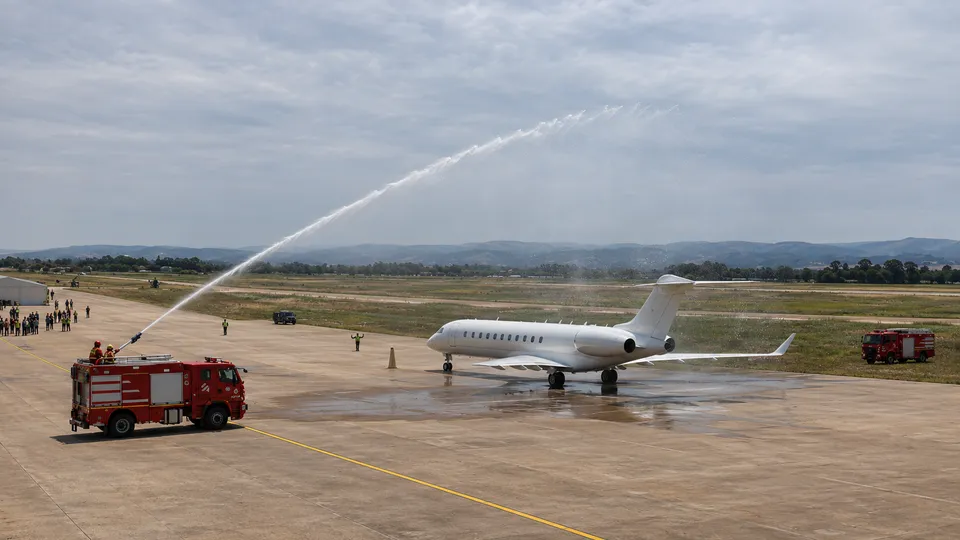
Here’s a basic fact about Lebanon: it has one working airport. Rafik Hariri International sits just south of Beirut, and the road between the airport and the capital is a road, which means people can block it. Hezbollah supporters have done that more than once. In February 2025 they did it after two Iranian planes were refused permission to land. Even if you never think about airports, you can see how this works. A country with one airport and one main road to it has a chokepoint, and whoever can shut the chokepoint has leverage over the country.
So Lebanon is building a second airport. According to Justin Salhani at Al Jazeera, the Rene Mouawad airport in Qlayaat, in the far north, is due to start test flights on Independence Day, November 22. Prime Minister Nawaf Salam announced that date after a meeting on preparations, and said regular commercial service would start on December 14. Salam and other officials already flew a test flight from Beirut to Qlayaat in June, so the planes do land there. The open question has been whether the rest of the airport is ready.

Readiness has been a moving target. The airport was supposed to open in mid-2026, and Israel’s war on Lebanon pushed that back. Commercial flights were then set for November 22, until construction delays moved them to December, now December 14. That date has a sales logic, at least: it’s when a lot of diaspora Lebanese fly home for the holidays. If your opening keeps slipping anyway, slipping it to your busiest week is not the worst outcome.
The chokepoint
Nobody official is selling Qlayaat as a way around Hezbollah. Officials say the motive is economic. But the analysts Al Jazeera spoke to are open about the political side. Political analyst Bassel Doueik called the ability to block the airport road “a strategic advantage for the group.” He also thinks the new airport only partly removes that advantage, because it “is small and it cannot substitute for the current airport.”
That’s probably right, and it’s also maybe not the point. A small second airport doesn’t have to replace Beirut. It just has to exist. Security analyst Marcel Baloukji made roughly this case: little changes on the question of Hezbollah’s weapons, but “the state gains manoeuvrability and alternatives.” If Beirut’s airport shut down, there would still be a way in and out, especially for foreigners and diplomatic missions. A chokepoint only works if there’s nothing on the other side of it. Once there is, even something modest, blocking the road costs Hezbollah the same as before and achieves less.

This is all happening while Hezbollah’s role is being openly argued over in a way it wasn’t a few years ago. Since the 2024 ceasefire with Israel and the fall of Bashar al-Assad in Syria, the group’s position has been up for debate, and its losses since October 2023 have been heavy. Its supporters have still shown they can fill a road: Al Jazeera reports that they burned tyres on the old airport road to protest a US-Israel-Lebanon trilateral agreement signed on June 27, 2026.
The money
Now the economics, which officials say are the real reason for the project, and which are grim. Lebanon still hasn’t recovered from its 2019 financial collapse, and since then it has dealt with Israel’s ongoing assault and the US-Israel war on Iran. Al Jazeera puts expected inflation this year at 17.5 percent and damage since 2023 at more than $14bn, and cites a World Bank forecast that the economy will shrink 6.4 percent in 2026. When GDP is contracting by about a sixteenth in one year, one regional airport won’t fix things. It is, though, a piece of infrastructure that might make money, and the country hasn’t had many of those lately.
The projections are modest. Qlayaat is expected to handle 115,000 passengers in its first year, which works out to about 315 a day, or a couple of full narrowbody flights. By year four it’s meant to reach about 600,000, a bit more than five times as many. It’s expected to attract low-cost carriers, and as of June the confirmed destinations were Istanbul and Mersin in Turkey, plus Dubai.
Dania Arayssi of the New Lines Institute pointed to something less obvious. Running a facility that brings in revenue, she said, “could help rebuild citizens’ trust in state institutions,” and it would show the state can protect public assets from Hezbollah interference. For a Lebanese state, managing an airport competently and collecting the fees is apparently a political statement in its own right.
Six kilometres from Syria
Location matters too. Qlayaat is in Akkar, one of Lebanon’s poorest and most neglected regions, and officials hope the airport will bring some growth there. Baloukji said it would keep local workers in the area and help tourism. It’s also 6km (3.7 miles) from the Syrian border, close enough to serve Syrian cities like Homs, Latakia and Tartous along with northern Lebanon. Until recently, that closeness was the problem: Assad’s government opposed the project. His fall in December 2024 removed that objection, and the airport became a priority once Salam formed his government in early 2025.
So the plan relies on Syria’s new government not minding a Lebanese airport near its border, after years in which Syria’s old government did mind. It relies on construction getting finished. And it relies on people wanting to fly from Akkar to Mersin. Baloukji gave one more reason they might: “many people are avoiding Beirut airport due to Hezbollah’s influence.” If that’s true, the airport’s best selling point is that it isn’t Beirut.