
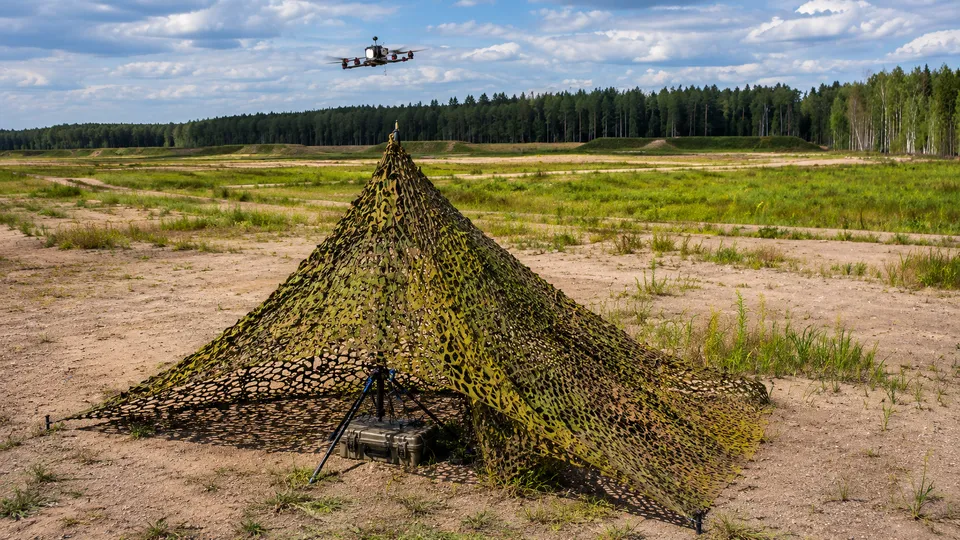
Latvia says it can approve drone, counter-drone and electronic-warfare trials at its Sēlija military training area within days. Comparable permissions can take months in some other Western countries. The comparison comes from Maj. Modris Kairišs, head of Latvia’s Autonomous Systems Competence Center, which tests, integrates and supports these systems and oversees the range, in an account by Sinéad Baker for Business Insider. It concerns permission to test, not certification or procurement.
The constraint is physical as much as administrative. A drone trial needs suitable airspace; electronic warfare, meaning military radio emissions used to sense, disrupt or deceive, needs permission to transmit. Kairišs said that “in some Western countries it’s almost impossible to get airspace and some radiation permission for electronic warfare due to the density of air traffic and the density of populations around.” Latvia, by contrast, is “quite liberal regarding all the permissions and bureaucracy relating to the testing activities,” he said.
Ranges can also face restrictions when cars, traffic or other civilian activity are nearby. Sēlija’s size and isolation reduce those conflicts, making it what Kairišs called a “safe space” for allied testing. Companies from Germany, Sweden, Latvia, Ukraine and the United States have conducted demonstrations or tests there; their names and the number of trials were not disclosed.
Company or allied military test plan → Latvian airspace, radiation and range permissions, potentially in days → drone flights, counter-drone trials or electronic-warfare transmissions at Sēlija.
That path removes one queue. The days-versus-months figure is an assessment by the range’s operator, not a published cross-country audit, and no distribution of approval times is given. Nor does a quick permit demonstrate that a system works, survives jamming, integrates with allied forces or can be manufactured in quantity.
One range inside a wider test network
NATO designated Sēlija an innovation range for uncrewed systems in 2025. It is one of five such ranges established through the alliance’s Ukraine-inspired Rapid Adoption Action Plan, and the only one assigned to uncrewed systems. The others cover capabilities including underwater systems and cyberspace. The plan brings companies from allied countries and Ukraine together with military specialists and government representatives to experiment with new technology. The designation supplies a shared test institution, not a purchase order.
The programme is already running structured campaigns. NATO records that Sēlija launched its first Testing, Evaluation, Verification and Validation, or TEVV, campaign for uncrewed aircraft and counter-uncrewed-aircraft technologies during 9–13 March 2026. NATO describes the site as suitable for “high-speed and high-altitude interceptor flights, as well as testing of various electronic warfare solutions in an open environment.” Those are permitted test conditions, rather than published performance results for any interceptor or jammer.
Officials plan to expand the training area to 25,596 hectares, equivalent to 255.96 square kilometres. That is the planned endpoint; no current hectare figure is supplied with the comparison. Kairišs called the range “quite huge,” but the useful engineering variables are more specific: how much airspace can be closed, which radio frequencies and power levels can be used, and how many trials the range can run concurrently. Those capacities have not been published in the account.

Usage is multinational. Drone pilots from 14 European Union member states trained at Sēlija over the summer, in an exercise the European Defence Agency called “a major step towards a European military drone training program.” The count measures participating states, not trainees, flight hours or systems tested.
The EU then added a development function. The European Defence Agency announced plans in October for a Sēlija hub to develop and test aerial and ground drones and counter-drone technology. Latvia’s defence ministry dates the announcement to 30 October and says European Commissioner Valdis Dombrovskis represented the EU in announcing two drone technology centres, one in Latvia and one in the Netherlands. A budget and opening date remain unspecified.
The same constraint appears in Poland and Britain
Sēlija is not the only attempt to locate demanding training where civilian airspace is less congested. Brigadier Atle Modle, who oversees Operation Legio’s training for Ukrainian soldiers in Poland, said the eastern Polish camp was purpose-built partly because operating drones there is less restricted than elsewhere in Europe. Conducting electronic warfare farther west, he said, could mean that “Domino’s pizza will be delivered to the wrong address and stuff like that.” The delivery example describes the underlying interference problem: a transmission intended to disrupt a drone can also affect civilian activity. Modle said Poland’s different rules allow the location itself to improve training quality.

Some restrictive jurisdictions are reviewing their rules. Luke Pollard, the UK minister for defence readiness and industry, said in June that “jamming for large parts of the United Kingdom is very hard” and called for regulatory change. That establishes ministerial recognition of the constraint, not evidence that a reform has since taken effect.
Permission is only the first clock
Latvia’s incentive is also strategic. It borders Russia and, as an eastern-flank ally, is concerned about a possible Russian attack. Its drone-warfare priority includes plans for an automated anti-drone border with Russia, and it has pressed allies to invest heavily in counter-drone systems. A local range lets Latvia test those systems while offering allied companies a reason to conduct their trials there.
Kairišs’s main lesson from Ukraine is speed. Western militaries already possess or can develop much of the required technology, he argues, but lengthy planning and procurement delay its adoption. “We need to think about how to better put all new technologies in the field because a standard planning cycle is too long and maybe it’s too academic in approach,” he said. The argument separates two bottlenecks: Sēlija can shorten access to a test area, while ministries control the subsequent funding and fielding decisions.
The full path is trial → evaluation → procurement → fielding. Latvia has supplied an estimate only for permission to reach the trial. The next numbers to watch are how many Sēlija-tested systems enter service, their elapsed time from first trial to deployment, and the eventual budget and testing capacity of the EU centre. Those figures would show whether a permissive range shortens the acquisition cycle or merely moves the queue downstream.