
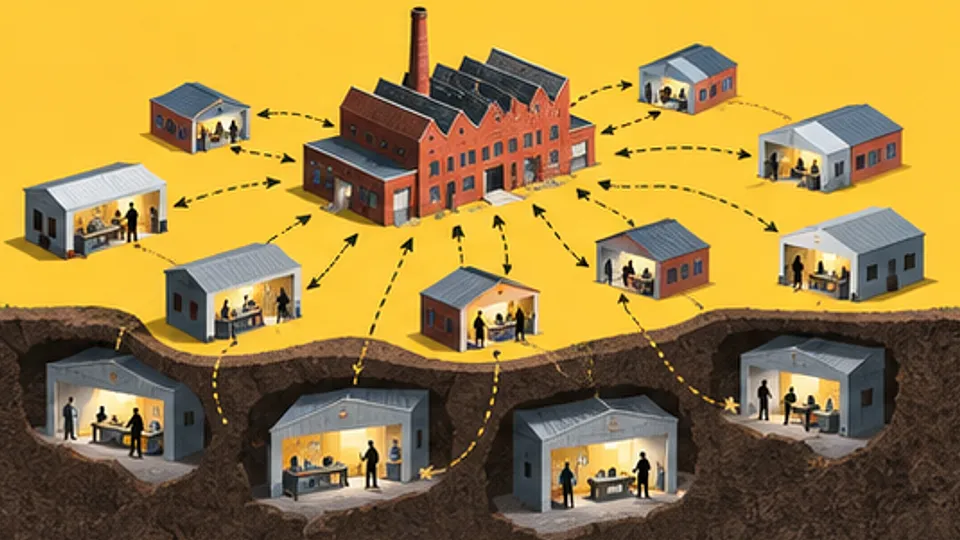
Consider the European defense factory: one splendid, gleaming, concentrated cathedral of production. All the engineers in one building, all the machines in one hall, all the know-how under one very large, very easy-to-target roof. Efficient! Economical! And to Raivis Melnis, the defense minister of Latvia — a NATO and EU member state sitting right on Russia’s border — it is a catastrophe waiting for a missile.
“Our industry is a peacetime establishment,” Melnis told Business Insider, built in a world where “there is no threat.” The question that keeps him occupied, he said, is “whether we are ready to produce the systems in different locations, dispersed, and how we organize that.” Because across the border in Ukraine, the arms industry has already been forced to answer it — with explosives for punctuation. Ukrainian makers split manufacturing across multiple sites, work underground, and pick up and move so that no single Russian strike can gut their operation.
And the Ukrainians are not shy about dispensing the lesson. Davyd Aloian, deputy secretary of Ukraine’s National Security and Defense Council, told Business Insider the Russian threat to Europe is so substantial that companies across NATO should “definitely” begin breaking up their production. The practitioners go further, down into the gritty mechanics of survival.
At Frontline Robotics, chief business development officer Mykyta Rozhkov told Business Insider that some alliance defense firms have already come asking how it’s done. The company has adapted, he said, to “endure the loss of any site.” A loss remains “painful” — but survivable. The whole operation is engineered so it is “as easy as possible to move.”
Then there is Oleg, an executive at the drone maker TechEx, who asked that only his first name be printed for security reasons — which tells you something about the calendar these people live on. “Every day we are facing another level of threat from Russia trying to hit the factories,” he told Business Insider. The company must find “creative ways to switch the locations every couple of months to raise the level of security for our people, because, of course, you want to take care of the people and keep them safe.” The message TechEx gives its international partners is blunt: their conventions are “slightly outdated.”
The CEO of Ark Robotics, a Ukrainian-Estonian defense tech firm, described making different components at different sites as “necessary,” even while conceding that a single site would be “the best way to do it.” The discipline is to be “smart about it and not create a big enough target for it to attract too much attention or to disclose where our operations are happening.” His verdict: dispersed production should be the “default for defense-based manufacturing going forward” — and not only in Ukraine.
Kyiv has been building the safety net, too. The Ukrainian government compensates businesses for some properties damaged or destroyed in Russian attacks and is planning further support — proof, as the reporting notes, that a state “can provide that reassurance if, for instance, an industry site is destroyed.”
And in Europe? Some of the neighbors hear the sermon and feel the chill of it. Karmo Saar, head of sales at the Estonian drone company Krattworks, whose machines are used by Ukraine, told Business Insider that for Ukrainian firms it “would be a lot more economical, cheaper, and better to run this operation in one big facility, but they cannot do that.” His follow-up is the line that should be stenciled over every industrial-convention badge lanyard on the continent:
“In Europe, we do that,” Saar said. “And when the war strikes, I think we’re going to be punished.”
Srđan Kovačević, CEO of the Croatian drone technology company ORQA — itself signing up to begin work in Ukraine — told Business Insider it is “our deep philosophy that distribution is more resilient.” “Distributed systems are much more resilient to any disruption than concentrated systems, centralized systems,” he said, adding that “this distributed nature actually reinforces resilience, even though there are economic downsides to it.” The thinking, he noted, appears to be shifting across Europe. Slowly. Cathedral builders do not love tents.
Melnis, for his part, is not waiting for the continental consensus to arrive by post. Latvia is among the NATO countries most alarmed about a Russian attack or invasion, a loud advocate within the alliance for higher defense spending, for arming Ukraine, for studying Ukraine’s fight. The lessons are already flowing into a new automated anti-drone defense wall and the acquisition of Ukraine-tested gear. Melnis has announced a series of deals to intertwine the two countries’ defense industries, and he wants Latvian firms learning at the elbow of Ukraine’s battlefield-hardened shops — their “proven, combat-tested” systems wedded to Latvia’s “peacetime establishment, where our scientist engineers can work and can develop and bring those two together.”
What Ukraine possesses, he told Business Insider, is precisely what “you can’t just sit in a normal office and build and simulate and create.” Its “military industry has established really close cooperation with the armed forces,” he said. “We don’t have such experience.” He intends to import it — “take those best practices.”
Deterrence, in Melnis’s telling, runs through capability and through Kyiv. Russia, he said, wants “to destroy that support for Ukraine.” His answer: “Therefore, it is important for us to support, and we will be supporting Ukraine to build the victory.” The peacetime establishment has been warned — by a minister whose country shares a fence with the threat, and by the executives who move their factories like furniture before the bombs can find the address.