
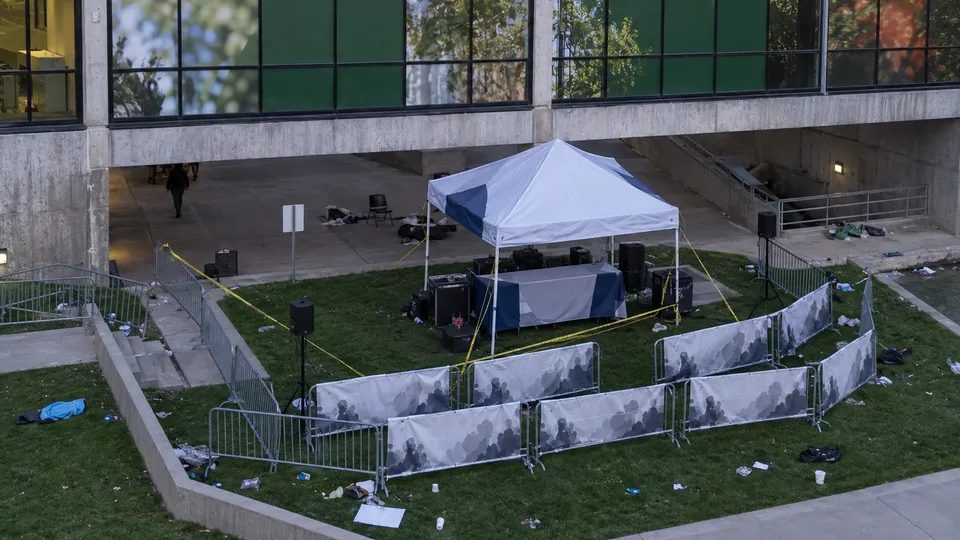
On September 10, 2025, Charlie Kirk, thirty-one years old, sat down to debate students in an outdoor courtyard at Utah Valley University in Orem, Utah. Several thousand people had come. The courtyard was surrounded by tall buildings. A sniper fired from a rooftop more than 400 feet away.
On Friday the university released an after-action report — an external, independent review of how that event was planned and how the campus responded, the university said. Its findings distribute the failure widely. Kirk’s own organization, Turning Point USA, had insisted he speak outdoors despite security concerns. The university, for its part, never properly assessed the dangers of that choice, including the possibility of a rooftop shooter.
There was no formal security assessment, the report said. There was no written event action plan. Critical decision making was deferred to Turning Point USA.
At a planning meeting in August 2025, according to the report, a Turning Point representative insisted on the courtyard because Kirk had been there previously and the organization was familiar with the location. Some university officials expressed reservations about holding the event in an outdoor space ringed by tall buildings. The event proceeded anyway.
In our assessment, those decisions were consequential.
The outdoor location, the report allowed, “created significant protective operations considerations” — the language of the review lending the courtyard a bureaucratic calm it did not have. The planning process included no documented line-of-sight assessment, no pre-event briefing, no walk-through with security stakeholders. There was no clear coordination between the speaker’s private security team and external law enforcement partners.
An Associated Press review had already found that the Orem campus did not use several public safety practices that have become standard at events around the country. Campus police staffing was far below recommended levels for a school of that size. No drone was flown to monitor the rooftops. There was no coordination with local law enforcement to secure the event, which drew about 3,000 people. There were no bag checks. There were no metal detectors.
Earlier this month, Kirk’s family sent Utah officials a wrongful death notice — a precursor to a lawsuit — claiming that university officials had made a string of “reckless” decisions that left him vulnerable to the rooftop sniper.
Tyler Robinson, a Utah resident, turned himself in to authorities a day after the shooting. Prosecutors say he told his romantic partner that he “had enough of his (Kirk’s) hatred.” He has pleaded not guilty to aggravated murder, a charge that could make him eligible for the death penalty if convicted. On September 1, a judge ordered the case to proceed toward trial.
A trial date has not been set.