
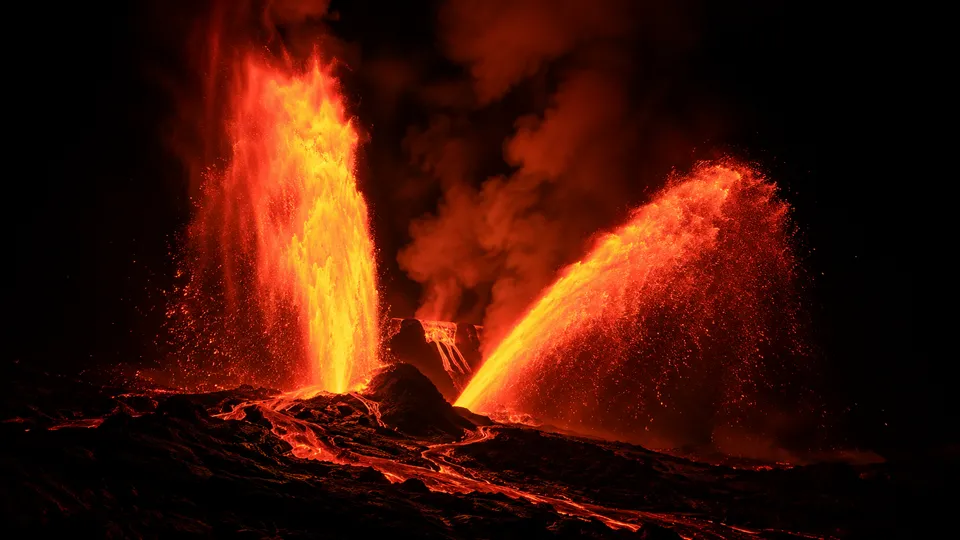
Every ruler keeps a calendar, and the rulers that cannot speak keep theirs in stone. At the summit of Kīlauea, the youngest and most active volcano in Hawaii, the crater called Halemaʻumaʻu has been writing one since 23 December 2024. Over and over the ground swells, a vent opens, and molten rock is thrown hundreds of meters into the sky. Then the ground sinks back and the swelling starts again. By September 2026 this had happened 54 times.
That is a great many for this mountain. As John Timmer reports for Ars Technica, Kīlauea had managed only three fountaining episodes since 1823. Most hotspot volcanism is a slow affair: lava creeps downhill at a pace a person can walk away from. Etna, Iceland and Hawaii are the exceptions, the places where the earth sometimes spits instead of seeping. Researchers at the US Geological Survey have now published the most detailed record yet of one of these spitting seasons. The paper, by A. F. Flinders and colleagues, appeared in Science on 8 October, and it says the 54 episodes are the most lava fountaining episodes recorded in any Kīlauea eruption.
The ledger beneath the crater
Hardly any volcano on Earth is watched as closely. Earlier work had found reservoirs of magma a few kilometers below the surface, and 35 separate instrument stations stood on the mountain, carrying what the researchers list as “seismic, infrasound, geodetic, gas, and visual and thermal cameras.”
The ground had been sending signals for years before the fountains began. A large eruption in 2018 partly emptied one of the underground reservoirs, and it then began to refill. In 2019 the refilling sped up, and the local peak rose by more than 22 centimeters a year. In 2023 that rate doubled to 57 centimeters a year, and the swelling spread to a nearby caldera.
Then, in 2024, came a large swarm of earthquakes. A vent opened, and so did a fissure 900 meters long. By Ars Technica’s account, fountains reached as high as 160 meters over 13 hours, and less than a day after they died down a second eruption followed. After that the episodes kept coming. The most violent threw lava more than 400 meters into the air. The USGS’s own eruption summary puts the highest fountains at 1,570 feet, or 479 meters, above the vents. The survey has also published fountain heights and timelapse images as open data, episode by episode.
Reading the tilt
What the scientists gained was a way to tell when the next fountain was coming. They still cannot say what drives it.
Each episode quickly deflated the summit. Afterwards the Halemaʻumaʻu reservoir refilled slowly and the ground tilted upward again. The survey noticed that one episode tended to follow another once the summit tilt returned to roughly the level it had reached before the last one. That trigger level crept downward over time, but from one episode to the next it changed only a little. This pattern let the USGS issue alerts when an eruption was likely. The alerts mattered all the more because the seismometers gave no clear warning just before the fountains restarted.
The method is old and humble. Watch how far the ground leans and wait.
The mountain has since broken its own rhythm. Since episode 54 on 25 August, the Hawaiian Volcano Observatory reports, irregular patterns of ground deformation have made it impossible to model when the next fountain might come. The observatory says the magma chamber beneath Halemaʻumaʻu is pressurized beyond the level usually seen before recent episodes. It warns that another fountain could follow, or magma could push in underground, or it could find old cracks and leak out quietly. The alert level remains at WATCH/ORANGE. The forecast worked until the moment it was published, and then the volcano changed the terms.
Two theories, one mountain
There are two leading explanations for why lava fountains at all. In the first, pressure deep in the reservoir keeps water dissolved in the magma until the melt rises high enough for that water to escape as steam. The steam breaks the magma into fragments, the fragments rise faster, more steam escapes, and the cycle feeds on itself until a jet bursts out near the surface. In the second, carbon dioxide leaving the magma builds a foam of gas and melt against the roof of the chamber. When the foam reaches a critical point the gas escapes and carries magma with it, until the chamber runs dry.
The Kīlauea data do not settle the question, but they do weaken the second explanation. Carbon dioxide stayed low through the whole eruption cycle. Sulfur dioxide, a marker of gas escaping from magma, rose during eruptions and fell afterwards, but it stayed high the entire time. Degassing, in other words, never stopped. It only sped up during fountaining. That leans toward the steam model, but nobody can yet say why a process that runs constantly should suddenly produce a fountain when it rises a little. Science News describes the team’s picture of trapped gas working like a piston, driving material up and down through narrow vents, and quotes the authors calling the findings a preliminary glimpse.
The rock tells its own story. Magnesium oxide, which indicates how hot the magma was, rose and fell through the cycle. That fits a reservoir that each eruption drains and that is then refilled with hot new melt. Other oxides climbed steadily, which suggests the magma arriving from below has a different chemistry from what came before. The mountain is not just repeating itself. Its supply is changing as it goes.
The camera that stayed
The researchers admit they would have liked more data. Gas is usually measured at infrared wavelengths, and a fountain of incandescent rock floods the infrared with its own glare. Some fountains were so tall that putting more instruments close by was not safe. One camera was left in place anyway, and it was destroyed. Before it went, it recorded red-hot, half-molten rock falling from the sky.
Fifty-four times the ground rose and fell, and every time it was measured, photographed and logged. The USGS photo compilation of those episodes is a remarkable record of a volcano’s behavior. What actually drives the fountains is still unknown.