
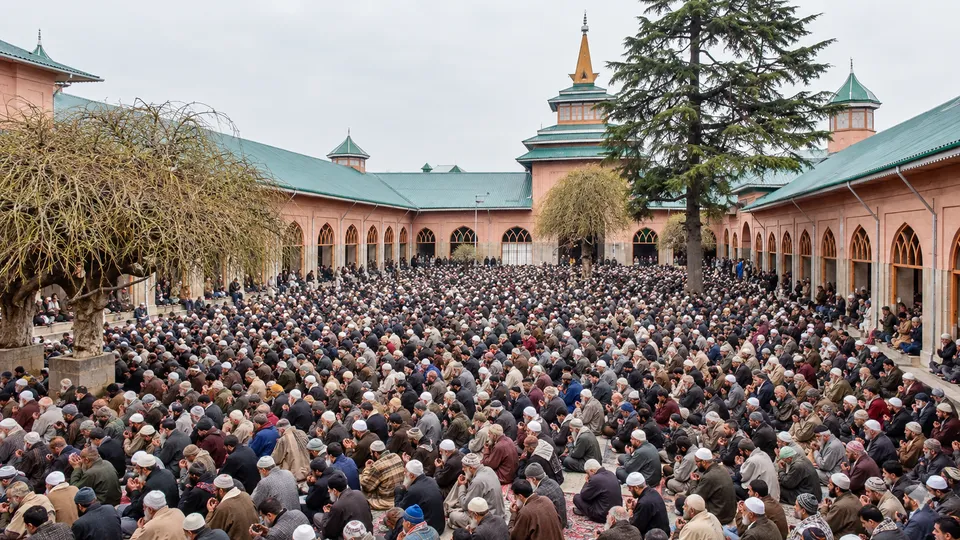
The government-backed Waqf Board in Indian-administered Kashmir backed away this week from a plan to impose identical Friday sermons at mosques across the region after Muslim scholars and politicians accused it of meddling in their religious affairs.
The Jammu and Kashmir Waqf Board announced the proposal last weekend, and on Sunday summoned about 1,500 scholars and preachers to a meeting, some attending in person and others joining from remote districts by video, Al Jazeera reported. Under the plan, a committee of senior scholars would draft a single sermon to be read uniformly from mosque pulpits each Friday.
A scholar from the Rajouri district, about 180km (110 miles) from Srinagar, who attended online said the board’s head told them the decision was settled. He spoke on condition of anonymity, saying he feared reprisals from the authorities.
“When we objected, saying that we won’t adhere to the directives if the sermon was found to be violative of Islamic teachings, she brushed aside our concerns and didn’t let us speak,” he said. “She said that their decision was final as it had been four years in the making.” He said they were never told who would sit on the committee.

Darakshan Andrabi, the board’s head and a local leader of Prime Minister Narendra Modi’s Bharatiya Janata Party, defended the plan in an interview with an Indian newspaper. A committee formed under the board, she said, “will be solely responsible for identifying the issue regarding the uniform sermon,” a step she called necessary to confront social evils, including drug abuse. She told reporters that religious scholars alone would approve the sermons, with no role for government officials.
The BJP connection is what turned an administrative proposal into a political fight. Mr. Modi’s government stripped Jammu and Kashmir of its semi-autonomous status in 2019 and split it into two federally governed territories. The move also swept aside the region’s own rules on waqf, the charitable endowments Muslims maintain for communal welfare, and replaced them with India-wide laws that gave the federally controlled bureaucracy broad powers over local religious boards.
Nayeem Akhtar, a senior politician who served as education minister in the last elected government before the special status was revoked, said centralized sermons belonged to an era of sultans and caliphs. “Today, we are supposed to be living in a secular state,” he told Al Jazeera. “As long as he has an audience, every cleric has freedom to speak about any topic of his choice.”

“The board’s job is just managerial,” Mr. Akhtar added. “It is exceeding its remit by trying to preach or guide the clerics on how they must do their job. Can a Muslim political party in India ever dictate how a Hindu pujari must conduct prayers or how a Christian pastor must deliver a sermon on Sunday?”
On Tuesday, Mirwaiz Umar Farooq, the region’s top Muslim religious leader, warned that the move would amount to “direct interference.” The Mutahida Majlis-e-Ulema, a joint body of religious organizations he leads, said that “determining sermon content was the responsibility of Islamic scholars and not of an administrative body.” Omar Abdullah, the region’s elected chief minister, joined the condemnation.
Ms. Andrabi then retracted her statement, saying it would be left to the discretion of “independent scholars, preachers (and) sermonists” to address problems such as rising suicides, mental trauma and substance abuse.
Kashmiri leaders said the episode fit a pattern. In January, police distributed a four-page form titled “profiling of mosques” seeking details, including biometric information, about imams and preachers across the region. Srinagar’s 600-year-old Jamia Masjid is often closed for Eid prayers and for Laylat al-Qadr, the most revered night of the Islamic calendar; the administration says the restrictions keep the peace, while religious leaders call them a “systematic assault on the religious identity, dignity, and fundamental rights” of Kashmiri Muslims.

Mr. Farooq himself has repeatedly been barred from travelling to deliver Friday sermons, including occasions when he was expected to speak on matters such as Israel’s genocide in Gaza, according to Al Jazeera. The board has also sought to end the distribution of yellow rice at major shrines, a centuries-old Sufi tradition, and in 2022 it banned voluntary nazr-o-niyaz donations to shrine attendants and caregivers, installing its own collection boxes instead.
Noor Ahmad Baba, a veteran political scientist and historian, told Al Jazeera that religion has long been a channel for political mobilization in Kashmir, so tampering with religious practice reads as politics. “The kind of political dispensation that we have and the kind of politics it has had with regard to Muslims is what makes the whole exercise suspicious,” he said. “If the standardisation had come, for instance, from clerics with public acceptability, it wouldn’t have become an issue. No one can deny the need for religious leaders to talk about topics such as drug addiction, late marriages, climate change, social harmony and more.”
A Srinagar-based political analyst who has written about the Kashmir conflict for four decades said such decisions reflected attempts to pre-emptively contain protests in the region amid the rising wave of Hindu nationalism in India.