
In October 2025, in an open-air market in Srinagar, a shopkeeper kept the real thing under the counter. Reporting for the BBC, Mir Seeneen describes how the man glanced towards the entrance before bringing out a small steel container wrapped in cloth. It held a few dark crimson strands. Then he pointed to a glass jar packed with brighter red threads. “Iranian saffron,” he said. “Many shops sell this now as Kashmiri. Most customers cannot tell the difference.”
Two jars. One name.
A crisis in the countryside often reaches the city first as a substitution: the genuine article goes into hiding and the counterfeit sits out in the light. To see what it is hiding from, you have to leave Srinagar for the plateau.
The plateau
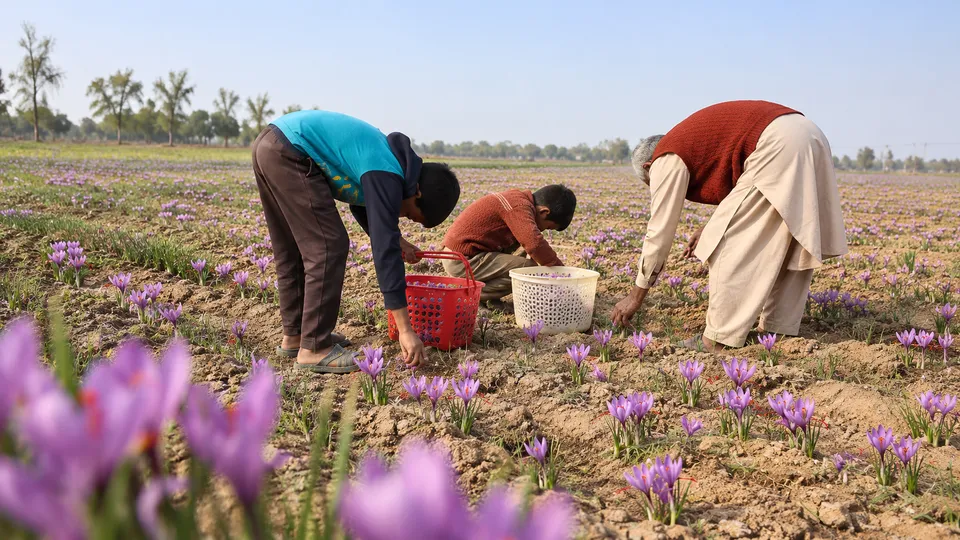
Past the apartment blocks and roadside shops lies the Karewa, a raised stretch of dry soil where the saffron crocus flowers each autumn. From mid-October to mid-November the fields should be purple. Families come out before sunrise with wicker baskets, and traders wait by the village roads for the morning’s harvest.
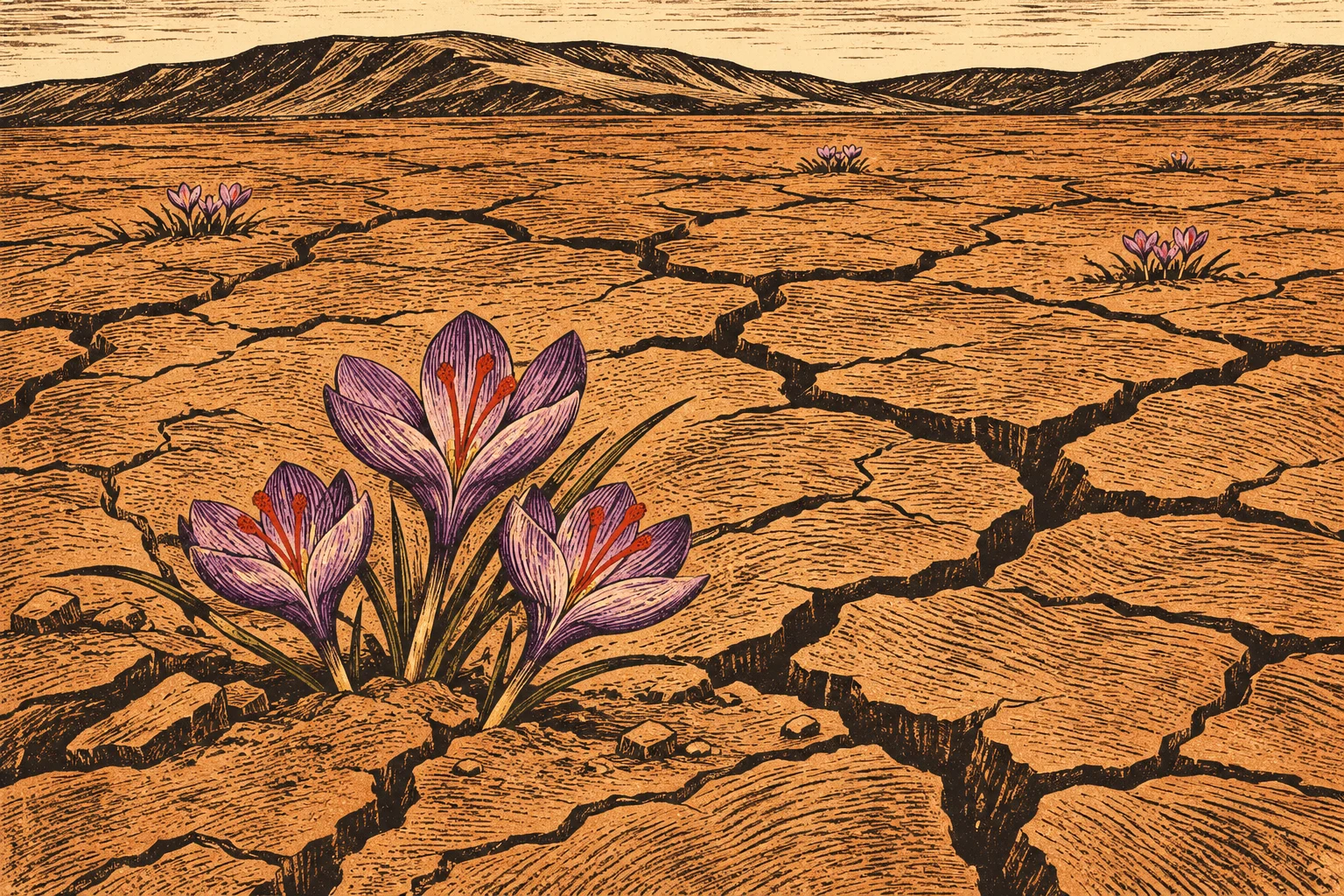
In Dussu village, Mohammad Asif farms land his family has worked for generations. That autumn the earth was cracked, the purple came in thin and uneven clusters, and parts of the field stayed bare. “We harvested nearly 250g (9oz) this year,” he said. In 2024 it had been close to 1.5kg, six times as much. “Saffron depends on timing. If rain does not arrive when the crop needs moisture, flowering suffers very quickly.”
The plant is Crocus sativus. Each bloom carries three crimson stigmas, picked by hand before sunrise, separated and dried over several hours. Roughly 4,000 flowers make a single ounce (28g), and the plant blooms for only two to four weeks a year. Kashmiri saffron is prized for its dark colour, thick stigmas and strong aroma, and researchers have found it unusually rich in crocin, the carotenoid behind the hue. It typically sells well above Iranian saffron, at $4 or more a gram.
In Pampore, families once planned household spending and marriages around the harvest. Whole neighbourhoods separated stigmas from flowers late into the evening over kettles of salted tea. The spice goes into wedding dishes and noon chai, traditional medicines and perfumes. Older residents remember autumn mornings when the plateau looked almost entirely purple.
Two sets of numbers
How far has it fallen? That depends on which office you ask. Indian government data cited by the BBC shows production across Kashmir and Jammu falling from eight tonnes in 2010-11 to 2.6 tonnes in 2023-24. The Jammu and Kashmir administration gives figures nearly ten times higher. In February 2026 it told the regional assembly that output stood at 23.53 metric tonnes in 2023-24 and 19.58 in 2024-25. Agriculture Minister Javid Ahmad Dar put the total at 90.28 metric tonnes between 2021 and 2025, most of it exported. The government also rejected claims made in the assembly that the 2025 harvest had shrunk to 5 percent of normal, and says the area under saffron has held at 3,715 hectares since 2010-11. None of these figures covers the dry autumn of 2025.
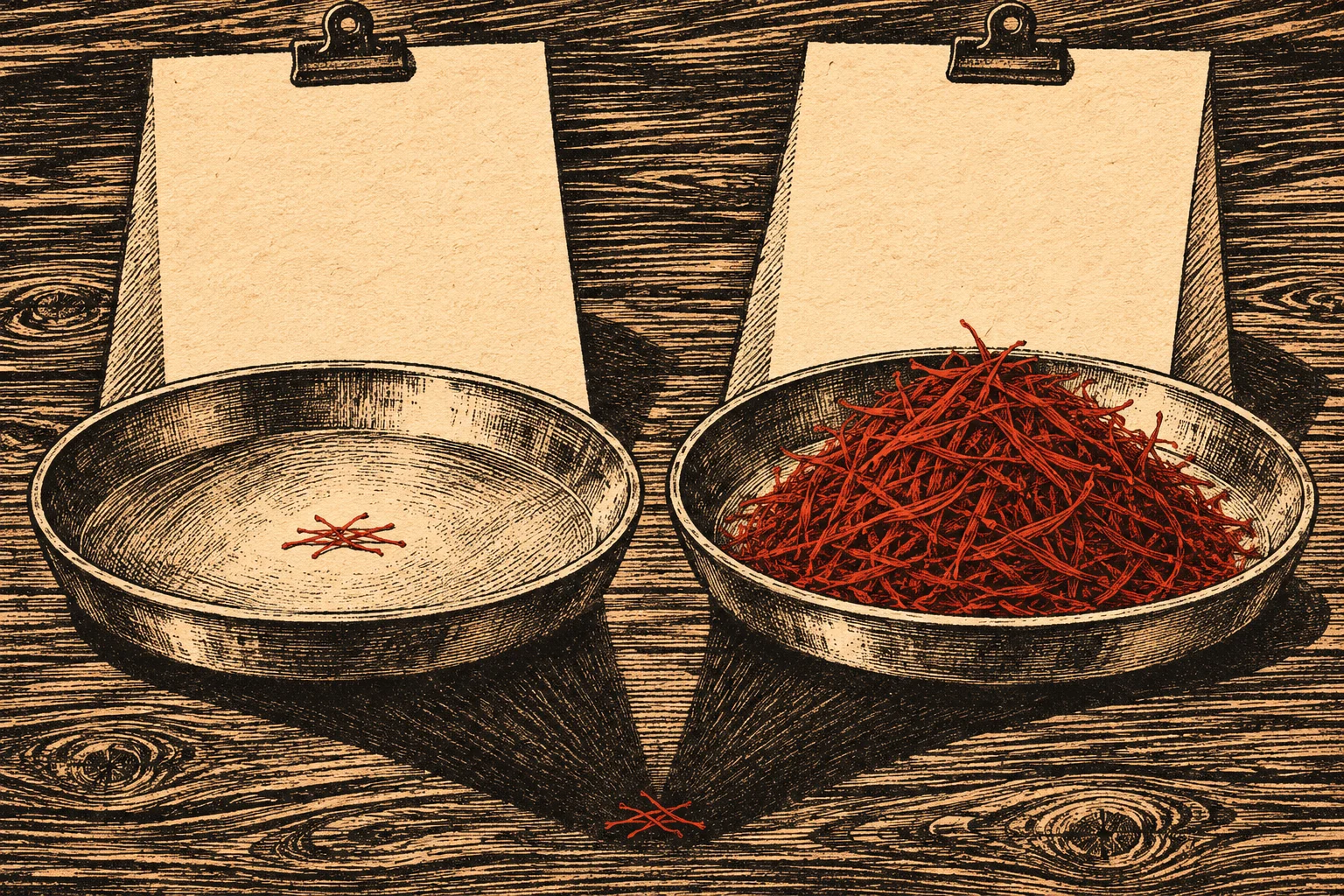
Governments everywhere prefer the number that flatters the programme. Growers in Pampore make a quieter point: as long as jars labelled “Kashmiri” stay full in the shops, nobody can see how little of the real crop is left.
Rain, snow and pumps
Studies have found that rain in August and September largely decides how well the crocus flowers and how its corm, the underground stem base, develops. Rabia Khan, an independent climate researcher and advocate in Kashmir, says that seasonal balance has grown increasingly unstable. Less snow in the western Himalayas and rising average temperatures linked to climate change are affecting water systems downstream.
The growers need no charts to see it. They describe winters that are milder and shorter, and streams once fed by snowmelt running thin earlier in the year. “Rainfall patterns changed a lot during recent years,” said grower Abdul Rashid Wani. “Today we depend heavily on pumps.”
New Delhi launched the National Saffron Mission in 2010 to improve irrigation, rejuvenate corms and raise yields, bringing borewells, sprinklers and scientific support to Pampore’s saffron belt. Some farmers say water reached their villages. Others describe broken pipelines, irregular supply and repairs that dragged on through the flowering weeks. India’s Department of Agriculture and Farmers Welfare did not respond to the BBC’s questions about these complaints.
Beneath the soil
In Dussu, Asif pointed to ground that porcupines had burrowed into. “They come at night and dig up the corms,” he said. “Sometimes we see the flowers are gone, but the real damage is underneath.” He said the attacks have grown more common, especially near settlements and scrubland. Other growers have put up makeshift barriers and taken turns keeping watch at night. Al Jazeera reported on the same pest in 2025.

Rats are the other enemy, and this one has municipal help. Down To Earth reported that a landfill near Patalbagh village, open since 2022, draws rodents that eat the sugary corms. Residents told the magazine that some 50 mini-trucks of fresh waste are dumped there every day.
The name that sells
In Delhi’s spice markets in January 2026, a trader explained how imported saffron arrives in bulk and is repackaged under Kashmiri labels. “Customers ask for Kashmiri saffron because the name sells,” he said. “Most cannot identify the difference once it is packed.” Other frauds include swapping in safflower or turmeric and adding hazardous dyes.
Shazia Malik, a food scientist who works on spice authentication at the J&K Food and Drugs Department, puts the cost plainly: “When imported saffron is blended or falsely labelled as Kashmiri, it weakens consumer confidence and affects farmer incomes.”
What the land is worth
Near Srinagar, the government horticulture scientist Neyaz Ahmad Dar grows saffron indoors, in rooms where humidity, temperature and light are controlled. “Controlled cultivation reduces climate-related risks,” he said in November 2025. “Our goal is to protect healthy corms and improve flowering consistency.” Researchers are also working on groundwater management, corm storage and soil-moisture monitoring.
“Every household depended on saffron,” said Habib Khan, an elderly resident of Konibal village. “Now many young people no longer see a future in it.”
What frightens the farmers most is not one bad harvest. A dry year passes. It is the construction spreading across the plateau, because once a field is built over, they say, saffron rarely comes back.