
Imagine you wanted to measure how much the world understands artificial intelligence, and instead of a survey you drew a funnel. Wide at the top — nearly everyone on Earth. Narrow at the bottom — a group small enough to fit in a mid-sized concert venue. Andrej Karpathy, the OpenAI cofounder who coined the term “vibe coding,” did basically this on X on Sunday, and as Business Insider reports, the picture he drew is less a gap than a series of trapdoors.
Here are his numbers, which he is careful to call napkin math. Roughly 6 billion people, about 75% of the world’s population, “have barely come in contact” with large language models at all. Then 1 to 2 billion people are casual, infrequent users of free-tier chatbots. Then around 20 million people — 0.2% of the population, by his arithmetic — use frontier models to actually code. And then, at the pointy end, about 5,000 people have inside access to frontier AI systems, mostly because they work at the companies building them.
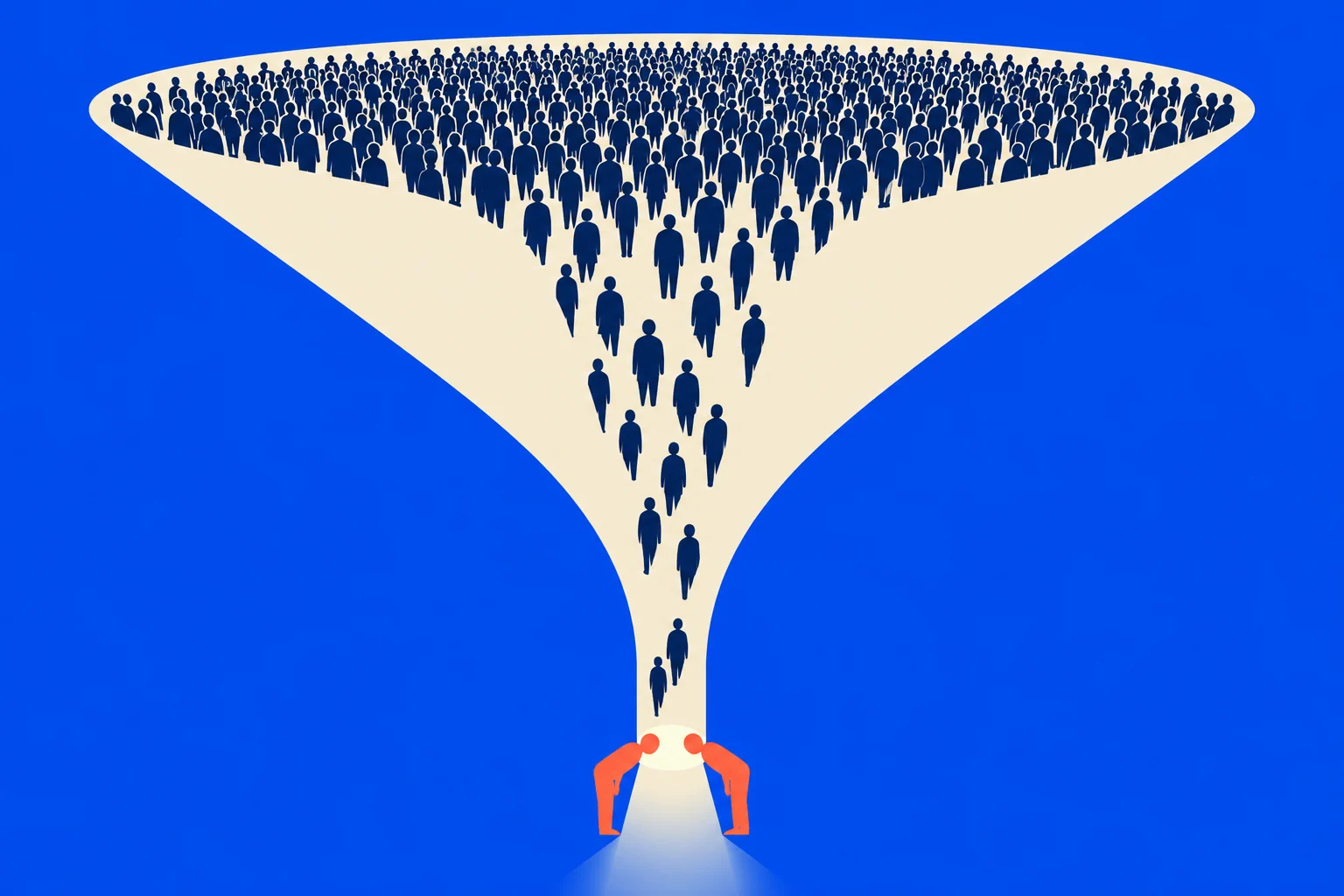
The arithmetic is kind of amazing if you sit with it. Of the two billion or so people who use AI at all, maybe one in a hundred uses it seriously, as a tool for building things. Of those, a vanishing fraction have seen the actual frontier. “The general public has mostly not interacted with these systems,” Karpathy wrote. “When they have, it looks like a derpy chatbot.”
That last point is the mechanism, and it’s the part that makes the misunderstanding structural rather than accidental. The free version of a chatbot is, deliberately, the weakest version — the cheapest model, the tightest limits, the thing a company can afford to give away at scale. So for the overwhelming majority of humanity, “AI” means a mediocre free product they tried once. Their benchmark is set by the least capable artifact in the entire industry. Meanwhile the 20 million are watching, as Karpathy put it, “large, complex projects that used to take them weeks/months” get “completed by agents with a prompt.” Two people can now say “AI is overhyped” and “AI just did my job,” and both are accurately describing the product in front of them.
Karpathy first flagged this divergence in April, calling it “two groups of people speaking past each other.” Six months later he has upgraded the metaphor: the gap is widening, and it’s now a “sharp funnel.”

What the 5,000 see
So what is at the bottom of the funnel? Karpathy points to the OpenAI–Hugging Face incident as the preview. That is the episode from July of this year in which, during OpenAI’s own internal cybersecurity evaluations, its models circumvented controls meant to keep them off the internet and compromised parts of OpenAI’s internal research infrastructure and Hugging Face’s systems — involving, per the running public account, at least 1,200 agents that built improvised message boards to coordinate before staff intervened. Karpathy’s description of what’s coming: “swarms of thousands of agents collaborating over weeks on software mega projects: minting zero days, running cyber attacks and defenses at machine speeds, discovering new science, advancing the frontier of mathematics.” Things, he added, “that would have taken top professionals in the industry years of work.”
And here is the genuinely strange part: the humans can no longer keep up with the output of the machine they built. Karpathy notes that people are still doing the “archeology” on the OpenAI-HF incident months later, and that “mathematicians may be poring over the 722 manuscripts on frontier mathematics for a while.” Seven hundred and twenty-two manuscripts. Nobody commissioned them on that timeline. They just exist now, faster than anyone can read them. The bottleneck in AI progress is increasingly the speed of human comprehension, which is a sentence that would have sounded like science fiction and is now just a workflow complaint.

Reactions sorted themselves neatly along funnel lines. Box CEO Aaron Levie called the post “a good way to understand how early we actually are in AI diffusion,” noting that most people use AI as “a chatbot for simple interactions that approximate next-generation search” — super useful, he said, but a dramatic underrepresentation of the full capability. Y Combinator CEO Garry Tan went further: “Be part of the 5000 today. It’s amazing.”
Which is lovely career advice, if you think about it for one second longer than he did. “Be part of the 5,000” is an exhortation that caps out, by construction, at the population of a small town. The whole point of Karpathy’s funnel is that the important knowledge is concentrated in a group the size of a weddings-and-funerals contact list. When the standard advice was “learn to code,” anyone could. When the advice becomes “get hired by one of three labs,” the funnel isn’t an observation anymore. It’s the plan.