
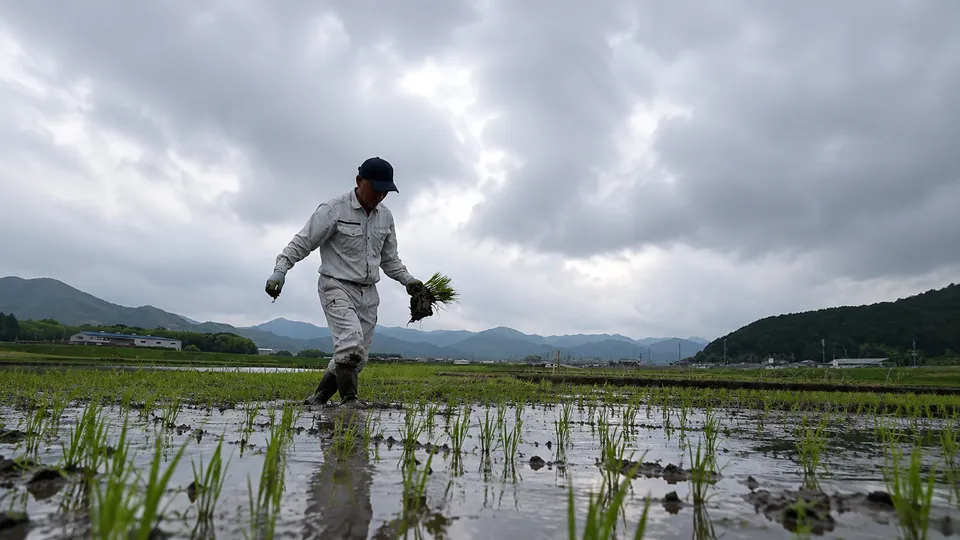
In 2023, extreme heat and drought damaged Japan’s rice crop during the grain-filling stage, which is the part of the growing season where the rice becomes rice. A year later the damage had become a national shortage severe enough that, according to Fortune, a government minister lost his job over it. And by 2026 the pendulum had swung so far the other way that Japan was sitting on a record surplus, and the government was buying 210,000 tons of rice back off the market this month to keep prices from collapsing and to refill its own reserves. How do you get from one to the other in two years?
Even the people paid to know are a little stunned. “Every expert is actually surprised by this fluctuation,” Ryosuke Inoue, a visiting fellow at the CSIS Japan Chair and a specialist in Japanese agricultural policy, told Fortune. His view is that the underlying imbalance was never that dramatic — “The supply-demand gap was there, but it’s not such a huge gap. It could happen, and it could happen also in the United States. But in the U.S., the price fluctuation is not so high.” Which is the interesting part: small gap, enormous price swing. Something about the plumbing turned a modest shortage into a doubling of prices, and then a doubling of prices into an overproduction crisis.
The shortage half is easy enough to follow. The 2023 heat cut the share of the crop graded as sellable, top-grade rice. Meanwhile a tourism boom and some panic buying after an earthquake warning pushed demand up. Private rice stocks fell from a normal range of about 2 million tons to roughly 1.5 million tons, and by Inoue’s data a five-kilogram bag went from about ¥2,000 ($13) in early 2024 to a peak of ¥4,300 ($27) by 2025. The government dipped into its emergency rice reserves for the first time since the reserve system was created in 1995 — reserves meant for natural disasters — and caught flak for the timing. “People said the government should have released the rice much more quickly,” Inoue said.
The surplus half is where human incentives take over. Farmers looked at rice that had more than doubled in price and did what anyone does when the thing they make doubles in price: they made much more of it. Supply overshot demand so thoroughly that private stocks climbed back to 2.43 million tons by mid-2026 — above the normal range, not back to it — and the agriculture ministry is forecasting an even bigger surplus heading into 2027. Prices have fallen to around ¥3,300 ($21) for five kilograms and, on Inoue’s estimate, could slide back to 2022 and 2023 levels or lower. The government that released reserves in 2025 is buying rice in 2026.
Inoue’s explanation for the violence of the swing is partly that Japan’s rice market doesn’t have much of a shock absorber, and partly that nobody — including the regulator — can actually see through it. Asked whether the stockpiles lacked a buffer, he said, “Your instinct is correct,” and added: “Many distributors are trying to maximize their profit, and even the government doesn’t know how the rice was distributed from the farmers to the final consumers.” At the moment prices were spiking, he said, regulators didn’t understand their own market’s structure well enough to respond quickly. That is a remarkable sentence about the staple food of a G7 economy.
Then the shortage wandered into a trade war. Japan grows nearly all the rice it eats and exports almost none, so in June 2025, mid-shortage, President Trump complained that Japan “won’t take our rice, and yet they have a massive rice shortage.” Japan did already import rice under a WTO-mandated duty-free quota of 770,000 tons a year, roughly half of it historically American. But a 2025 U.S.-Japan trade deal pushed Japan to increase its U.S. rice purchases by 75%, an increase Inoue says is still working through the system: “This trend will continue in 2026 and further.” A country whose rice politics exist to protect its farmers ended up buying more American rice at the precise moment the shortage made resistance impossible — and just before the surplus arrived.
Underneath all of this is a farm sector that is, demographically speaking, retiring. The average Japanese rice farmer is 67.7 years old, and 1.2% are under 30. Japan has some 500,000 rice farms spread across 3.4 million acres — about 6.8 acres each — while California, a major U.S. rice region, has roughly 1,100 farms working about 512,000 acres, or more than 460 acres apiece. Inoue says the shrinking headcount matters less than the land it leaves behind: “The problem is how to take over the land that was cultivated by them,” since much of Japan’s rice farming happens on mountainous terrain that doesn’t attract new operators, and abandoned land is extremely hard to return to production.
His proposed fix is imported, appropriately, from America: a version of the U.S. Price Loss Coverage program that would pay farmers only when prices fall below a level covering production costs, which he pegs at around ¥2,800 ($18) per five kilograms. Japan tried something similar in 2011 and abandoned it after a change of government, before prices ever dropped far enough to trigger it. “I think now is the time,” he said — the argument being that a market with a floor under it beats production caps and the boom-and-bust they keep producing.
Meanwhile the thing causing the shocks is not going away. This year’s drought across western Japan has drawn comparisons from some meteorologists to the country’s worst in more than 30 years, with official data already tying it to yield declines. Summer temperatures ran above their long-term trend from 2023 through 2025, and farmers are shifting toward heat-tolerant varieties, though those still account for under 20% of plantings. Which leaves Japan where it started, more or less: a market that converts modest weather problems into enormous price signals, and a farm population that responds to those signals a full growing season late.
The reserves got refilled, at least. Whether anyone has figured out where the rice goes after that is apparently still an open question at the ministry.