
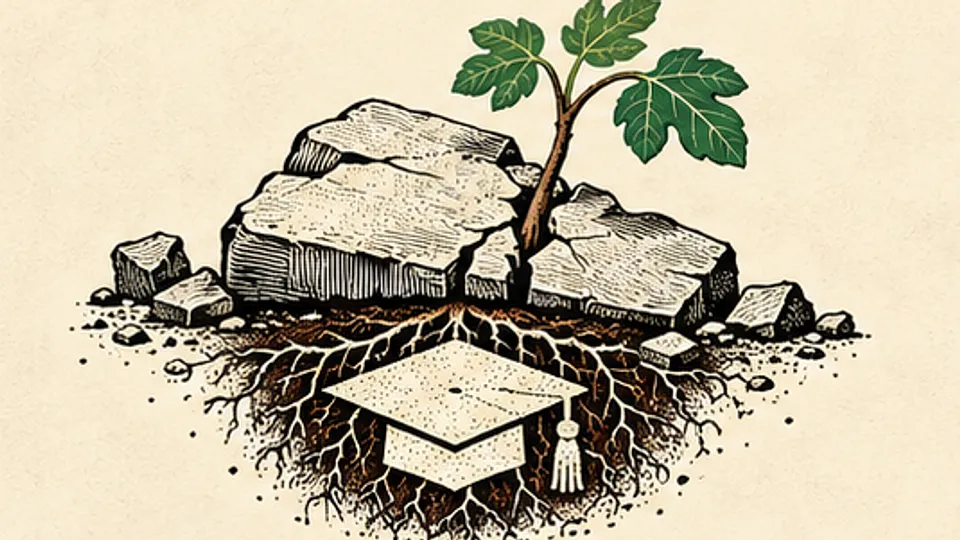
Thirty-eight names were carved into the stone memorial at Birzeit University, students and alumni killed by Israeli forces or settlers. Early Monday, Israeli soldiers raided the campus near Ramallah, demolished the monument, and planted a fig sapling in its place, with a message to water it twice. It was the fifth Israeli military incursion into the campus since the start of 2026, Fayha Shalash reported for Al Jazeera. The university condemned the destruction of the Martyrs’ Monument as a violation of international law and an attack on education and national memory.
For Rania Washaha, 47, the demolition repeated the shape of a loss already five years old. Her brother Fadi, 34, was shot in the head by an Israeli soldier near el-Bireh’s northern entrance in May 2021. A memorial is a durable object; that is its purpose. Demolishing it and substituting a seedling that requires ongoing maintenance inverts the accounting: the monument lasted, the replacement is conditional.
The toll underneath the symbolism
The memorial’s demolition is a small line item in a much larger ledger. According to OCHA figures cited by UNRWA, between 7 October 2023 and 20 December 2025, 1,043 Palestinians, at least 229 of them children, were killed in the occupied West Bank including East Jerusalem. That average works out to roughly 40 deaths a month over more than two years, a pace with no equivalent in the territory since the second intifada. The three years since October 2023, Al Jazeera has reported, have also seen escalating Israeli violence and discrimination against West Bank Palestinians.
The week of the memorial’s demolition kept pace with that average. On Monday, troops opened fire on a vehicle carrying three Palestinians near Bani Naim, east of Hebron, killing one and seriously injuring two, according to Palestinian officials; the Israeli military said the car had rammed one of its vehicles, Al Jazeera reported. The two accounts differ, and the vehicle itself would settle it; no independent inspection was reported.
On Wednesday, during the olive harvest, settlers attacked Palestinians picking on farmland near Burqa, west of Nablus, in what Palestinian authorities described as an assault conducted under the protection of Israeli forces. Ali Hassan Yasser al-Bazzari, 44, from Burqa, was killed and 16 others were wounded, the Palestinian Ministry of Health said, per Al Jazeera. The October harvest has for years concentrated settler attacks, because the olives are both the crop and the claim to the land.
The method, stated at the lectern
The dispossession is not incidental to the violence; it is announced. On September 23, weeks before Israel’s parliamentary elections, ministers and lawmakers inaugurated a new settlement, Metzoke Eretz, on a West Bank hilltop. It is illegal under international law, as all Israeli settlements in the occupied territory are. At the ceremony, Finance Minister Bezalel Smotrich praised the outpost from which the settlement grew:
The first pioneering settlers who were here on the farm… we will lift them up as our greatest joy. It shows that the method works: establish a farm, seize the land, prepare it, turn it into a community, move to the next point. There are many, many such heroes – those who prove they are not doing real estate. They are doing Zionism.
The method Smotrich describes is a serial process, and the displacement data measure its throughput. Between January 2023 and 16 February 2026, OCHA documented 883 Palestinian households, 4,765 people, displaced across 97 communities and areas by settler violence incidents, most of them Bedouin. Bedouin families, Al Jazeera reported from al-Awsaj, describe the same thing from the receiving end: a state-backed project of forced transfer.
Demolitions add a second channel. In one week this September, demolition orders displaced 147 Palestinians, more than three times the 2026 weekly average, including 58 people among the South Anata Bedouin. Settler assaults drive families off; bulldozers remove what they leave; a farm appears, then a checkpoint, then a community with a regional-planning file.
An election, then the next point
The timing binds the pieces together. A settlement inaugurated with cabinet ministers in September. A university memorial razed in October, days before voters go to the polls. A shooting near Hebron whose two versions will likely never be reconciled. One olive harvester dead and 16 wounded, in an attack where the soldiers’ role, in the Palestinian authorities’ telling, was escort duty for the attackers.
The fig sapling at Birzeit is the rare case where the message is written down: the stone that said 38 people were killed is gone, and what stands in its place lives only if the university waters it. Whether it does, and whether the names are recarved after the election, is the number to watch at Birzeit. In the wider territory the count is already moving: OCHA’s running tally of killed and displaced updates weekly, and the election result will set the rate at which Smotrich’s method moves to its next point.