
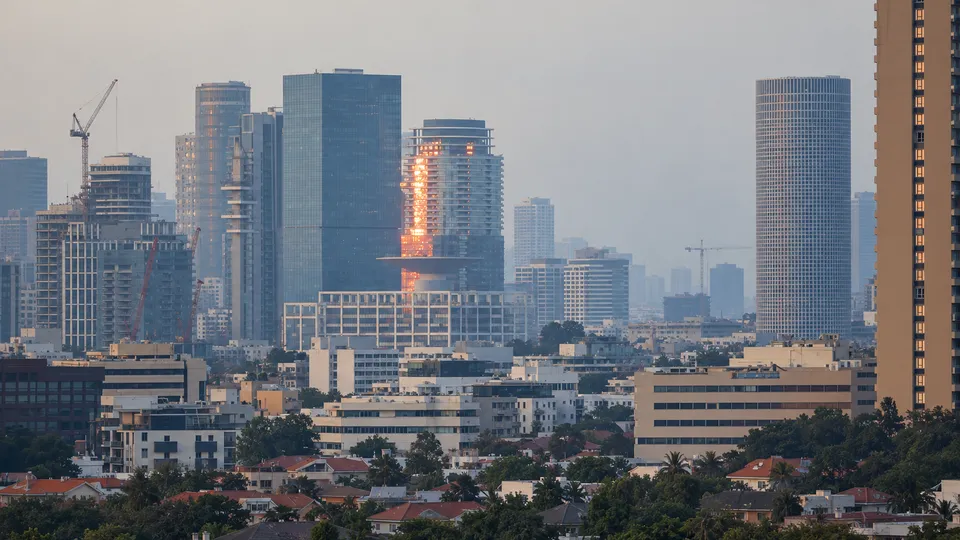
Here is a puzzle. Israel has been fighting for three years on fronts spanning Gaza, Lebanon, Syria, Iraq, Iran and Yemen, and it holds a Knesset election on October 27. You would expect the economy to be in bad shape. Instead, as John Power reports for Al Jazeera, it is flourishing by most headline measures. Government figures show GDP growing 1 percent in 2024, 2.9 percent in 2025 and 3.2 percent in the first half of this year. The Bank of Israel’s July staff forecast has 4 percent for 2026 and 5.5 percent for 2027, well ahead of the outlooks for the US, the UK, France, Canada and Japan. Unemployment is 2.8 percent. Inflation is 1.5 percent. The shekel hit a three-decade high against the dollar in May, and the benchmark TA-125 is up more than 110 percent over three years, so it has more than doubled.
Sure. But where is the money coming from?
Mostly from tech, which drives about a fifth of economic activity and has been largely insulated from the fighting while the world spends frantically on artificial intelligence. Foreign direct investment hit a record $26.2bn last year, up 78 percent from 2024, which puts 2024 at roughly $14.7bn. The jump came largely from two record-breaking deals: Alphabet buying the cybersecurity company Wiz and Palo Alto Networks buying CyberArk. Then government figures put inflows at a quarterly record of $14.1bn in January to March of this year, which is about as much in three months as the whole of 2024. The war also turns up on the revenue side: the defence sector has stepped up orders from hundreds of startups making radar systems, communications platforms and anti-drone technology. The war is a cost to the state, and the state is a customer of the startups.
Keren Uziyel, a senior Middle East and Africa analyst at the Economist Intelligence Unit, called it primarily an “export-driven story that reflects strong global technology demand, particularly in areas where Israel – and multinational firms operating from Israel – is globally competitive, such as cybersecurity and artificial intelligence.” And: “Interest in Israel’s technology goods and services is driving high levels of FDI and venture capital fundraising, and boosting the capital markets, which in turn is having significant wealth effects and boosting government revenue.”
Translated: when a US tech giant pays a huge sum for an Israeli company, Israeli founders, employees and shareholders get rich. They pay tax and spend money, and the stock market goes up. None of that depends very much on what happens in southern Lebanon. The things that do depend on southern Lebanon end up on a different ledger.
The other ledger
In March the Bank of Israel estimated the war’s cost to date at about 350 billion shekels ($114.6bn). That figure left out the Iran war, which had only just started. Prime Minister Benjamin Netanyahu, whose right-wing coalition calls security “the foundation of everything else”, has pushed to raise the annual defence budget to 183 billion shekels ($60bn), or roughly 9 percent of GDP. If it passes, military spending would be two and a half times its level before October 7, which implies a pre-war budget of around 73 billion shekels. And if 183 billion is about 9 percent of GDP, then GDP is about 2 trillion shekels, so the war bill through March came to roughly a sixth of a year’s output before Iran was even counted. The outgoing opposition leader, Yair Lapid, supports a bigger defence budget but has clashed with Netanyahu over how to pay for it. So the real fiscal argument is not about whether to spend the money. It is about who pays.
Debt is about 68 percent of GDP, far below the US, the UK, France and Italy. The July forecast expects it to settle around 69 percent, with deficits of 4.9 percent of GDP this year and 4.2 percent next. Still, the gap between revenue and spending has widened fast, and in its latest annual report the central bank said it was “essential” for the government to “restore orderly budgetary processes” and take “credible measures” to bring debt down. When a central bank asks for orderly budgetary processes, it is telling you the current ones are not orderly. Omer Moav, an economist at the University of Warwick and Reichman University, said: “Deficits and national debt have expanded significantly, making current spending trajectories unsustainable without fiscal consolidation. The next government is facing a huge challenge.”
Fine print
Population growth has averaged nearly 2 percent a year over the past decade, which flatters the growth figures. Per person, the economy has grown more slowly than the headline suggests. The Bank of Israel also estimates the accumulated loss of output through the end of 2025 at 8.6 percent of annual GDP, and it expects output to stay below its pre-war trend even at the end of 2027. Joseph Zeira of the Hebrew University of Jerusalem said performance has “not been great at all” given that growth has trailed the pre-conflict trend since late 2023. Israelis, he said, face “higher prices, or rather lower real wages and incomes” and deteriorating public services. “The only improvement is some decline in housing prices due to a vast wave of construction in recent years.”
Voters, meanwhile, are thinking about groceries. In an Israel Democracy Institute poll released last month, 38 percent of Jewish Israelis and 46 percent of Palestinian citizens of Israel, who make up about a fifth of the population, named the economy and cost of living as their first or second most important issue. Israel has long ranked among the most expensive countries in the OECD, which economists attribute to limited trade with its neighbours and cumbersome regulation. According to the consumer group Lobby 99, food prices rose 8 percent between the start of 2024 and mid-2026. Headline inflation of 1.5 percent is an average, and people buy food every week.
The campaign has nonetheless been about security, with Netanyahu of Likud and the retired general Gadi Eisenkot, who leads the centrist Yashar, each claiming to be the one who can keep Israelis safe. In September the Times of Israel asked why the candidates barely mention economic anxiety. Ayal Kimhi of the Shoresh Institution in Tel Aviv said people worry less about the macroeconomy than about “their personal perspectives, especially cost of living,” but expects security to dominate the vote. “Some parties do not even bother presenting a vision or an agenda,” he said. “Other parties do not differ much about economic issues.” Longer-term problems are waiting too: low employment among ultra-Orthodox men, whose refusal to do military service has become a major election issue, and among Arab women.
Everything depends on the fighting. The Bank of Israel’s forecast assumed no more war with Iran, citing the memorandum of understanding between the US and Iran. The IMF is more cautious and has cut its 2026 forecast to 3.5 percent. Uziyel expects about 4 percent this year and more in 2027, with “significant downside risks to growth” if conflicts in Gaza, Iran or Lebanon resume. Kimhi said: “If we are able to put an end to the war and reduce military spending, the future could be bright.”
That is a sensible condition. The proposed defence budget, at two and a half times its pre-war size, goes the other way.