
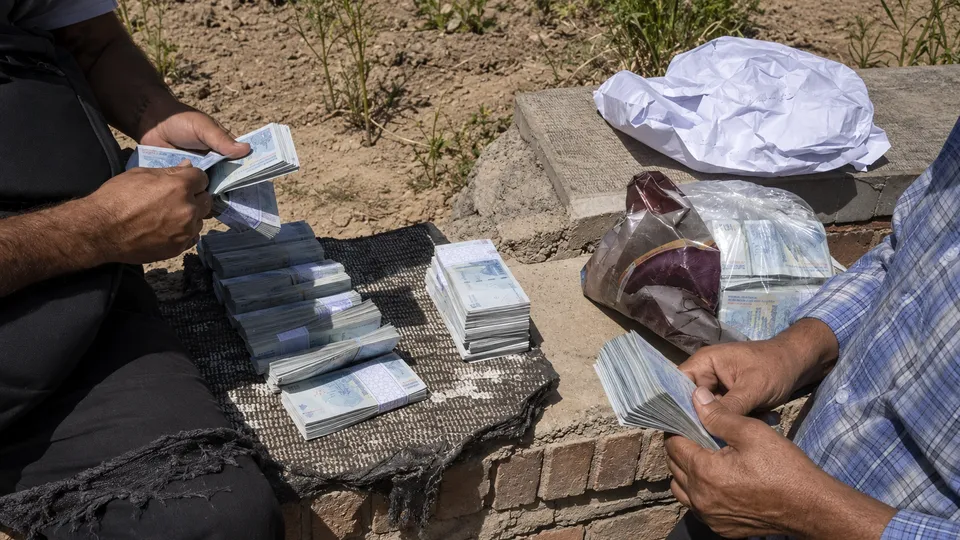
Iran’s currency tumbled to a record low on Tuesday, with the rial trading above 2.5 million to the dollar in Tehran as a U.S. naval blockade wiped out the oil exports that long supplied the government with hard currency.
The drop came less than a month after the rial hit its previous record of 2.2 million on Sept. 2. The rate was near 1.5 million at the start of the year and about 920,000 in August 2025, a slide of roughly 170 percent since then. The rial began 2018 at 35,000 to the dollar.
Iran loaded no oil at its export terminals last month, the first time that has happened since the 1979 Islamic revolution, according to Homayoun Falakshahi, head of crude oil analysis at Kpler. Tehran still draws a trickle of revenue from an estimated 90 million barrels that were at sea before the United States reimposed its blockade in mid-July, but Kpler says those cargoes, bound mostly for China, run out by mid-October, with payments stretching into December. Oil sales ordinarily cover about a third of the state budget and help fund the Islamic Revolutionary Guard Corps.
Inflation is near 90 percent, the economy is expected to shrink 5.4 percent this year, unemployment has jumped and energy is being rationed. Supreme Leader Ayatollah Mojtaba Khamenei has voiced concern about “social cohesion.” A currency collapse late last year set off protests that were put down in a crackdown early this year, and since the United States and Israel attacked on Feb. 28, the rial has only fallen further.
Washington tightened sanctions again last month. “We can’t even get our own money out of a country to which we’ve supplied goods,” President Masoud Pezeshkian said in a Fox News interview last week, describing funds blocked in China. President Trump has rejected Tehran’s attempts to restart talks, and Secretary of State Marco Rubio told Fox News on Monday that Iran was heading toward an economic “cataclysm.”
In Tehran, Mohammad Bagher Ghalibaf, the parliament speaker and top negotiator, said on Sunday that the Strait of Hormuz would not open until Iran’s seven conditions under the Islamabad Memorandum are met, the state-linked agency Nournews reported. The demands include a halt to U.S. “acts of aggression,” an end to the blockade and economic warfare, and the release of Iranian assets; Washington’s central demand remains that Iran dismantle its nuclear program. The memorandum, an interim deal Mr. Trump and Mr. Pezeshkian signed in June, produced a brief pause in fighting. Nournews said Washington had made “some proposals through a mediator” days earlier. “Iran will not regulate its national security with tweets from American officials,” Mr. Ghalibaf said.
Shipping is paying for the standoff. A crude tanker was hit by an unknown projectile four nautical miles east of Oman on Saturday, and a second tanker was struck in the strait on Sunday, damaging its engine room, the U.K. Maritime Trade Operations center reported. Attacks have occurred regularly for weeks on a waterway that carried about a fifth of the world’s oil before the war.
Yemen’s Houthi movement said on Saturday that it had fired ballistic missiles and drones at an Aramco facility in Riyadh in retaliation for Saudi strikes on Sanaa, and a witness told Reuters that smoke and flames rose over the site. Saudi authorities did not comment, and Aramco did not respond to CNBC’s request for comment.
The seven core OPEC+ producers, led by Saudi Arabia and Russia, kept November output targets unchanged at an online meeting on Sunday. Gulf members have been pumping well below quota, with exports at 60 to 80 percent of normal, and the seven produced 25 million barrels a day in August, still about 5 million below prewar levels, OPEC data show. “The oil market remains tight,” said Giovanni Staunovo, a UBS analyst. The Group of 7 said it would release 100 million barrels of reserves over four months, with diesel coming first; Brent settled on Friday at $102.25 a barrel, down 6 cents, but up from about $73 before the war. The seven meet next on Nov. 1.
Iraq, squeezed by the same chokepoint, had its state tanker company load a supertanker with 2 million barrels and send it through the strait “for the first time in decades,” its director general, Ali Qais Abdul Jabbar, said in video posted on the Oil Ministry’s Facebook page, delivering crude beyond the Gulf rather than leaving buyers to brave Hormuz. Iraqi exports averaged about 2.6 million barrels a day through Sept. 21, up from 2 million in August but below the 3.3 million to 3.5 million shipped before the war, the ministry said.
Farther from the front, the Pentagon said on Sunday that all American bombers deployed to RAF Fairford in Britain, a dozen B-1s used in strikes on Iran, had returned to their home stations. Five British men had been arrested near the base on Sept. 27 on suspicion of explosives and terrorism offenses and released on bail; a 25-year-old dual British-Iranian national was arrested in London on Thursday and bailed on Saturday. Prime Minister Andy Burnham said Britain had “strong indications” of Iranian involvement. Tehran called the accusations baseless and summoned the British ambassador. The Wall Street Journal first reported the withdrawal.