
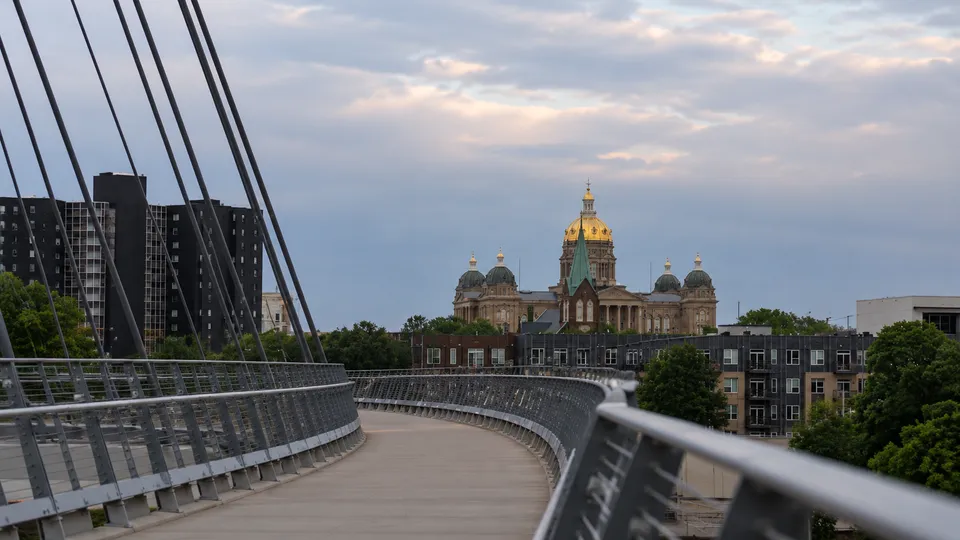
On Monday, President Trump announced that the largest steel plant in American history would be built in Iowa — a $15 billion facility promising 1,750 permanent jobs and about 6,000 construction jobs. Commerce Secretary Howard Lutnick told reporters at the White House that “the deal is done.” This was news to, among other people, the Iowa lawmakers who would have to pay for a large chunk of it, who had at that point received neither details of the deal nor a schedule for reviewing it. By Friday, the Iowa legislature had held a one-day special session and handed Mesabi Metallics, owned by the Indian conglomerate Essar Group, $1.36 billion in tax incentives over ten years. The House passed it 75-17, the Senate 28-19, and Gov. Kim Reynolds signed it Friday night. Protesters at the statehouse carried signs reading “No Steel Steal!” Early voting in Iowa starts October 14.
Sit with that sequence for a second, because the sequence is the story. When we wrote about the announcement itself a few days ago, the question was who this company is. This week’s question is why everything had to happen this week, and the answer is roughly the shape of Iowa’s 1st congressional district.
Start with the arithmetic, which both sides of the debate agree on and disagree about. Take $1.36 billion and divide by 1,750 permanent jobs and you get about $777,000 in tax credits per permanent job, spread over ten years. Supporters of the deal argue that this math is unfair because it ignores the roughly 6,000 construction jobs. Opponents reply that construction jobs are temporary, which is true almost by definition, and that the state will be paying permanent-job money for a jobs figure that mostly evaporates when the cranes leave. One way to put it: Iowa is buying 1,750 jobs and renting 6,000.
Why Iowa, specifically
Iowa is not a steel state. It has a couple of scrap-fed steel mills, much smaller than what Mesabi is promising, and no commercial iron ore of its own. Mesabi is based in Minnesota, and its pitch is that Iowa sits conveniently downriver on the Mississippi. Fine. But it is worth noting what else Iowa has that Minnesota doesn’t: one of the tightest congressional races in the country, plus competitive Senate and governor’s races. The plant would sit in the 1st district, where Republican Rep. Mariannette Miller-Meeks is defending one of the GOP’s most endangered seats — she won her 2024 recount against Democrat Christina Bohannan by 798 votes — and Sabato’s Crystal Ball moved the race from “toss up” to “leans Democratic” just before the steel announcement landed. A $15 billion factory and 6,000 construction jobs, real or otherwise, is the sort of thing an incumbent congresswoman might enjoy mentioning between now and November.
Then there is the company. Essar announced a $1.6 billion iron ore mine and steel plant in Nashwauk, Minnesota, back in 2008, promising more than 700 permanent jobs. The steel mill plans were dropped in 2015; Essar Steel Minnesota filed for bankruptcy in 2016; the project was renamed Mesabi Metallics under new owners and eventually returned to Essar’s control. Essar has also received billions of dollars in loans from VTB, the Russian state-owned bank, according to local media reports that CBS News notes it has not independently verified. None of this means the Iowa plant won’t happen. It means that a state paying $777,000 per promised job might reasonably want a weekend to read the paperwork. It got a day.
The extortion works
The most honest summary of the special session came from Republican State Sen. Kevin Alons, who told the Des Moines Register before Friday’s vote that lawmakers needed more time. “The political extortion is breathtaking,” he said. Then he voted for it. That is not hypocrisy so much as a demonstration of how the mechanism functions: when a president announces a factory in your district before an election, the cost of saying no is immediate and the cost of saying yes is due sometime after 2030, which is when Mesabi says the plant might start operating. The tax credits don’t even kick in until the plant is running, which is the closest thing the deal has to a safeguard. Other Republicans resisted differently. State Sen. Dave Sires voted no over the rushed process; State Sen. Dan Dawson called it the “largest corporate giveaway in the state of Iowa’s history”; State Sen. Jeff Taylor raised concerns about an existing budget crunch and was swapped off the Senate Ways and Means Committee at the last minute so the bill could clear it, 10-8, with six Republican senators voting no.
Republican gubernatorial candidate Zach Lahn, who has campaigned against corporate handouts, supported this one as a “once in a lifetime” exception — corporate handouts being bad in general but presumably election-sensitive ones being special. Democrats, meanwhile, tried to oppose the rush without opposing the jobs. Rob Sand, the state auditor and Democratic nominee for governor, called the plant “a promising idea for Lee County” but wanted details, pointing to recent data-center deals: “we gave away the farm... I want to make sure this is a real opportunity, but also at the end of the day Iowa is getting served by it and not getting fleeced.” Senate Democratic Leader Janice Weiner told CBS News the deal should have waited: “If it’s a good deal now, it will be a good deal in January when due diligence has been done.” That sentence is the whole case against the timeline, and it is also exactly why the timeline was the timeline.
Everyone in Iowa is haunted by the same ghost. In 2017, Trump and Foxconn promised a $10 billion plant and 13,000 jobs in Wisconsin; by 2021 the project had been scaled back to $672 million and 1,454 jobs, and Gov. Scott Walker, the deal’s champion, had lost his 2018 reelection bid as public support curdled. The Foxconn lesson is usually told as a warning to officials who take the check. But there is a second lesson, less often stated: the announcement works politically even when the factory doesn’t. Walker lost, but the jobs promise was a real campaign asset while it lasted, which was precisely as long as it needed to be.
Democratic State Rep. Dave Jacoby voted yes “with the hope that this plan is real,” while cautioning that “today is not a ribbon cutting.” Right. The ribbon cutting, if there is one, is years away and conditional on everything going well for a company whose last attempt ended in bankruptcy court. The votes, on the other hand, start getting counted in eleven days. The steel mill is a bet about 2030. The legislature’s part of the transaction settles this November.