
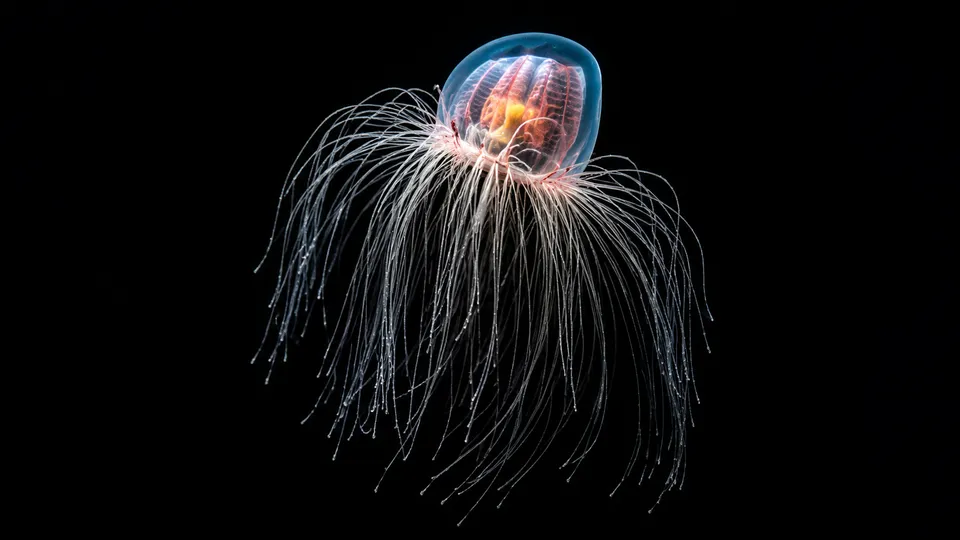
Turritopsis dohrnii, a jellyfish small enough that researchers call it ant-sized, carries roughly twice as many copies of DNA-repair genes as the closest relative that cannot do what it does, according to a 2022 whole-genome comparison published in PNAS. What T. dohrnii does, and its cousin Turritopsis rubra apparently does not, is revert from a sexually mature adult back into a juvenile polyp and restart its life cycle. As far as anyone has tested, it is the only animal that can repeat this more than once.
The trick has a name: transdifferentiation. Ordinary development runs one direction. An embryonic stem cell commits to becoming a nerve cell, a muscle cell or some other specialized type, and stays that type until it dies. Transdifferentiation runs the process backward: a committed cell loses its specialization, reverts to a stem-cell-like state, and then re-specializes into a different cell type, skipping reproduction entirely. The biologist Stefano Piraino of Italy’s University of Salento documented the mechanism directly in T. dohrnii’s tissue: under stress, cells in the adult medusa’s bell and gut lining dedifferentiate and reorganize into the structures of a polyp, the life stage that normally comes before a jellyfish, not after one.
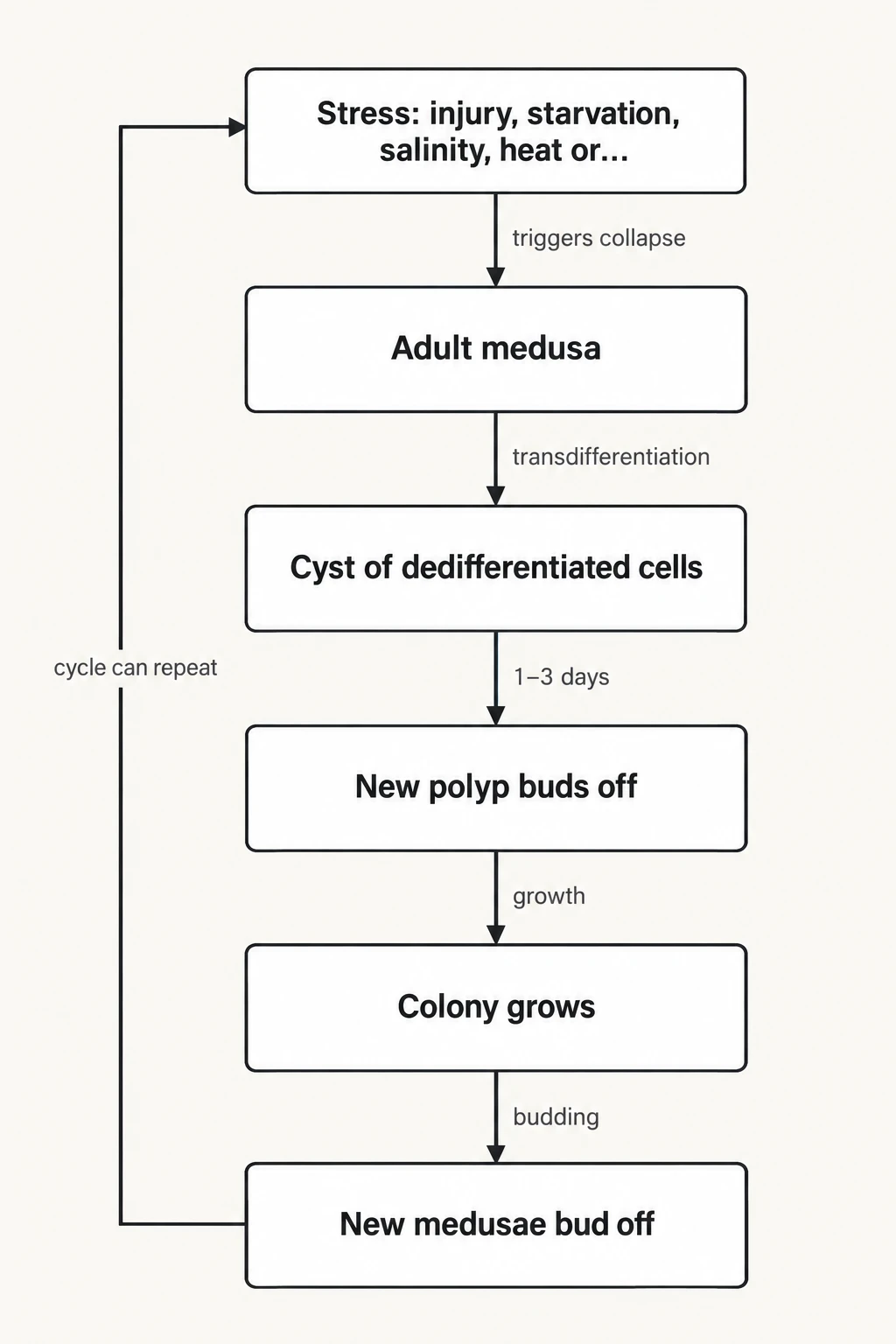
| From | To | How |
|---|---|---|
| Stress: injury, starvation, salinity, heat or… | Adult medusa | triggers collapse |
| Adult medusa | Cyst of dedifferentiated cells | transdifferentiation |
| Cyst of dedifferentiated cells | New polyp buds off | 1–3 days |
| New polyp buds off | Colony grows | growth |
| Colony grows | New medusae bud off | budding |
| New medusae bud off | Stress: injury, starvation, salinity, heat or… | cycle can repeat |
Based on BBC Future, reporting the lab observations of Maria Miglietta
As BBC Future reported, this is the sequence the marine biologist Maria Miglietta of Texas A&M University at Galveston has recorded after cutting, boiling, starving and over-salting specimens in her lab: the stressed medusa stops moving and sinks, collapses within one to three days into a formless cyst, buds a single polyp, and grows that polyp into a colony that in turn buds off new medusae — each one a near-clone of the original and each one capable, in principle, of running the cycle again. “From one jellyfish that doesn’t die, then you get this colony that can form hundreds more,” Miglietta told the outlet.
Who found this, and when
The reversal was formally documented in the journal Biological Bulletin in 1996, in a paper titled “Reversing the Life Cycle” by Piraino, Ferdinando Boero and two co-authors. The underlying observation is usually credited to Christian Sommer, a German biology student who in 1988 was collecting hydrozoans in petri dishes near Portofino, Italy, and found polyps where he expected dying adults — an episode recounted in Nathaniel Rich’s 2012 account in the New York Times Magazine. BBC Future’s version of events differs: it dates the discovery to 1992 and attributes it to an unnamed Italian scientist who forgot to feed his tanks over a weekend. Neither the 1996 paper nor Rich’s reporting corroborates that account. Either way, it took close to a decade before the word “immortal” attached itself to the species.
What the genomes show, and where they disagree
The 2022 PNAS comparison, led by Maria Pascual-Torner and Victor Quesada at Spain’s University of Oviedo, sequenced both species using Illumina short-read technology and assembled genomes of 390 megabases for T. dohrnii and 210 megabases for T. rubra. Beyond the roughly doubled count of DNA-repair genes, T. dohrnii carried extra copies of genes that maintain telomeres — the protective caps on chromosome ends that shorten with each cell division and serve as a standard marker of cellular aging. During the reversal itself, the team measured a shift toward pluripotency gene activity and the silencing of Polycomb repressive complex 2, a gene-regulating complex that normally locks a cell into its specialized fate once it has committed to one.
The 390-megabase figure is one of at least two estimates for T. dohrnii’s genome. A separate assembly published in DNA Research in December 2022 by a team led by Yoshinori Hasegawa, using long-read PacBio sequencing combined with short-read Illumina data rather than Illumina alone, put the genome at 435.9 megabases and identified 23,314 high-confidence genes. Because a single jellyfish does not yield enough DNA to sequence, the team bred a clonal line and pooled 1,500 young medusae to collect 3 micrograms of genetic material. The two T. dohrnii estimates differ by about 12%, which says less about the animal than about how unsettled the basic measurement still is for an organism this hard to keep alive in bulk.
The comparative framing of the 2022 PNAS paper has also drawn a direct challenge — from Miglietta herself. In a 2023 PNAS commentary titled “On the perils of working on nonmodel organisms,” she argued that the entire premise — that T. rubra cannot reverse its life cycle after reproducing — rests on a paper that never actually tested T. rubra for that ability. Many jellyfish species are simply understudied enough that absence of evidence gets read as evidence of absence. Pascual-Torner and Quesada published a reply defending their comparison; no follow-up experiment has settled which account is right, which means the gene-count differences the 2022 study highlighted could, in principle, turn out to distinguish two rejuvenating species rather than a rejuvenating one from a mortal one.
Not actually immortal
A portion of the T. dohrnii specimens in Miglietta’s lab cannot complete the reversal at all, she told BBC Future, and among those that can, there is probably some limit to how many times an individual lineage can cycle before it dies of something resembling old age — though keeping colonies alive long enough in captivity to test that limit has proven difficult. Nobody has observed a life-cycle reversal happening in open water; every documented case comes from a tank. In the wild, the species’ population is kept in check by the ordinary hazards of being a small, slow organism: food scarcity when plankton is scarce, predators, and algae that smother entire colonies. The biologist Maria Pascual-Torner, who ran the 2022 genome comparison, put it plainly: “Although it has the ability to rejuvenate and, theoretically, not die from ageing, it is at the same time an extremely vulnerable organism.”
The applied goal researchers describe is not reversing human aging wholesale. Michael Koldobskiy, a pediatric oncologist and physician-scientist at Johns Hopkins now collaborating with Miglietta, frames the target as organ- and tissue-level regeneration: coaxing damaged human cells toward a more youthful state well enough to speed wound healing, or to repair tissue after a stroke or heart attack, without reverting a person to infancy. That would require finding, in human cells, something resembling the molecular switch that lets T. dohrnii’s cells drop their specialization on demand — and showing it can be thrown safely. Scientists have already induced rejuvenation-like states in mammalian cells in the lab; getting the same result in intact human tissue, rather than a dish, has so far not worked. Whether the jellyfish’s switch has a human equivalent, and whether a reply to the 2023 critique or a third genome assembly will settle what T. rubra can or cannot do, are the two numbers worth watching next.