
Political consultants in India say they run covert social media campaigns for candidates abroad, from Kenya’s 2022 presidential race to a Michigan Senate primary in August, Al Jazeera reported on Monday, a day before the U.S. midterm elections.
The American case involves Representative Haley Stevens, who lost Michigan’s Democratic Senate primary on Aug. 4 to Abdul El-Sayed, now the party’s nominee. Antibot4Navalny, an anonymous group of disinformation researchers that mostly tracks influence operations tied to Russia, told Al Jazeera it found at least 28 accounts on X sharing videos that backed Ms. Stevens. Those videos drew more than seven million views. At least 15 of the accounts were posting from India, according to Al Jazeera’s own review.
The New York Times first reported the posts. Researchers at Clemson University’s Media Forensics Hub separately identified for-hire Indian accounts and pages using similar tactics on Ms. Stevens’s behalf. It was not clear who paid for them.
Nearly a dozen consultants in India talked to Al Jazeera, and they described work with no rules to speak of.
“We are manipulating elections; there is no other way to say it,” said Tushar Giri, a political consultant in New Delhi. “The concept of electoral democracy is so overrated. There is no free will for voters. Everything is manipulated.”
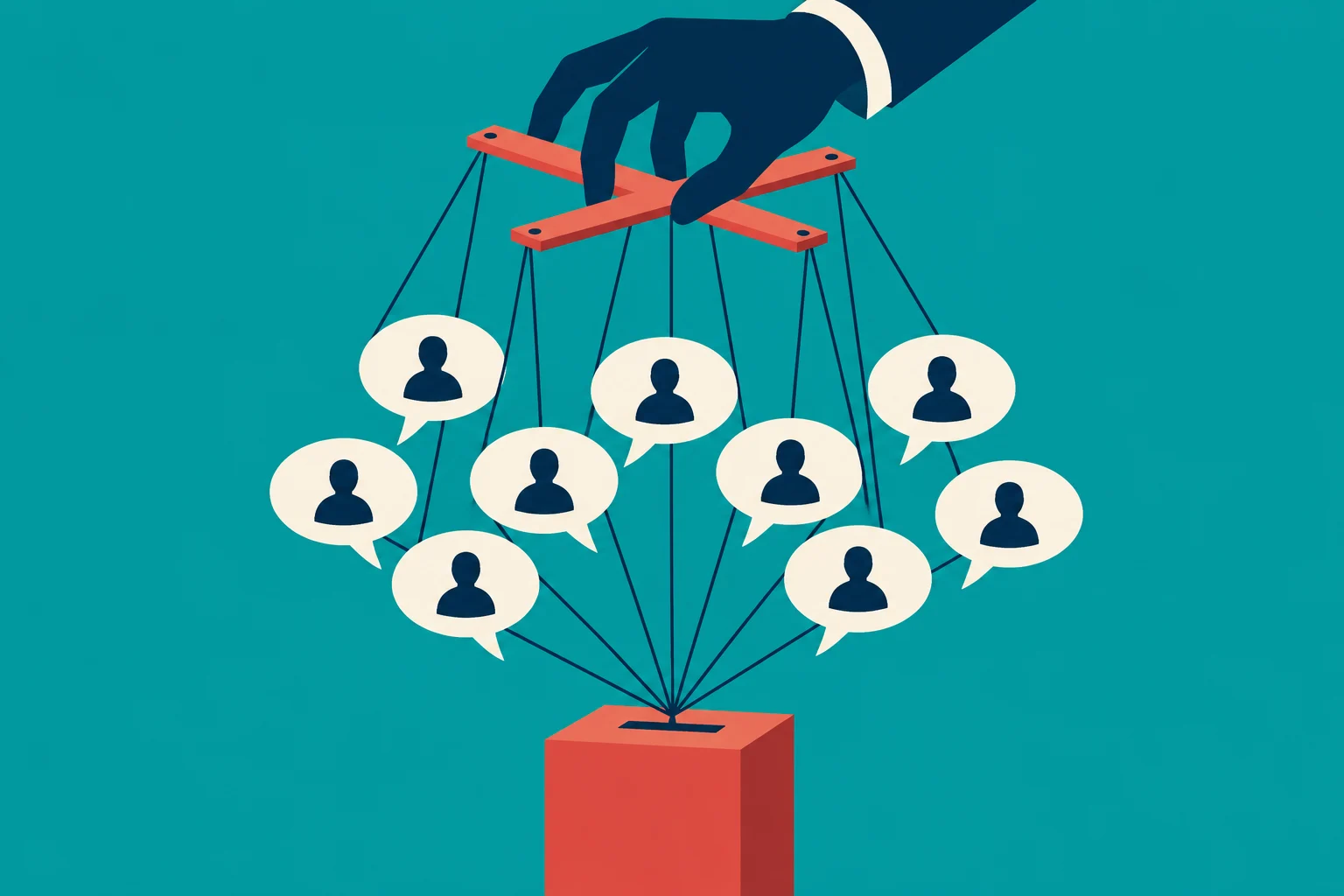
Mr. Giri said that in the last couple of years India had become “a big wholesale market to run these shadow political campaigns.” His pitch to foreign clients is the record at home. “It is like you buy toys from China; similarly, you can manipulate elections anywhere in the world at the cheapest cost in India,” he said.
In 2022, Rajan Kumar worked through the nights in an unfurnished apartment in Ahmedabad, in western India, making posters and videos for William Ruto’s run for president of Kenya. He was paid about $7 a day under a monthly contract, he said, and on some days was asked for up to 100 pieces of content, with assignments coordinated in Telegram groups. None of it went out on Mr. Ruto’s official channels. It ran on shadow accounts that hide who is behind them, so coordinated messaging looks independent.
Mr. Kumar said he cut opponents’ speeches and interviews to twist what they said, and made posters with false claims about Mr. Ruto’s popularity. “If there’s a woman politician, we simply link her to someone to damage her reputation. It’s one of the easiest ways to discredit,” he told Al Jazeera.

He said he never dealt with anyone from Mr. Ruto’s campaign directly, and that creators like him aren’t told who sits further up the chain. Chats get deleted. SIM cards get destroyed. “One always needs to be careful and hide footprints nonetheless,” he said.
Mr. Ruto won and became Kenya’s fifth president. Two Indian consultants working for his campaign, Zulfiqar Ahmad Khan and Mohamed Zaid Sami Kidwai, disappeared in Nairobi in July 2022 and were found dead in October. They had allegedly been abducted by an elite police unit, which Mr. Ruto disbanded after taking office.
Fifteen officers were charged with murder in the deaths of the two men and a Kenyan taxi driver. In August, the High Court terminated those proceedings after prosecutors asked to discontinue the murder investigation. The officers now face fresh charges over the 2022 kidnapping, Kenyans.co.ke reported.
Meta’s rules bar users from trying to “sell, buy, or exchange” accounts or from operating under false identities, and both Meta and Google generally require political advertisers to verify who they are and disclose who paid. Mr. Giri said consultants work around that with premium VPNs, or by changing an account’s country of origin so someone abroad can run targeted political ads. “These platforms have long pages of such rules, but when you read between the lines, there are several loopholes one can exploit,” he said.
The money moves quietly too. “Black money is a pillar of political consultation,” said one consultant, who asked not to be named out of fear for their safety. Several firms use hawala, an informal broker system for sending cash across borders outside banks, and at least three consultants pointed to export businesses in Old Delhi’s Chandni Chowk market as one hub.
Another consultant, also speaking on condition of anonymity, described collecting a payment two years ago with an Indian banknote whose serial number worked as a code. “I saw people use 10-rupee notes to collect millions in cash,” the consultant said. “It was like I’m in a movie.” The consultant would not say which country or campaign had paid.
Mr. Giri said he met representatives of a presidential campaign in Suriname last year, though the talks fell through. Consultants said they had also worked in Nepal and Sri Lanka. Amogh Dhar Sharma, author of Backstage of Democracy, a book on Indian political consultancies, said he found the firms working in Australia and Germany during his research.
“But sometimes the real power is being wielded, completely hidden from the public eye,” Mr. Sharma said. “The way it creates certain, hidden sources of power in a democracy is one of the biggest ethical concerns.”