
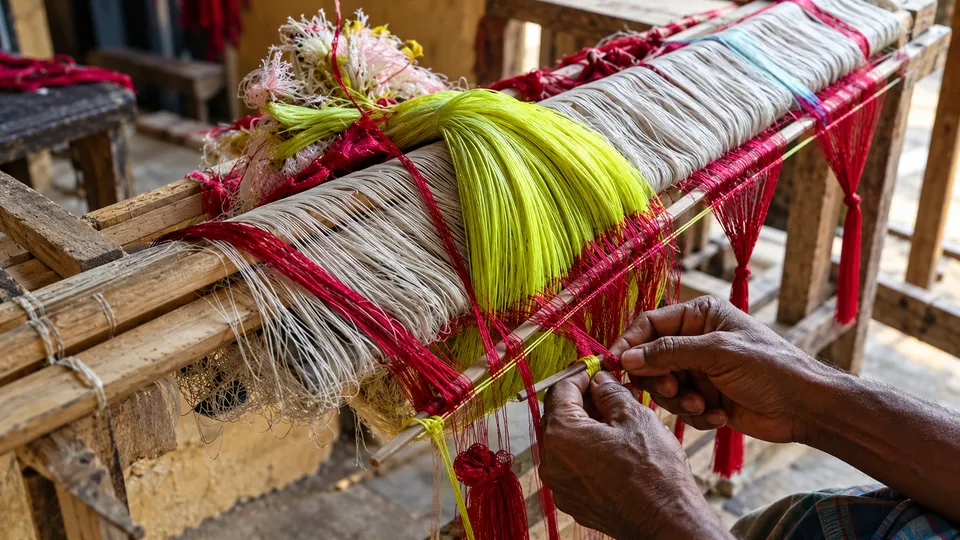
It began, as these things often do, in a market. Bitupan Deka was in Meghalaya, in India’s northeast, shopping with his mother for a gamusa, the traditional scarf, and he noticed that the shops were all selling the same thing.
“Every shop selling the scarf had the same handful of patterns repeated over and over,” he told Shreejaya Nair of Al Jazeera, speaking by phone from Shillong, the state capital. Deka is an assistant professor of computer technology at MIT University in Shillong. Where a shopper sees monotony, an engineer sees a problem waiting for a solution.
Two thousand rupees, once
The scarcity has a cause, and the cause is money. In Sualkuchi, the weaving town in Assam, a designer who creates a new pattern receives a single payment of about 2,000 rupees, roughly $21. No royalties follow. A design that could be woven for decades earns its maker the price of one afternoon.
Deka’s answer was a system that generates designs without limit. He is patenting it through his university and intends to sell it as a commercial service. His work, he says, “isn’t meant to replace the traditional designers.”
He may mean it. But consider the arrangement as it now stands. The human designer is paid once and forgotten. The machine that learns from what such designers made will be patented, and the patent will belong to someone. In this trade, ownership has always gathered at the end of the chain furthest from the loom, and the new tool seems likely to settle in the same place.
The name is the community
The same story is unfolding across the country. In Rajasthan, Reddy Sai Nivas C assembled the Rekh Sanganeri Dataset: high-resolution images of hand-block prints, annotated for the small flaws that mark the work of a human hand, ink bleed and misalignment. He says it is meant for research and for art, not as a substitute for artisans.
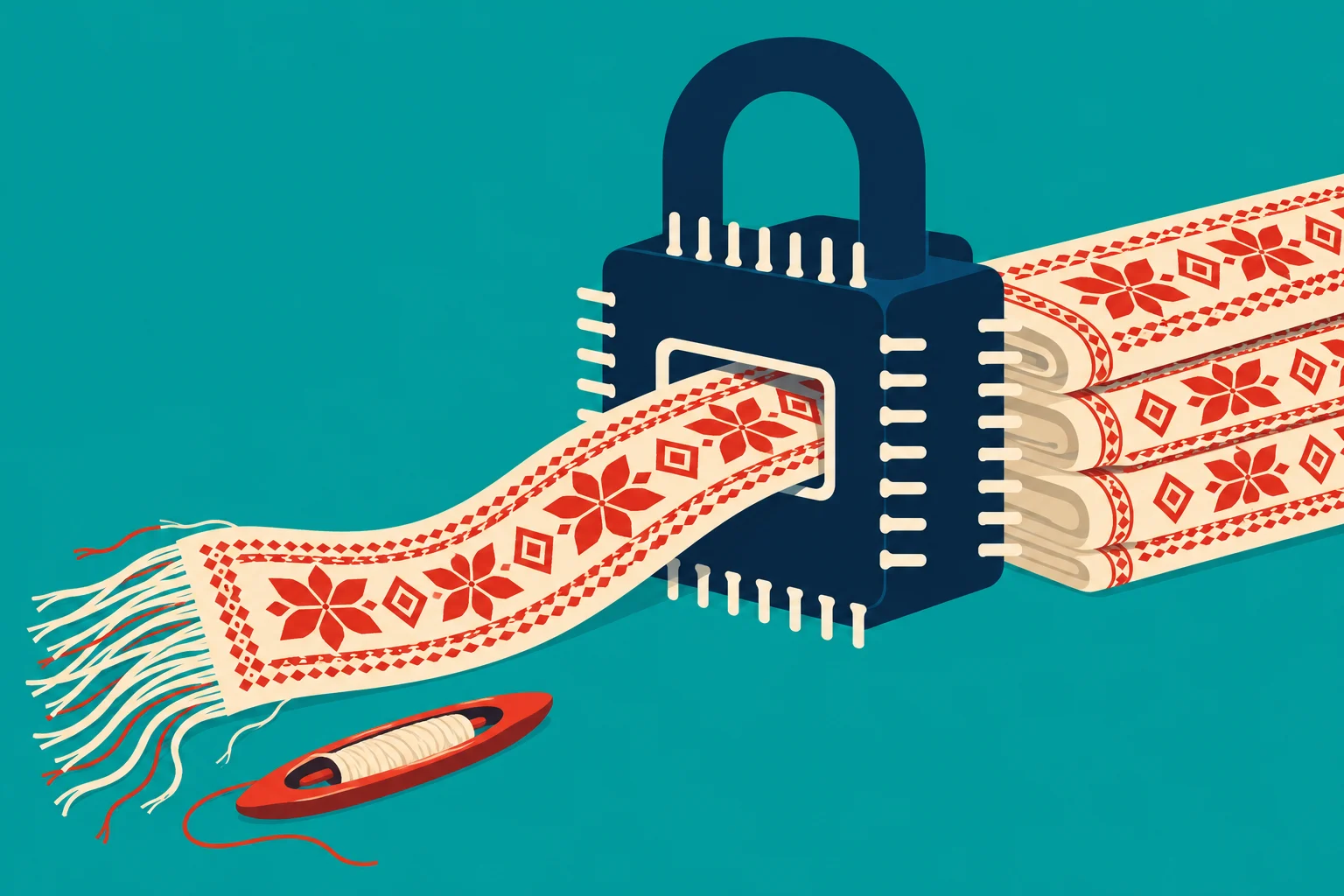
Dinesh Chhipa, a Bagru designer and textile businessman from the Chhipa caste, whose very surname is the trade, does not blame anyone who uses AI to make up for a shortage of supply. What he objects to is the borrowing of names such as Bagru and Jaipuri. “You cannot separate the names from the community,” he said. A pattern can be copied, and a place name can be printed on a label. The people the place name refers to cannot be copied, and for now nobody is obliged to ask them.
A loom that gives instructions
In February 2026, at the India AI Impact Summit in New Delhi, the conglomerate TCS showed Bridgital Loom. The system converts a design into instructions for the loom and guides the weaver with LED lights through Banarasi and Kanchipuram patterns. A pilot is running in Kanchipuram. Muthulakshmi Nellaiappan, who heads AI strategy for the project, told the magazine Digit that becoming a master weaver takes more than 15 years, and that with the system young weavers “can become a master much sooner.” She added that it works on non-electronic handlooms as well.
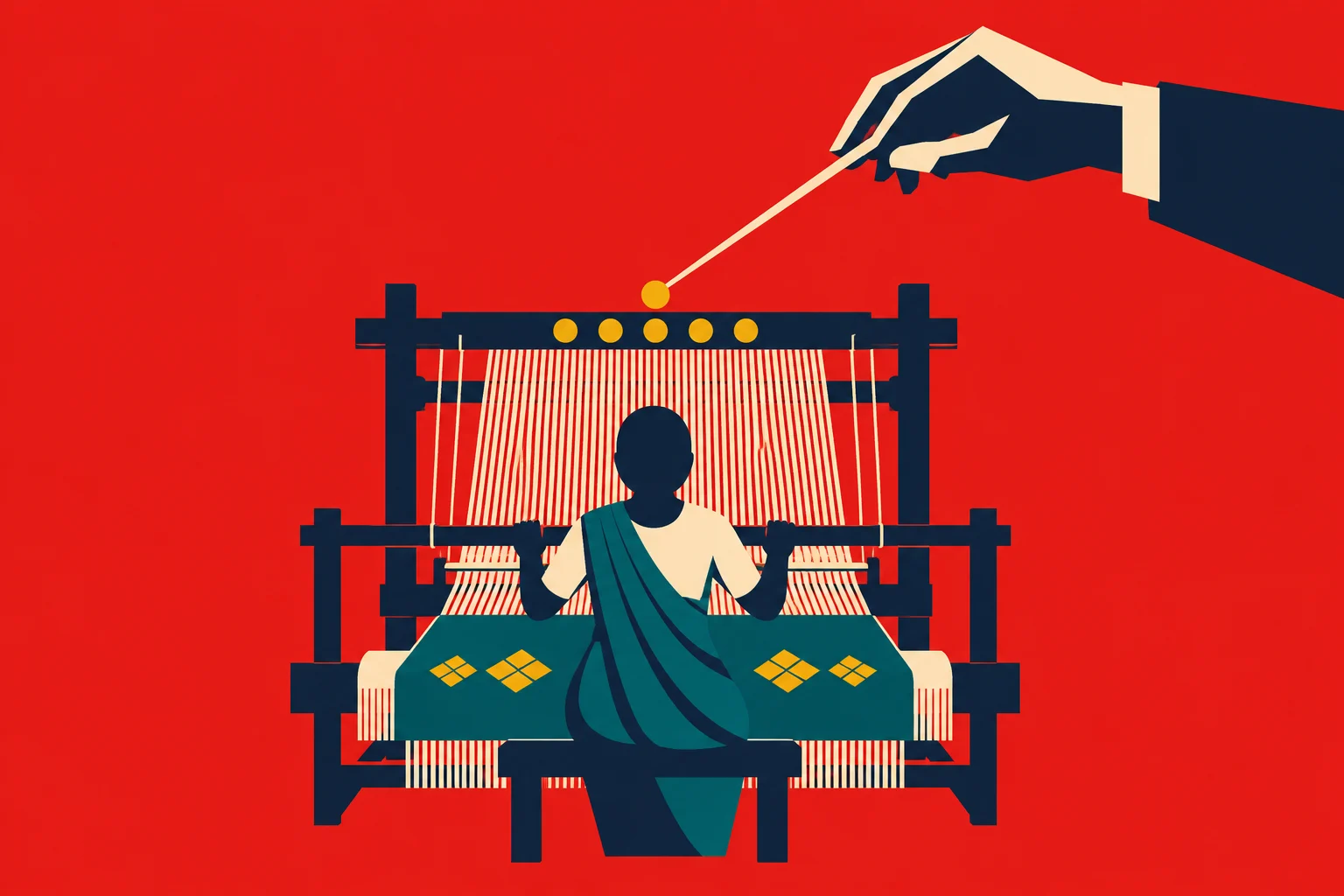
Ananthalakshmi Vadivel, a third-generation weaver who owns Vadivel Silk Looms in Kanchipuram, already competes with cheaper sarees made on electronic looms. She is not alarmed. “These imitations can never replace the original,” she said. That conviction has kept many craft families going. Whether it will hold up against the price on the label is another matter.
The law wants one author
The state is digitising too. Collections at the Botanical Survey of India are being scanned, and the National Institute of Fashion Technology (NIFT) and C-DAC have built the Bharatiya Vastra Shilpa Kosh, a textile repository. Each archive meant to save a craft is also, in effect, raw material for anyone who wants to reproduce it.
In December 2025, the Department for Promotion of Industry and Internal Trade floated an answer to who should be paid. Its working paper on generative AI and copyright proposed a blanket licence: developers could train on lawfully obtained copyrighted work without asking each rightsholder, and would pay royalties at rates set by the government once their products earned money. According to Business Standard’s account, the licence would be mandatory, and the paper’s own text says rightsholders “will not have the option to withhold their works.” Payment would require registration, and the industry body Nasscom, which sat on the committee, dissented and argued for an opt-out exception instead. None of this is law yet.
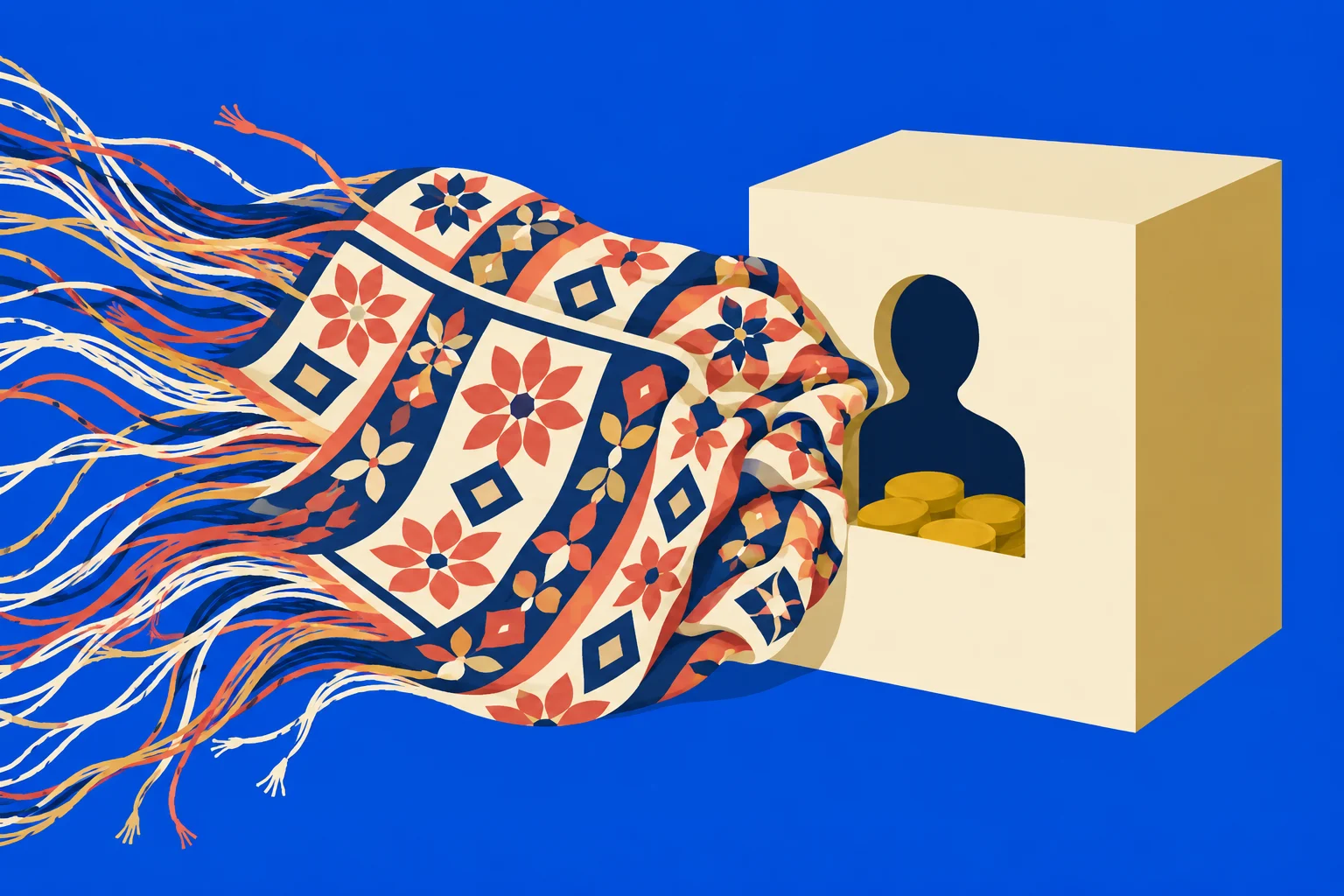
Even if it were, it might miss the looms. Intellectual property law assumes an author who can be identified, someone to register and someone to pay. A gamusa motif has no such author. It belongs to a town, a caste, a valley, to generations who never signed anything. A royalty system built for novelists and record labels has no account to pay into for a whole people.
Sensors, tags and an empty preview
Other remedies are being tried. In August a Centre of Excellence for Handloom Technology, costing $1.4m, was inaugurated at IIT Delhi, with a research department on AI and handlooms planned. Proposals for proving where cloth comes from include registering weavers, fitting looms with sensors and issuing QR-coded tags. Maharashtra’s Vingatha system already authenticates Paithani and Karvat Kathi sarees. To prove they are real, weavers must first be counted, wired up and labelled.
The galleries have their own way of leaving people out. When the exhibition “No ‘One’ Maker” opened in New Delhi in April, the artisans were missing from its preview. Last month the curator Aparupa Ray Ganguly mounted a show in the capital featuring 20 artisans and collectives. She spoke of Kanmai Payun, the last person who still practises Fulor Saneki, an Assamese flower pattern. Payun was encouraged to teach it to her son, who is 17.
For now, a single mother and her teenage son hold that pattern, in a country where machines can turn out unlimited designs and a government committee is still working out who should be paid for them.