
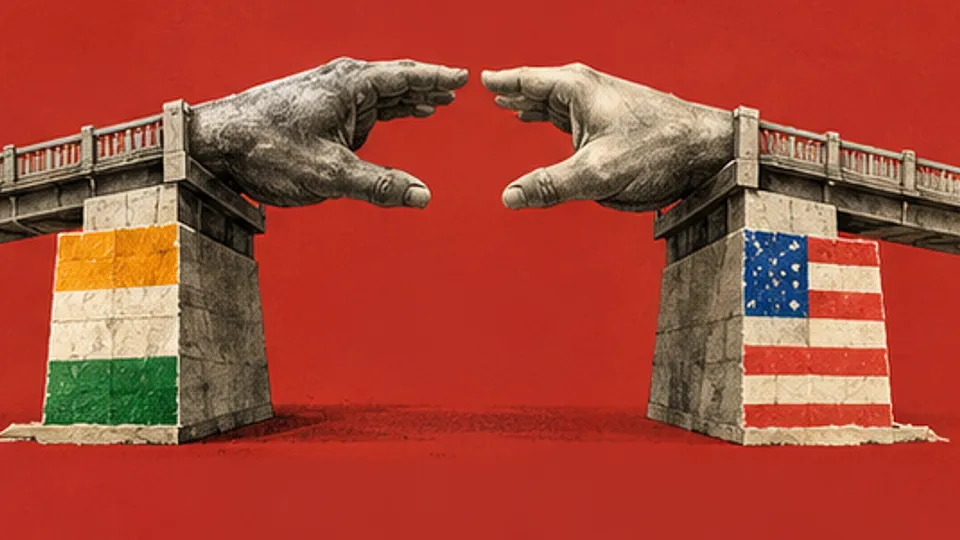
India’s foreign minister declared this week that the United States had been an insensitive partner on “terrorism,” had warmed to India’s arch-rival Pakistan and had pursued “self-centered” trade policies that hurt the developing world.
The remarks by S. Jaishankar at an Asia Society event in New York, after the U.N. General Assembly, marked a break from decades in which New Delhi handled disputes with friendly governments quietly. On Wednesday, Prime Minister Narendra Modi held a telephone call with President Trump that Mr. Modi described as “productive” — a cooler, more formal word than the “good friend” he used to apply to Mr. Trump.
“If I stand back and look at the relationship, I note that much of the world has had a more difficult relationship with the U.S.,” Mr. Jaishankar said. “I mean that may not be a consolation, but that’s a reality.”
Trade has been the sharpest flashpoint. The United States is India’s largest trading partner, with goods trade reaching $149.1 billion in 2025, but with a $58.4 billion surplus in India’s favor. After the U.S. Supreme Court struck down Mr. Trump’s sweeping tariffs in February, his administration turned to other tools, including a new 10 percent global tariff. Earlier this month Mr. Trump signed a law allowing tariffs of up to 100 percent on countries, like India, that buy Russian oil.
Ajay Bisaria, a retired diplomat who served as India’s high commissioner to Canada and Pakistan, told Al Jazeera that the 100 percent measure, due to take effect in less than a month, “is sort of a deal breaker in the relationship right now. If that becomes reality, then all Indian efforts would come under scrutiny.” With Washington, he said, “India has decided to be more public because there has been a lot of public criticism and a sentiment that the U.S. is bullying India and India has been silent.”
Mr. Jaishankar said there was “more or less an understanding on the trade agreement,” which so far has yielded a roadmap rather than a deal. Agriculture, where India has kept its market largely closed for decades to protect its farmers, remains among the most contested points. Once a deal is closed, he said, it “would contribute to a better relationship.”
The deeper rupture dates to May of last year, when India fought a four-day war with Pakistan after an attack by armed fighters in Indian-administered Kashmir killed 26 civilians. Mr. Trump announced the ceasefire himself and has since claimed dozens of times, including at the General Assembly this month, that he brokered it. India maintains that Kashmir is strictly a bilateral matter with no room for outside intervention. Pakistan’s leaders, meanwhile, praised Mr. Trump and nominated him for a Nobel Peace Prize, and ties between Islamabad and Washington have since flourished.
“Particularly important is the issue of terrorism,” Mr. Jaishankar said. Few countries, he said, had endured “the kind of terrorism that we have from a neighbour as part of a deliberate, conscious policy over many, many decades.” He was referring to Pakistan. “If something which matters so deeply to us, there isn’t enough understanding or appreciation or empathy of that, I think that creates a problem too.”
Harsh Pant, vice president of the Observer Research Foundation in New Delhi, told Al Jazeera that “the obsession with Pakistan in the Trump administration,” without regard for India’s sensitivities, drove the change. “When at the top level, you don’t see reciprocity, then calculations change and decisions are taken to bring differences out in the open,” he said.
Domestic pressure is also building. Indians have been the biggest beneficiaries of the U.S. H-1B visa program, which the Trump administration has burdened with higher barriers and fees. “Today the economics of mobility and the politics of mobility are at odds with each other, at least in some quarters,” Mr. Jaishankar said. Mr. Bisaria said Mr. Modi “is feeling domestic pressure, with key state elections coming up next year,” and that the government’s posture “should not be one of taking bullying from the U.S.”
Mr. Pant said the Indian public mood was shifting too. Connections like migration once made the United States “an attractive partner for a large mass of Indians,” he said. Now, he said, “the same issues are becoming a negative drag on the relationship,” and the government was airing that sentiment publicly.
Chietigj Bajpaee, a senior research fellow for South Asia at Chatham House, said Mr. Jaishankar’s remarks offered a frank assessment. “Clearly, the shine has come off the bilateral relationship after India was initially among the most optimistic about a second Trump term,” he said. Even so, he added, “both have not given up on reviving their relationship.”