
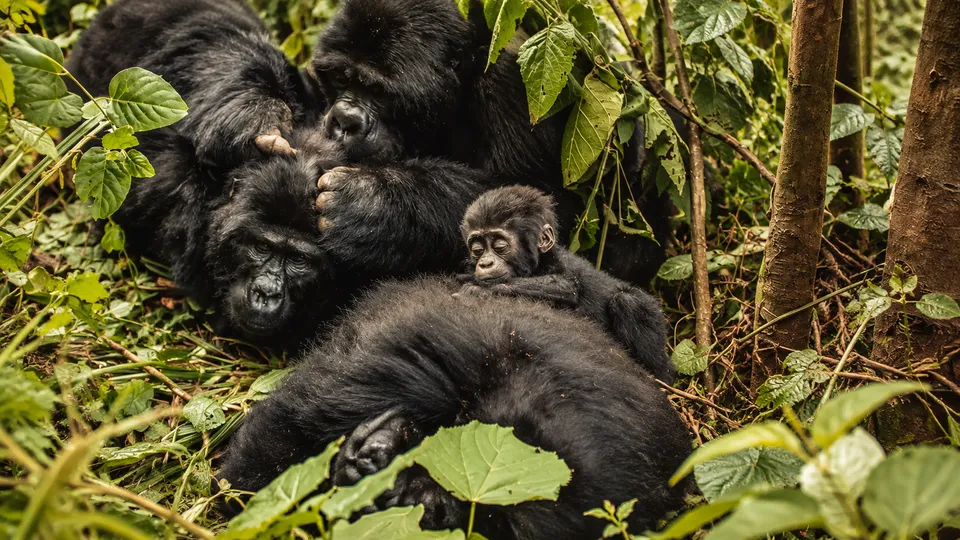
In the Bwindi Impenetrable National Park, where Uganda dissolves into the edge of the Rift Valley and the border of the Democratic Republic of the Congo, a tourist pays $800 to stand beneath the canopy and watch a troop of mountain gorillas. The animal being watched is, by the cold arithmetic of the 1980s, not supposed to be there at all. The mountain gorilla was then on the fast track to extinction. Today more than 1,100 of them live in thriving populations across Uganda, Rwanda and the DRC — and around them, in the villages, an economy has grown like vegetation after rain: wood carvings sold to visitors, beds for up to 40,000 tourists a year, jobs for the rangers and guides of the national park.
Reporting for Al Jazeera, Nick Clark describes how deeper in the forest another contingent of gorillas lives beyond all human contact, and there performs the older, unpaid labour of a species: foraging, building nests, scattering seeds, enlarging the world simply by moving through it. And enlarging itself. That is the crucial part.
The mountain gorilla story shows us that conservation can work. It’s a really important example of the effort that’s needed to make that happen – decades of sustained conservation action that includes direct protection, science-informed management and meaningful community support and involvement.
The words belong to Tara Stoinski of the Dian Fossey Gorilla Fund. Note what she lists: not sentiment, not slogans, but decades, direct protection, science, and the involvement of the people who live beside the animals. Conservation, like war, is won by logistics.
Seventy-three percent
The gorilla is the exception, and the exception is needed, because the rule is calamity. This year’s Living Planet Report from the World Wide Fund for Nature records that over the past 52 years the average size of monitored wildlife populations has declined by 73 percent. Across the world, habitats are degraded and lost while overexploitation, climate change, pollution and invasive species do their work. Three-quarters, in half a century within a human lifetime: a child born when the counting began is now watching the tally come in.
And yet the same report that delivers the catastrophe also delivers the counter-evidence: recoveries among green turtles, bluefin tuna, tigers and Southern African elephants. Andrew Terry, chief conservation officer at the Zoological Society of London, who helped produce the report, frames it as a matter of valuation. “For too long nature has been undervalued,” he says. “But these declines are not inevitable and change is possible. Nature can recover, and these stories are a powerful reminder of this.”
When science and policy align
The recoveries share an anatomy. They are not miracles; they are treaties, patrols, measurements and money, sustained past the point where fashion moves on. Intergovernmental commitments from the tiger range countries — India, Bhutan, Nepal, Laos, China — lifted global wild tiger numbers by more than 70 percent between 2010 and 2025, and WWF presents this as proof of what international partnerships can drive. In 2025 the green sea turtle became the first marine turtle ever downlisted from “endangered” to “least concern” on the Red List of the International Union for the Conservation of Nature, a reclassification resting on 50 years of species research, active protection of nesting females and eggs, measures to reduce fishing gear and sustained community engagement. Half a century. Bureaucracies are often mocked for their slowness; here slowness is the method itself.
Professor Brendon Godley of the University of Exeter and the Sharjah Marine Research Centre in the United Arab Emirates has spent much of his career on sea turtles, and his verdict carries the caution of a man who has watched the ocean a long time. “Conservation success stories are hugely important because they demonstrate that declines are not inevitable,” he says. “The recovery of species such as green turtles shows that when science, policy, enforcement and public support align, populations can rebound, sometimes remarkably so. However, they are not grounds for complacency.”
The bluefin returns to Britain
In 2010 the Atlantic bluefin tuna had fallen by 80 percent and was listed as endangered, vanished from much of its historical range, including the waters of the United Kingdom. Today the fish is returning to those waters in numbers not witnessed in generations — perhaps ever. Tom Horton, a research fellow at the University of Exeter, sees in this something rarer than a population curve: “What makes this story particularly powerful is that the recovery is visible. Coastal communities, fishers and sea-users who had never seen a bluefin tuna in British waters are now encountering them regularly. It transforms conservation from an abstract concept into something tangible.” A graph never convinced a fisherman. A fin off the bow does.
The systems that eat the forest
These are, the reporting is careful to insist, small battles won inside an ongoing war. The Living Planet Report names the three systems primarily driving nature’s destruction: the global food system, the leading cause of habitat loss as land is cleared for crops; the energy system, fuelling climate change through the burning of fossil fuels; and the finance system, which bankrolls the harmful work — the large-scale infrastructure, the mines. The armies arrayed against the gorilla and the turtle, in other words, are not poachers with rifles but the ordinary machinery by which humanity feeds, warms and enriches itself.
Kirsten Schuijt, WWF’s director general, says these systems must be transformed — and refuses both despair and triumphalism. “Progress is already under way,” she says. “Not everywhere, and not yet at the scale required, but enough to demonstrate that change is possible.”
The other gorilla
Far to the west of Bwindi, in the vast remote forests of the DRC, lives the largest primate on Earth, the critically endangered Grauer’s gorilla — cousin to the mountain gorilla, heir to a harder country. Its landscape is beset by instability and habitat loss, and its numbers have fallen by an estimated 60 percent, to just 6,800 today. Whether the Bwindi parable can be carried into that forest is the open question of Central African conservation.
Urbain Ngobobo, country director for the Dian Fossey Fund in the DRC, does not promise that it can. He promises something more modest, which in such places is more credible: that the work is the hope. “Every forest we help communities protect, every gorilla we are able to monitor and every young Congolese person who develops the skills to become a conservation leader, represents progress.”
That is where hope comes from – not from assuming the future will be easy, but from knowing that our actions today can change what is possible tomorrow.
The tourist at Bwindi pays his $800 and goes home with photographs. What he has actually purchased is evidence — the rarest commodity in the environmental century — that the direction of the arrow is a choice, and that a species written off forty years ago can, under protection and with the consent of the poor who share its forest, come back into the world.