
Hasanat al-Rashid is 48 and has had diabetes for fifteen years. For the last three and a half of them she has also had a war. The fighting between Sudan’s army and the Rapid Support Forces did not give her the illness. It took away nearly everything that kept the illness under control: the pharmacy, the right food, a doctor in a fixed place, a refrigerator.
Her story, and the stories of three others, were reported for Al Jazeera by Fatima Edam. No single shell or massacre appears in them. The damage comes slowly, a little at a time, in Sudanese pounds.
South, then east
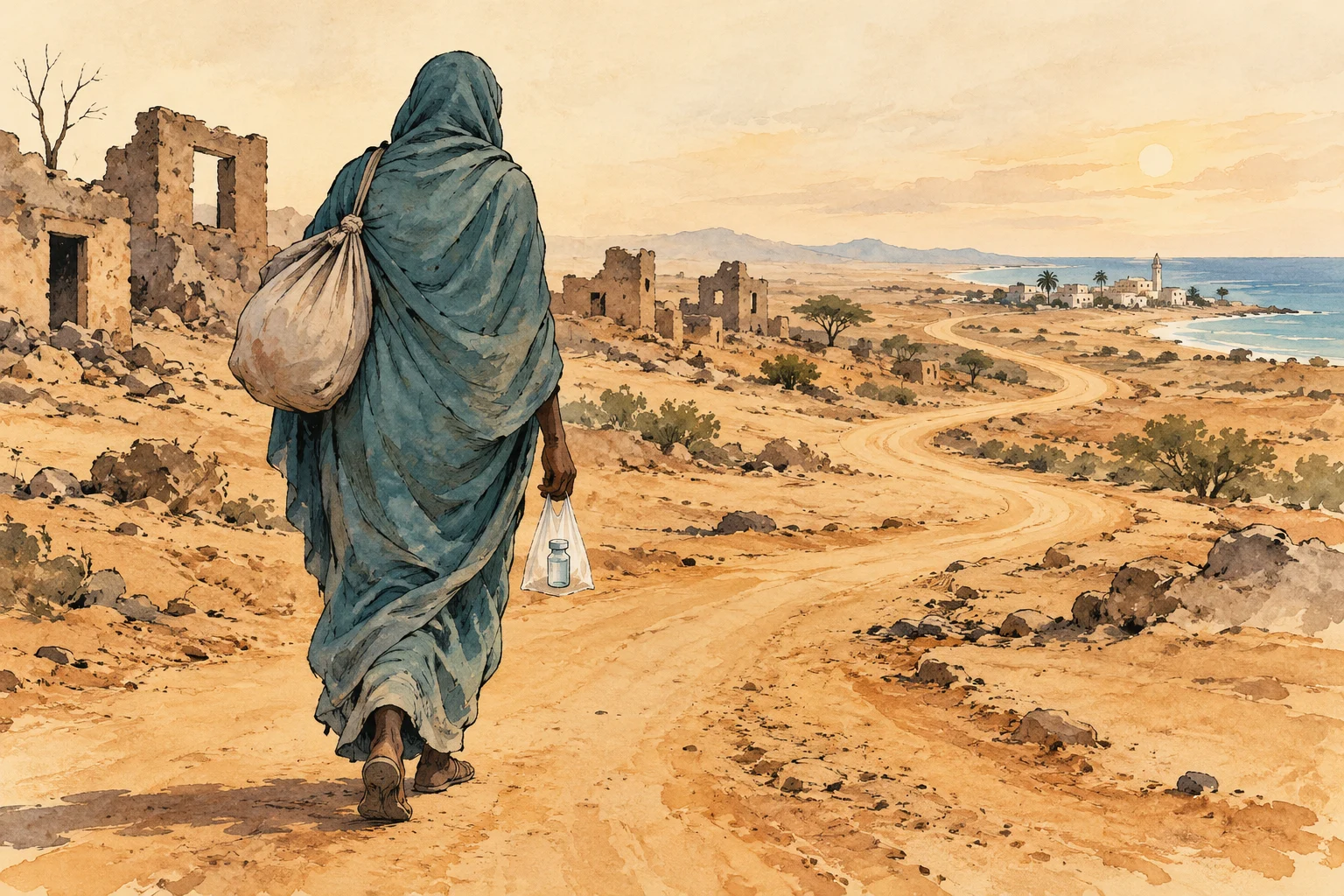
When the war began in April 2023, al-Rashid fled her home in Haj Yousif, in Khartoum North, for Umm Daw Ban, further south in Khartoum State. Displaced, she sometimes went days with no medication at all. She ate whatever there was, often asida, a porridge that is the wrong food for a diabetic. Complications set in. She needed two operations on her feet, one of them for a serious infection.
She looked for treatment in Gezira State, in Rufaa, then Wad Madani, then Al-Hasahisa. In December 2023 the fighting reached Gezira and she fled again, this time to Port Sudan on the Red Sea, where the state that is still standing has gathered.
The arithmetic of ice
She now needs insulin every day. “The doses vary depending on whether my blood sugar is high or low,” she said. An insulin pen costs 70,000 pounds, about $8, which is more than she can pay in one go. So she buys vials at 17,000 pounds ($1.80) each. Insulin has to be kept cold, and she has no refrigerator, so she buys ice: about 180,000 pounds, or $20, a month. Keeping the medicine cool costs her more than ten vials of the medicine itself. On top of that come painkillers and vitamins.
This is happening in a country where, according to the UN Development Programme, the war has pushed incomes back to the levels of the 1990s. A household’s money now has to cover rent, flour and ice for insulin, and all three compete.
Six medicines
At Port Sudan Hospital, Fatima Adam, 75, is treated for hypertension and a thyroid condition. Her daughter, Aisha, spoke for her. Before the war, the National Health Insurance Fund paid three-quarters of her medicine bill. When the economy collapsed, that cover ended. “My mother takes six different medicines because hypertension has affected her heart,” Aisha said.
A son who works as a casual day labourer pays. A recent month’s supply cost 160,000 pounds ($17.80). When there is not enough money, his mother takes her pills on some days and skips them on others.
The state offers protection only as long as it is there. When the state retreats, that protection is quietly handed back to a son with a day job.
The factories of Khartoum
The shortage was built from losses that officials themselves have counted. The National Medical Supplies Fund puts the war’s damage to medicine stocks, infrastructure and transport at about $500m. Of 30 drug factories in Khartoum that were forced to close, the National Medicines and Poisons Board says only eight have reopened. Sudan now depends more on imports, and imports have to be paid for in a currency that keeps losing value.
Hossam al-Naeem, a pharmacist in Port Sudan, gives the numbers. Before the war a dollar bought about 600 pounds. On the black market it now buys 9,300, roughly fifteen and a half times as many. He used to sell a strip of cold and flu tablets for 6,000 pounds, about 70 cents. Then he found his supplier was charging him that same 6,000, which left him nothing to live on and nothing to run the shop with. “I feel deeply saddened when I see the expressions on some patients’ faces,” he said.
Other findings match what he describes. A survey of pharmacies across several Sudanese states, published this year in Scientific Reports, found that more than 95% had problems keeping essential medicines in stock. Insulin, blood-pressure drugs and antiepileptics were among the worst affected, and insulin was available only 11% of the time. A separate study of 608 patients with diabetes or hypertension found that 79.1% had been displaced by the conflict and 79% said their disease had become harder to control. In June, Al Jazeera reported that smuggling networks had filled the gap with unregulated drugs, and that patients often cannot tell whether their insulin has spoiled. Aid groups bring in what they can. Direct Relief says its support has totalled more than $31 million since April 2023. A doctor quoted by the charity says the lack of diabetes and blood-pressure medicines has driven up chronic kidney disease.
El-Obeid
Huda Mahmoud, 58, lives in el-Obeid, in North Kordofan, a city that still comes under drone attack in a region where much of the war is now being fought. She has had heart problems for more than twelve years and takes five medicines. “If I forget one, my heart starts beating very fast,” she said.
When el-Obeid’s pharmacies ran short, she had relatives and acquaintances in Wad Madani, Sennar or Port Sudan send her drugs, at about 300,000 pounds ($33.30) a month. She went to Omdurman in March and has since come back. Her medicines now cost 151,000 pounds ($16.80) a month, which is cheaper than before and still barely within reach. If the supply runs out, she fears a blood clot.
“I feel like I’ve become a burden on my family,” she said.