
In Khartoum lives a girl named Muzan Abdelrahman. She is four, the age when a child in a quieter country gets ready for her first classroom. Muzan has a hearing impairment. A child like her needs specialised teaching and rehabilitation to go to school at all, and that help cannot be had in Sudan now, Abdelazim Allahgabo reported for Al Jazeera.
She was a few months old in April 2023, when the Sudanese army and the paramilitary Rapid Support Forces went to war with each other. Many people hoped it would be over by the time she was old enough for lessons. It is not over. The centres she relied on have closed.
Her mother, Abeer Osman, puts it simply. She is “not a specialist and cannot provide the rehabilitation sessions or educational tools she needs.” Her fear is about time. A deaf child has only a few early years in which to learn to communicate, and Muzan’s are slipping away.
Stairs
Wars are usually counted in the dead, the displaced, the towns taken and lost. There is another count, slower and quieter, that seldom makes it into the generals’ statements: the child who cannot get up the stairs.
Mohammed Ahmed is 14 and has a physical disability. The entrances and staircases of the buildings he needs were not built for him, so he depends on other people to get through them. “I want a school where I can access classrooms and facilities independently and with dignity,” he said.
Ali Hassan is eight and has Down’s syndrome. Before the war he went to a government-run school for children with disabilities. Those places are shut now, and private centres cost more than his family can pay. His mother, Aisha Abbo, wants the government to reopen the specialised centres. “These children cannot wait until the war ends and life returns to normal,” she said.
What survives without money
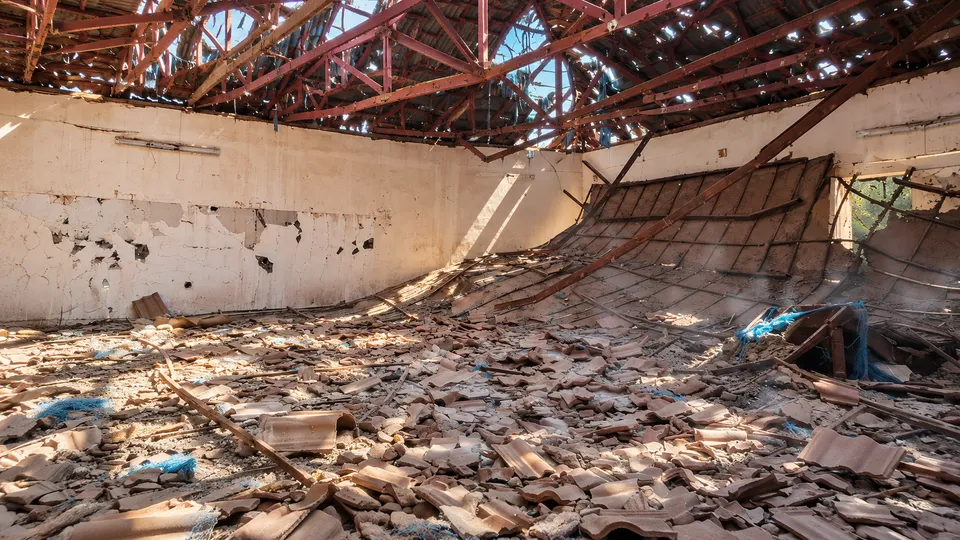
The Usratuna Sudanese Association for Children with Disabilities works in Khartoum. Early in the war its classrooms were hit by shelling, and it has lost equipment. Its project manager, Badr al-Din Tawfiq, says most of its services have stopped. He blames the war, the lack of funding and the damage itself. “The premises need rehabilitation, the classrooms are unsafe,” he said.
More than 100 children are still registered with the association for physiotherapy, speech therapy, behavioural support and vocational rehabilitation. Families have also come asking for hearing aids and the batteries to run them, and the association cannot give them any. In Gaza, too, deaf children have dropped out of school as their hearing aids broke down.
The work that goes on is the work that needs no funding: psychosocial support and advocacy. Its inclusive kindergarten in Dar al-Salam, in Omdurman, is still open. Its branches in Zalingei, in Central Darfur, and in Blue Nile state have stopped working.
There is a hard rule in this, offered here as reflection. In a war, comfort and argument outlast everything else, because they cost nothing. Whatever needs a battery goes first.
Counting what is gone
According to UNICEF figures cited by Al Jazeera, at least 8 million school-age children in Sudan have no access to formal education. As of August, about 30 per cent of schools were not operating, and around 1 per cent were being used as shelters for displaced people. When Education Cannot Wait, the UN’s global education fund, announced a $22 million programme in August, it said those eight million make up nearly half of Sudan’s 17 million school-age children. It also said children with disabilities would be at least 10 per cent of those the programme reaches.
Sudan had more than 230 schools for disabled children before the war, according to UNICEF. Many have since closed, but nobody can say how many, because there is no current count. A state at war knows how many drones it has. It does not know how many of its special schools are still standing.
UNICEF’s own reports catch glimpses of the problem. Its situation report covering January 2026 said fighting in Kadugli and Dilling had closed schools and limited services for the most vulnerable, naming girls, children with disabilities and the internally displaced. That month UNICEF and its partners gave mental health and psychosocial support to 121,220 children and caregivers, 5,150 of them children with disabilities. Elsewhere the closed schools have pushed children into work: in Port Sudan, a nine-year-old shines shoes.
Before the shelling, too
Nagi Mansour, director-general of the Sudanese Coalition for Education for All, says the system was failing these children before the war began. Buildings were poor. There were few specialised schools and few qualified teachers. Curricula had not been adapted, and Braille and sign-language materials were scarce. The war added more damage: institutions destroyed, families displaced, and some students left without their assistive devices.
He wants a national survey of the children who have dropped out, rehabilitation of the special education centres, Braille resources and sign-language interpreters, and teachers trained in inclusive education. “Children with disabilities have an inherent right to education,” he said.
Al Jazeera asked the Sudanese government to comment. It had not replied. Muzan is four.