
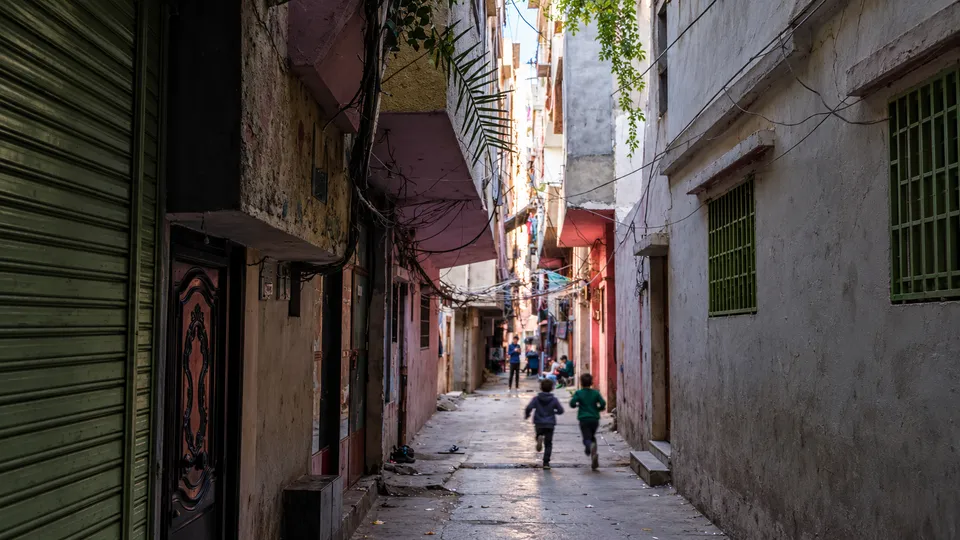
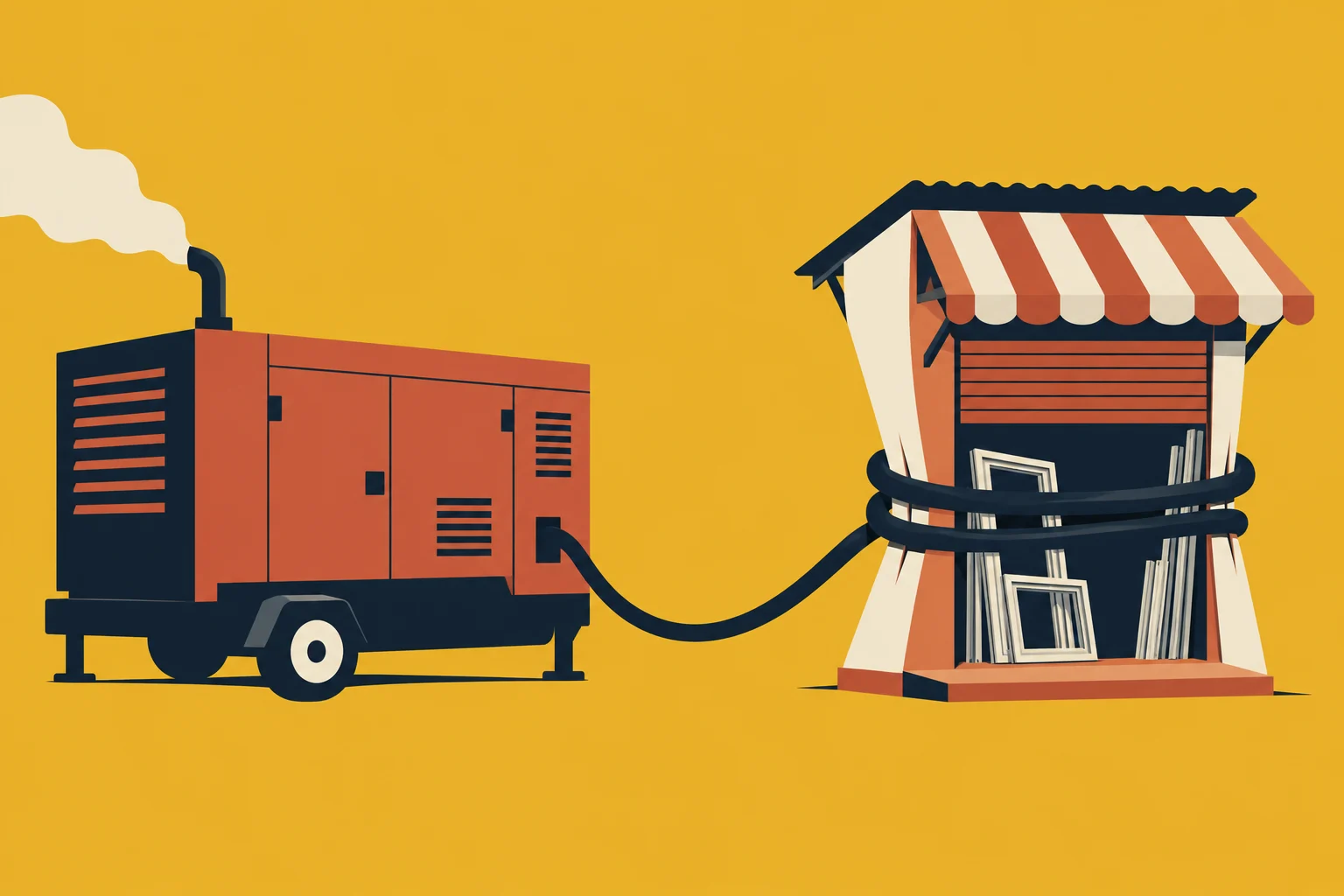
A kilowatt-hour of electricity from a private generator in Lebanon cost 30,244 Lebanese pounds in February 2026. By September it cost 52,840 pounds, according to the Ministry of Energy and Water’s monthly tariff notices reported by Daily Beirut — a 75% rise in seven months, with another 9.5% increase in the single month from August to September alone. For a Palestinian refugee who cannot legally practise medicine, law, engineering or pharmacy in Lebanon, and who therefore depends more than most on running a small shop, that is the number that decides whether the shop stays open. Osama Najjar’s aluminium shop in the Beddawi camp near Tripoli did not survive it: he closed it in early 2024, telling Al Jazeera’s Justin Salhani that falling sales, inflation and the electricity bill made it impossible to keep going. “The whole Palestinian situation in the camps is tragic,” he said.
Lebanon’s state utility, Électricité du Liban, cannot supply the country around the clock and has not been able to for years. Even at full output, EDL’s installed capacity tops out at about 1,884 megawatts against national peak demand of roughly 3,000 to 3,500 megawatts for continuous 24-hour supply, according to the Arab Reform Initiative. Between 67% and 83% of total electricity consumption is met instead by private and decentralised generation, the same analysis finds, with private generators alone accounting for 51% of local production. EDL’s own tariff is cheap where it works: the first 100 kilowatt-hours a month are subsidised at $0.10/kWh, consumption above that at $0.27/kWh. The private generator tariff that fills the gap has no subsidy. It is reset every month by the ministry off the average price of a 20-litre diesel canister, so when diesel moves, the bill to the household or shop owner moves with it, with a lag of weeks rather than months.
The tariff dipped in June, when diesel briefly cheapened and the rate fell 9.3% from May, according to L’Orient Today, which also noted that even after the drop the rate stood 40% above its level before the regional war resumed. By September, in dollar terms, the tariff had reached about $0.59/kWh for lowland subscribers and $0.65/kWh for villages and anything above 700 metres. That increase sits inside a broader inflation run: Lebanon’s Central Administration of Statistics recorded headline consumer prices up 17.53% year on year in September 2026, with the water-electricity-gas-and-fuel category up 38.91% — more than double the headline rate, according to Econotimes. The World Bank’s Summer 2026 Lebanon Economic Monitor projects full-year inflation of 17.5%, driven by the conflict escalation of March 2026 that interrupted a recovery which had produced 4.2% real GDP growth in 2025 — the fastest since the 2019 crash — and now points to a 6.4% GDP contraction for 2026, per the World Bank. The pound has stabilised around 90,000 to the dollar, but it has lost more than 98% of its pre-2019 value, and that stabilisation is the floor the World Bank warns could still give way if foreign inflows slow or the conflict reignites.
A labour market closed by statute, not by chance
Palestinians in Lebanon are not merely poor; they are poor by legal design layered over seventy years. A 1964 decree, No. 17561, requires every non-Lebanese national to hold a work permit, a requirement built on reciprocity with the worker’s home state — a condition stateless Palestinians structurally cannot meet. A 2005 labour ministry decision opened some previously closed trades but left the professions governed by a syndicate — medicine, law, engineering, pharmacy among them — off limits; a UN Special Rapporteur on extreme poverty counted 39 syndicated professions Palestinian refugees are barred from entering, according to TIMEP. Law No. 296 of 2001 bars Palestinians from owning property outright. A December 2021 labour ministry decree that would have eased syndicate access was reversible by design and was in fact suspended after political pushback. The most recent change, in February 2026, lets Palestinian nursing students apply for an annual sponsored practice permit — but only if an employer sponsors them and only if no Lebanese candidate wants the job, a mechanism TIMEP describes as “time-bound, employer-specific, and discretionary.”

The resulting labour market is informal almost by definition: 94% of employed Palestinians in Lebanon rely on informal work to survive, TIMEP finds, with overall unemployment among Palestinian refugees at 32% (31.3% for men, 35.6% for women) and labour-force participation split sharply by sex — 65.1% for men against 17.6% for women. Palestinians also hold no seats in Lebanon’s parliament. “Lebanon has an ethno-sectarian system, but Palestinians are not [recognised as] one of them,” the UK-based researcher Elia Ayoub told Al Jazeera, adding that Palestinians “can study many professions but cannot work in them.” Roughly 222,000 Palestinians lived in Lebanon as of February 2025, about 45% of them inside its 12 UNRWA-recognised camps — among them Shatila, where some 40,000 people live on one square kilometre, per TIMEP.
An aid agency running on a $100 million gap
The institution refugees rely on for schooling, healthcare and cash assistance is itself short of money. UNRWA, which serves 2.6 million Palestinians across Gaza, the West Bank, Lebanon, Jordan and Syria, took in $829 million in contributions in 2025 against a stated need of $3.3 billion — 27% of the ask, UN figures show. UN Secretary-General António Guterres told the General Assembly in June that the agency had already cut service-delivery hours by 20%, cut local staff salaries and left 15% of international posts vacant, and warned of a further $100 million shortfall, saying “any further cuts could push conditions past the breaking point,” according to reporting via The Spokesman-Review. By September, UNRWA was projecting a minimum $200 million deficit spanning late 2026 into early 2027, Al Jazeera reported — double the gap Guterres had flagged three months earlier, a sign the shortfall is widening rather than closing.

The boats
Najjar told Al Jazeera that talk inside the camps now turns increasingly to boats: to Turkey first, then on toward Greece. The pattern predates this year’s price spike. Mediterranean crossing attempts launched from Lebanon doubled between 2020 and 2021 and rose a further 121% the following year, according to the Friedrich Naumann Foundation, cited by Freiheit.org. In 2022, at least 86 people died when a boat that had left Lebanon sank off the Syrian coast; many of the dead were camp residents. On October 12, 2026, the EU approved a three-year support mission for Lebanon’s army and security forces that includes training on maritime security and counter-smuggling, alongside border surveillance and port-security work, the New Arab reported — a mission aimed at the state’s capacity to police its coast, not at the economic pressure pushing people onto it.
None of the individual numbers here is new by itself: Lebanon’s inflation has been running above 15% for most of 2026, generator tariffs have tracked diesel all year, and the legal exclusions date back decades. What changed in 2026 is that the same households absorbing a 75% generator-tariff increase and a near-40% jump in energy costs are also the households legally shut out of the professions that would let them earn their way through it, while the agency meant to backstop them is cutting hours and leaving vacancies unfilled. The open number to watch is UNRWA’s: whether the $200 million gap it flagged in September narrows or widens by the time its next funding report lands, and whether the February 2026 nursing permit, built to be discretionary and employer-sponsored, survives longer than the December 2021 decree it was meant to improve on.