
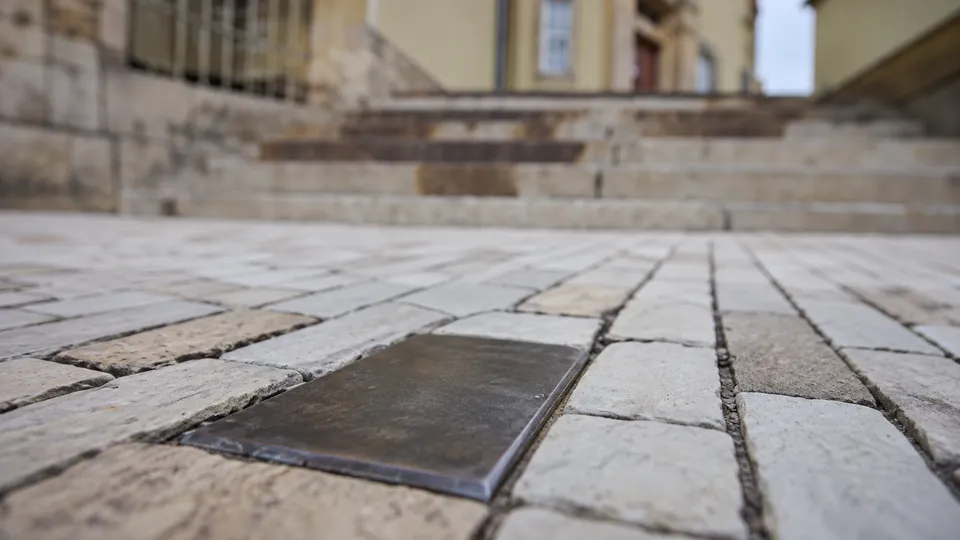
A stumbling block is 10 centimetres on a side. It is a cube faced in brass, set flush into the pavement in front of an ordinary house, and it records a catastrophe of a particular and ordinary kind: a name, a date of deportation, a place of death. The project — Stolpersteine, the German word for stumbling blocks — is the work of the artist Gunter Demnig, who began installing the plaques in the 1990s so that a citizen walking to the shop would, once in a while, trip over history with the eyes. The stones now number 116,000 across 31 countries, the vast majority of them in Germany. This week the town council of Heidenau, near Dresden in Saxony, voted that Heidenau will get no more of them.
The motion came from the local branches of the far-right Alternative for Germany (AfD) and the centre-right Christian Democratic Union (CDU), and the council backed it on Thursday, according to CNN. The parties’ stated difficulty with the stones was physical before it was historical: pedestrians, they argued, are “walking over or even stepping onto the names of the victims.” In place of brass underfoot, the two parties proposed that future Holocaust commemoration in Heidenau be gathered at the memorial site at the town’s northern cemetery, German media report. CNN has approached both parties for comment.
Opponents of the ban note that the quiet intrusion of the stones into daily life is not a flaw in the design but the design itself. Demnig has rejected the motion outright, telling German media that the blocks must remain visible in the specific places where people lived and worked, and that their presence on an ordinary street helps bring history to life for the young. He said he was not surprised by the vote, given the AfD’s recent electoral successes. Of the CDU, he remarked that the party “should perhaps drop its ‘C’. Because they’ve clearly left Christianity behind.”
Felix Banaszak, co-leader of Germany’s Green Party, called the decision a scandal and the stepping-on-names rationale “absurd.” “They bring the names and fates of the victims into our everyday lives and prompt us to pause for a moment,” he told German media. Charlotte Knobloch, a Holocaust survivor and the president of a Jewish association in Bavaria, offered a more complicated objection. Speaking to Germany’s Funke Media Group, she said she was herself no friend of the Stolpersteine concept — and yet she described the council’s decision as the “completely wrong path,” because “decentralized commemoration that is not banished from public spaces” is key to the country’s culture of remembrance.
The firewall, with a gate in it
The AfD has long contested the way Germany remembers the crimes of the Hitler years. In Saxony-Anhalt, where the party recently sealed its best-ever result in state elections, a prominent AfD official described the ambition to overhaul the state’s school history lessons as “more Bismark – less Hitler.” At the federal level the party has been designated a far-right extremist organization by German domestic intelligence, a designation now under review, and individuals within it have also been accused of extremism. None of this is new. What is new, and what has turned a municipal squabble in Saxony into a national argument, is the company the motion kept.
That company is measured against the Brandmauer — the firewall — the informal position of Germany’s mainstream parties ruling out cooperation with the AfD, intended to keep the far right out of decision-making and to stunt its growth. The firewall is under serious pressure, and the CDU’s willingness to pass this motion alongside the AfD has drawn criticism down on the party’s leadership at a moment when Chancellor Friedrich Merz, the CDU leader, is already in crisis over his party’s poor performances in recent regional elections. The International Auschwitz Committee called the CDU’s support scandalous, according to Deutsche Welle, and the committee’s executive vice president put the matter this way:
This is a transparent and despicable attempt to drive Nazi victims in Heidenau out of the city once again and dispose of them where, according to the AfD, their memory has belonged a long time ago — at the cemetery.
So the quarrel in Heidenau comes down, in the end, to a question of pavement. A brass cube, ten centimetres by ten: a name, a date of deportation, a place of death, laid where the named person last lived or worked. The council’s two parties propose the northern cemetery instead — a single address, at the edge of town, where commemorations may be kept together and out of the way of the walking public, which was, of course, the problem the stones were invented to solve.