
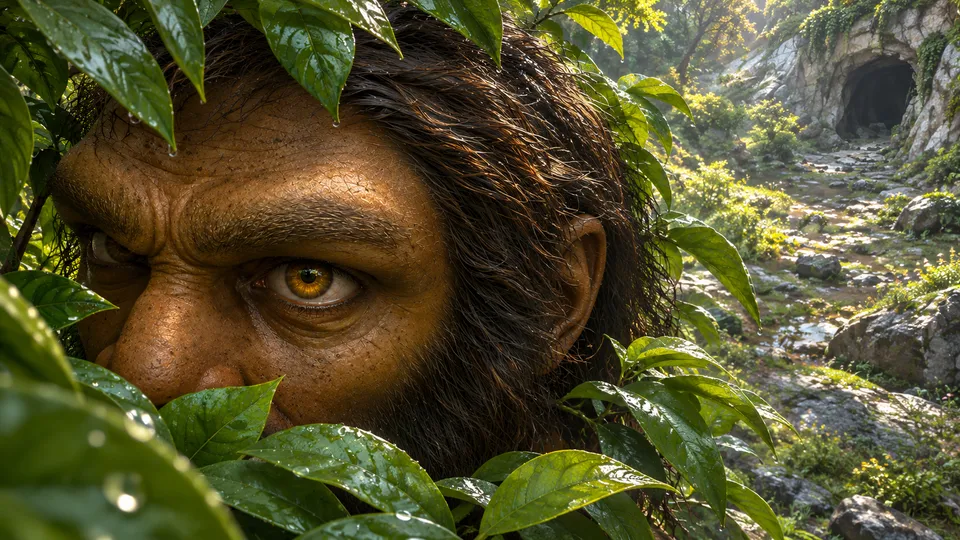
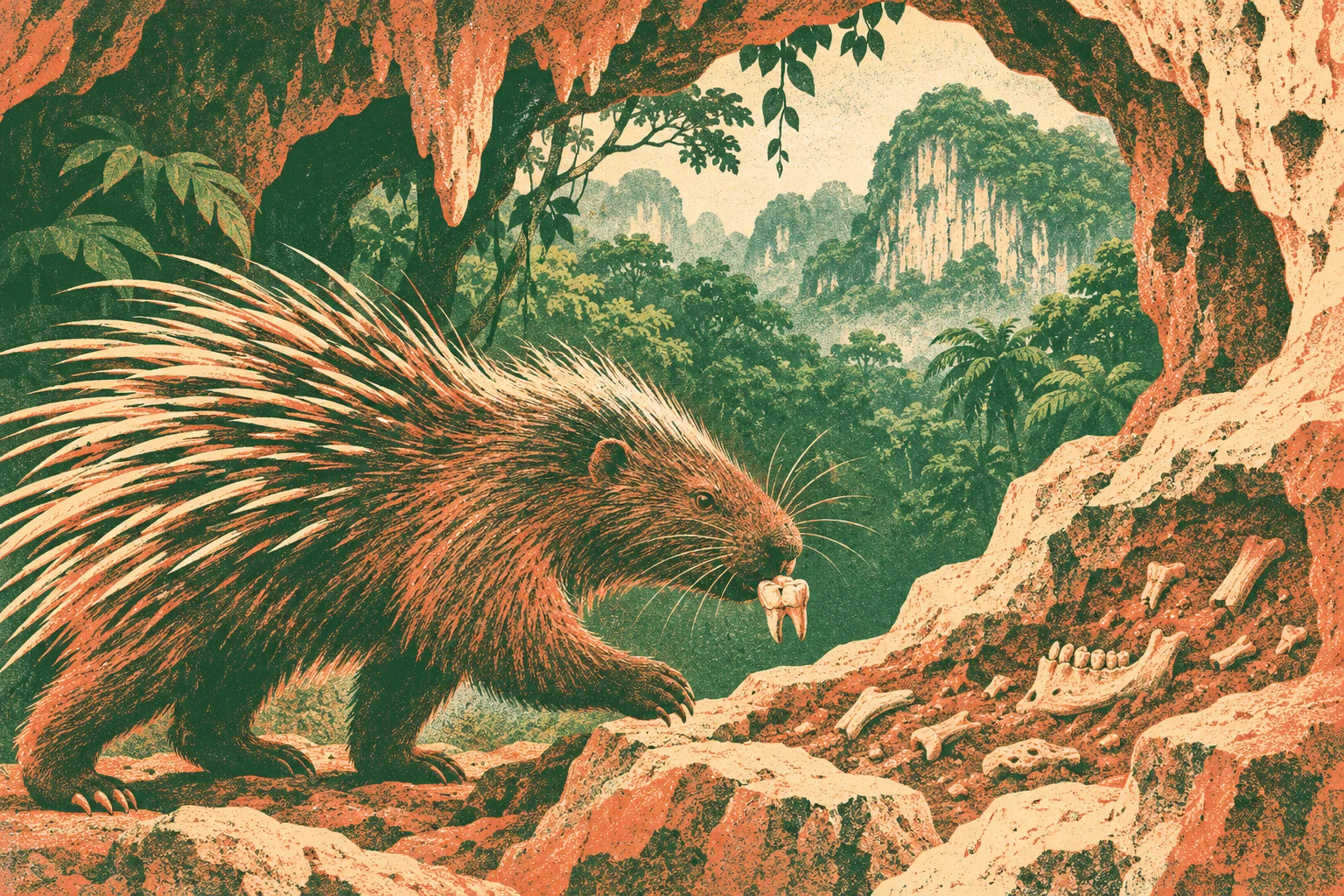
The deep past rarely leaves its records with historians. In two limestone caves near Chongzuo City, in China’s Guangxi province, the record keepers were porcupines. Over many thousands of years they dragged bones underground, the way porcupines do, and the bones set into breccia, a rock as hard as cement. More than 18,000 mammal fossils came out of Baxian and Naxian caves, which sit about 15 kilometres apart along a karst valley. Nine of the teeth among them were human, in the old, broad sense of the word.
Those nine teeth now fill a silence in the story of our genus that had lasted some 200,000 years.
A gap in the chronicle
The broad outline is well known. Homo erectus appeared in Africa more than 2 million years ago and had reached East and Southeast Asia, Indonesia included, by about 1.7 million years ago. China holds many of its fossils, at Zhoukoudian, where Peking Man was found, and at Hexian, dated to 410,000 years ago. Most of them lie in the north and centre of the country. On the mainland the trail stopped somewhere between 420,000 and 400,000 years ago. On Java the species held on far longer: the last population, at Ngandong, is dated to 117,000 to 108,000 years ago in the figures reported by ScienceBlog, while Ars Technica puts the upper end at 177,000.
So for two or three hundred thousand years the mainland said nothing. Two papers published in Nature on 18 November break that silence. One, led by Kira Westaway of Macquarie University and Renaud Joannes-Boyau of Southern Cross University in Australia, dates the fossils and reconstructs their world. The companion paper, with Wei Liao as first author, identifies them. As Kiona N. Smith wrote in Ars Technica, the University of Copenhagen paleoanthropologist Frido Welker and his colleagues did the work of naming the teeth.
What enamel remembers
DNA falls apart over a few hundred thousand years. Proteins in tooth enamel last longer, and like DNA they vary from species to species. The team recovered ancient proteins from five of the teeth. Four of them carried a single amino-acid change in the enamel protein ameloblastin that has so far been found only in Chinese Homo erectus. Measurements of the crowns and roots, and of the boundary where enamel meets dentine, assigned four more teeth to the species. That makes eight.
These people also carried a second substitution that other Asian Homo erectus lack, which marks them as a separate population that had branched off at some point. The researchers wrote that, “although based on sparse data, this hominin population might have diverged before the divergence of the common ancestor of modern humans, Neanderthals, and Denisovans”, a split that took place more than 600,000 years ago.
The dating was done five independent ways, on the teeth, on the cave sediments and on the flowstone sealing them. The team modelled 43 of 45 ages and found a 95 per cent probability that Homo erectus was in the area sometime between 324,000 and 184,000 years ago. The authors call it the youngest reliably dated occurrence of the species in China. How much this changes depends on which end of the range you pick. Even the oldest date extends the mainland record by at least 60,000 years. Macquarie University’s release uses the youngest and calls it 200,000 years.
The ninth tooth
One tooth from Baxian, catalogued as PA1796, does not belong to the eight. Its proteins match no known Homo erectus variant, and its shape matches neither Homo erectus nor Neanderthals nor modern humans, “strongly suggesting the presence of a hominin population other than Homo erectus in Baxian Cave,” the researchers wrote. They suggest it may be a Denisovan, the lineage some now call Homo longi. They go no further than possible, though. Its proteins do not exactly match any known Denisovan sequence, and no identified Denisovan molar of the right kind exists to compare it with.
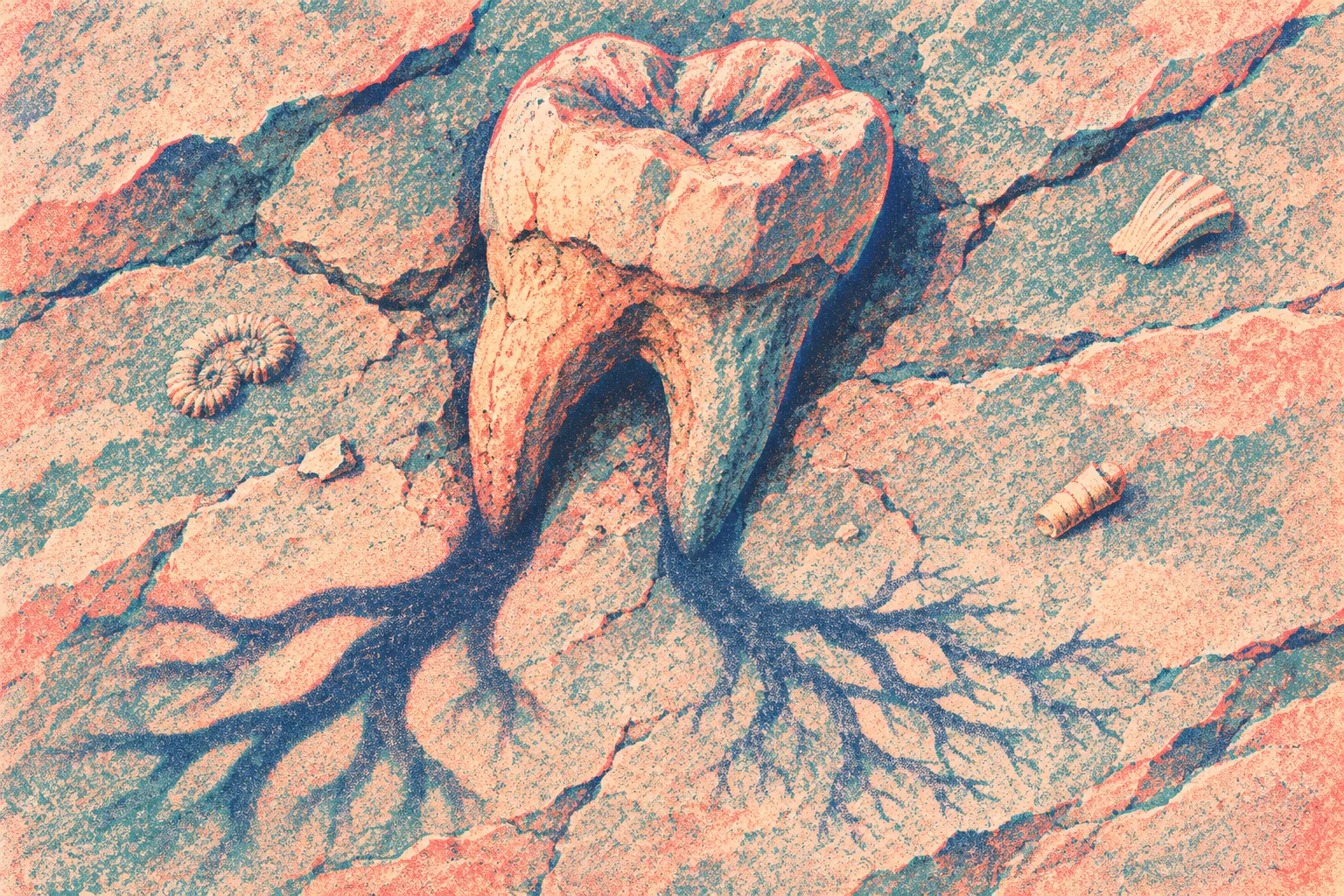
Still, Denisovans are known from other sites on the mainland at that time, and there is no evidence of any other species. “It therefore seems plausible that the Homo erectus population represented by the fossils from Naxian and Baxian Cave on the mainland existed in relatively close proximity to Denisovan hominins,” the authors wrote. Modern porcupines forage within a limited territory, so the teeth probably came from an area of less than 100 square kilometres. Whether the two kinds of people ever met is beyond what the evidence can show. Some fossils from southern China that may be Homo sapiens date back 100,000 or 120,000 years, so for a while the forest may have held two hominin species, perhaps three.
The forest that was supposed to be ours
Ideas about how Homo erectus lived came mostly from Javanese sites such as Trinil and Sangiran, which have been read as open woodland and grassland. The Ngandong people were thought to have lived in woodland refuges while rainforest closed in, and some researchers suggested that the spreading forest helped finish the species off.
Guangxi tells a different story. The fauna in both caves was mostly forest animals: orangutans, the extinct elephant relative Stegodon, a rhinoceros, relatives of modern cattle. Carbon isotopes in their enamel came in below the authors’ threshold for dense-canopy forest, with no trace of tropical grasses. Three Homo erectus teeth from Naxian gave values consistent with eating in that same closed forest. “In this case, the animal teeth and the Homo erectus teeth are telling the same story—these individuals were part of a rainforest ecosystem,” said Nicolas Bourgon of the Max Planck Institute of Geoanthropology in Jena.

His colleague Patrick Roberts said Homo sapiens is recognised as having adapted to rainforests around the world between 100,000 and 13,000 years ago. “This is the first clear, direct evidence we have for another hominin living within these habitats,” he said. The paper notes that the earliest archaeological evidence of our species regularly using rainforest is about 150,000 years old, from western Africa. The Guangxi dates are older.
Strontium in enamel reflects the local rock, and it hints at people on the move. The four individuals tested seem to have moved between different areas, or eaten food from them, between the ages of about two and six. Some signatures point as far as northern Vietnam, a range the authors estimate at around 250 kilometres and describe as tentative. “So we have a late-surviving Homo erectus population that shows signs of being flexible, adaptable and mobile — usually skills we associate with Homo sapiens, not ancient humans,” Westaway said.
What eight teeth cannot say
The authors list the limits themselves. The isotope evidence for the hominins rests on three teeth from a single cave. A 140,000-year window cannot show how long Homo erectus stayed or whether it lived there without a break. Two caves cannot show how common forest living was across the species’ range, and whether these adaptations belonged only to the late southern Chinese populations “remains to be seen”. They also caution that the rainforest may not have been the species’ ideal home, only one it could survive in.
For a long time our species credited itself with conquering the rainforest. Now it has to share the honour with an older kind of human, and the evidence comes from nine teeth that porcupines happened to collect.