
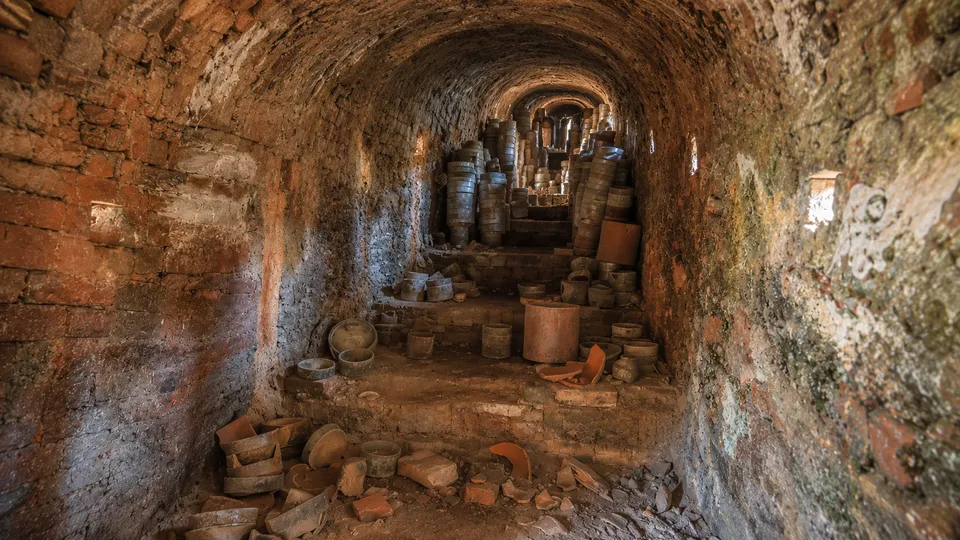
Potters in the hills of southeastern China were firing glazed vessels in kilns dug into the earth by about 1700 B.C., according to a study of nine dragon kilns at Kuzhaikeng in Fujian province that was published in the journal Antiquity and reported on Nov. 28 by Arkeonews.
The six authors, the first of them listed as Z. Chen, sorted the kilns into two phases and counted the debris. Proto-porcelain, the high-fired, lime-glazed ware that came before true porcelain, made up 483 of 2,175 classified fragments from the first phase, or 22.2 percent, and 1,416 of 4,011 from the second, or 35.3 percent. From those counts and from radiocarbon dates, they concluded that the technology may have grown up in several regional traditions rather than spreading out of Zhejiang, Fujian’s northern neighbor and the province long treated as its main early center.
The Fujian claim is older than the paper, and the record around it is less tidy. Local archaeologists announced Kuzhaikeng in 2016 as the oldest proto-porcelain kiln in China, 200 years older than Zhejiang’s leading candidate. The new paper’s own dates don’t support that margin. They put the two traditions in the same centuries. What Kuzhaikeng does document, kiln by kiln, is a second workshop tradition learning the same skills at the same time. Whether that makes Fujian a birthplace of porcelain depends on which of three thresholds counts: the first glaze on a high-fired pot, the first mature celadon or the first white, translucent body. Each was crossed in a different place, and the last two came more than a thousand years after these kilns went cold.
Nine kilns in a hillside
The site lies 674 meters above sea level near Zimei village in Jiefu township, Yongchun County, in the uplands of Quanzhou. Villagers planting ponkan mandarins there in the 1980s turned up shards that experts judged to be Shang or Zhou, according to a December 2016 report carried on the Quanzhou government’s website. A team from the Fujian Museum and the Quanzhou Museum began digging in November 2015.
That first season, which ran to January 2016, opened about 235 square meters and exposed nine kilns, according to the Chinese Academy of Social Sciences’ archaeology portal. Their floors rose at 5 to 15 degrees, their walls were 2 to 5 centimeters thick, and they had been cut into the hillside as tunnels rather than built above ground. The portal counted eight more kilns nearby at Liaotianjianshan, where the Antiquity paper says four were first identified in 2014. A second season late in 2016 covered about 350 square meters, work moved on to Mount Kengdao in 2017, and Kuzhaikeng was named one of China’s top 10 archaeological discoveries of 2016 when the list came out on April 12, 2017.
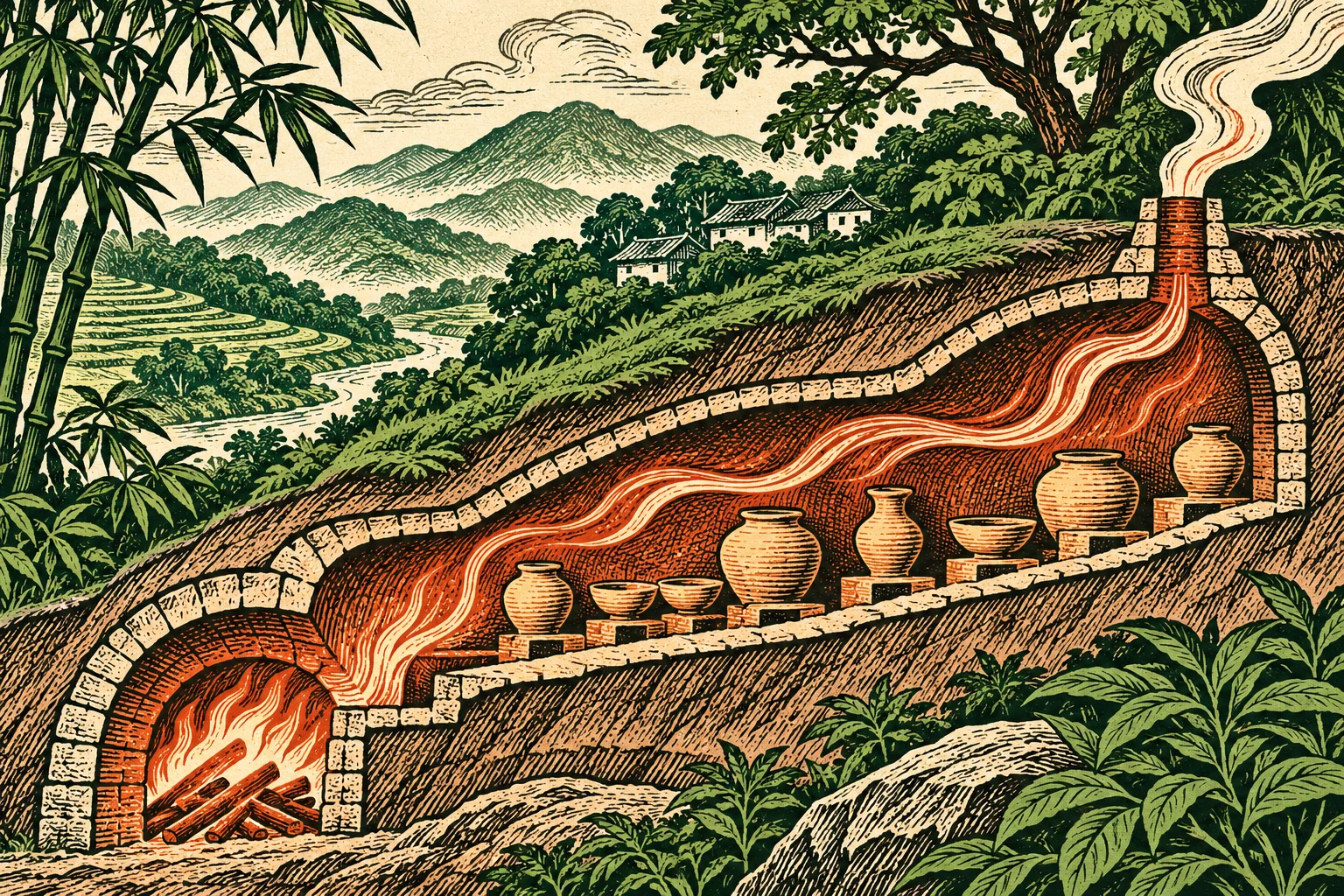
The Antiquity paper divides the nine into two generations by their architecture and by which layers sit on which. The early kilns ran about three meters long and one meter wide, with shallow fireboxes. Later chambers widened to 1.3 meters, and the kiln catalogued as Y7 stretched past four meters. Those extra 30 centimeters of width let the potters stack vessels in order. The authors suggest that deeper fireboxes may also have given better control over combustion and over how heat moved through a load.
The glaze shows the change more directly. In the first phase potters laid a thin coat mostly on the outsides of vessels, and it pooled, ran unevenly and peeled. In the second they glazed the insides as well, and sometimes the inside of the ring foot. That brought a new problem, since a glazed surface turns sticky at high heat and pots could fuse to one another or to the kiln floor. The answer was the dianbing, a small clay disc set between vessels, and the use of firing supports rose with the share of glazed ware.
Nothing was abandoned. Unglazed hard pottery kept coming out of the same kilns, scraped, stamped and patterned with the same geometric designs as the new ware.
How Zhejiang got the title
For decades China’s earliest glazed stoneware was a product without a workshop. Excavators at Yinxu, the Shang capital at Anyang in Henan, found hard, glazed vessels in 1929 that they could only call “glazed pottery,” a 2015 paper in PLoS One recounts, and the term proto-porcelain came into use in the 1960s. Finds at Erlitou, the Henan site associated with the Xia, pushed the ware back further. No kiln that old had been found.
Then, in June 2012, archaeologists excavated the Piaoshan kiln in Huzhou, in northern Zhejiang. Its zigzag decoration, read as an imitation of woven bamboo, dated it to the late Xia, and the PLoS One authors, a Fudan University group writing with Zheng Jianming of the Zhejiang Provincial Institute of Cultural Relics and Archaeology, called it the earliest proto-porcelain kiln ever discovered. Piaoshan sits in the Dongtiaoxi River valley, where the count kept climbing. Deqing County alone has more than 60 proto-porcelain kilns, some from the Shang, according to a University College London doctoral thesis by Yin Mingzhi, and more than 100 pre-Qin kiln sites are known in China, most of them in northern Zhejiang, China Daily reported in June.
The Fudan analysis also gave the southern case its chemistry. Proto-porcelain found at northern sites resembles the later porcelain of the south rather than that of the north, the authors wrote, in a passage on the long dispute over where the ware was made.
Moreover, to date no proto-porcelain kiln sites have been found in northern China.
Zhejiang never had the field to itself. Wucheng, a Shang town on the Gan River in Jiangxi first excavated in 1973, was judged in a study in the Journal of Archaeological Science to be a likely production center for some of the earliest proto-porcelain in China. Fujian had a claim on the kiln itself. In 2005, expressway construction exposed a Shang kiln group at Mao’ershan in Pucheng County, in the province’s north, and its sloping kiln was described as the earliest and best preserved dragon kiln in China when the site made that year’s national top 10. Excavators there called it possibly the ancestor of China’s dragon kilns, the Straits Metropolis Daily reported in 2006.
The 200-year claim
Kuzhaikeng’s excavators went further than any of them. Zhang Hongxing of the Quanzhou Museum, who led the dig, said more than 10 charcoal samples from the firebox floors had been sent for radiocarbon dating and had come back at 3,400 to more than 3,700 years old, the Quanzhou government’s site reported. He called Kuzhaikeng the earliest proto-porcelain site yet found in China and said it pushed the history of proto-porcelain firing back by 200 years. A 2020 series produced by Fujian Daily and the provincial heritage bureau went further and headlined the kiln group as the birthplace of Chinese porcelain civilization.
The Antiquity paper makes a narrower claim. It dates the main production to the Late Xia through the Middle Shang, about 1700 to 1300 B.C., which starts Kuzhaikeng in the same late Xia span the Fudan team gave Piaoshan. On those figures the two traditions overlap. Neither leads by two centuries. A 2018 analysis of 22 sherds from neighboring Liaotianjianshan, published in Ceramics International, put production there at 3,770 to 3,400 years before the present, which leaves room for an earlier start. The comparison is uneven either way: Kuzhaikeng’s age rests on charcoal dates, Piaoshan’s on the style of its decoration.
What the 2016 judges said about the site holds up better than the priority claim. The panel found that the stamped-hard-pottery zone of the southeast had invented glazed proto-porcelain on its own, at nearly the same time as the Dongtiaoxi basin, with each region building on its local hard-pottery tradition, according to the 2020 Fujian Daily account. It also found that Kuzhaikeng’s long tunnel kilns belonged to a different technical system from Zhejiang’s. Production later shifted to northern Fujian in the Western Zhou and died out in competition with eastern Zhejiang, the panel said.
The case against
The sharpest challenge to any southern origin comes from the northwest. At Lajia, in Qinghai province, a team led by X. Q. Zhou found a white ceramic fragment with a thin, uneven glaze in a layer left by the Majiayao culture, which preceded the Qijia culture of roughly 2400 to 1600 B.C. at the site. In a paper in Archaeometry they described it as possibly the earliest result of experiments with glaze in China. They found no kiln, and they judged there were probably no special kilns at all, since such pieces are very rare.
A second problem cuts against Zhejiang as much as Fujian. A 2023 study by a group including Zhang Bin of Fudan and Mr. Zheng, in Nuclear Instruments and Methods in Physics Research B, compared proto-porcelain from Erlitou and Yinxu with wares from five Zhejiang kilns. It concluded that the Xia-period pieces from Erlitou might not come from Piaoshan and that only a small part of the Shang material at Yinxu might come from Huzhou and Deqing. The authors cautioned that the Erlitou sample was small, and a 2025 study in npj Heritage Science found more overlap between Yinxu and the southern centers. Either way, the oldest proto-porcelain found in the north still has no kiln anyone can name.
A third objection asks what “on its own” can mean in a region where pots and methods moved. Fujian potters had the heat long before they had the glaze. Stamped hard pottery from the Nanshan site in Mingxi County, no relation to the Huzhou kiln of the same name, and from Yanzaidong in Jiangle County, both on the upper Min River, was fired at 1,100 to 1,270 degrees Celsius about 5,000 years ago, according to a 2024 study in the Journal of Archaeological Science of 160 sherds. The authors called the upper Min the core area where stamped hard pottery began, and the 2016 citation for Kuzhaikeng tied its patterns to that southern stamped-pottery tradition. If Fujian and Zhejiang both built on an older southeastern skill at high firing, separate invention and early contact are hard to tell apart in the sherds.
Some of the technology did travel. Michèle Demandt of Jinan University in Guangzhou argued in a 2019 paper in the Cambridge Archaeological Journal that a package including high-fired proto-porcelain and specialized dragon kilns reached Lingnan, in what is now Guangdong, from neighboring cultures in the Early to Middle Bronze Age. For Fujian’s own centers, the Antiquity authors say, how knowledge passed between them and whether trade followed the same routes is not yet known.
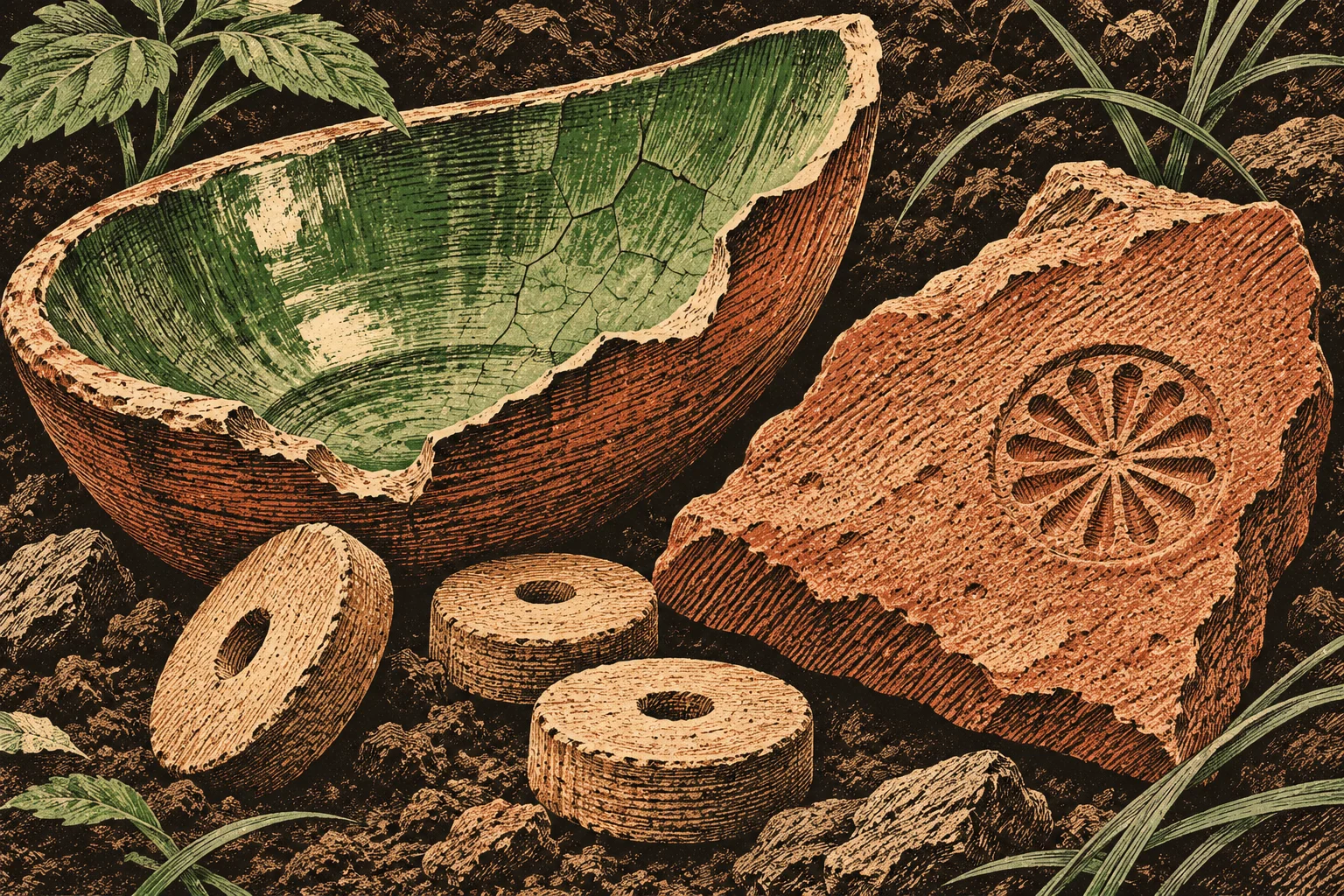
The last objection is about the name. Wenjing Li, Yue Chen, A. Mark Pollard and Changsui Wang argued in the Journal of Archaeological Science: Reports in 2022 that “proto-celadon” was a compromise term with no scientific basis. They proposed that any ware with a kaolin body, a high-temperature glaze and an original firing of at least 1,100 degrees counts as celadon, which would move celadon’s origin back to the Xia at least. Later papers have mostly kept the old term. Under that rule the argument over who made the first “proto” ware becomes an argument over who made the first celadon.
What the potters had to learn
Heat came first. Ordinary earthenware is fired at 700 to 800 degrees Celsius and proto-porcelain above 1,100, China Daily reported. Dr. Yin, Thilo Rehren of University College London and Mr. Zheng analyzed 54 proto-porcelain sherds and 18 other samples from eight Deqing kiln sites and found, in a 2011 paper, that the glazes formed at about 1,200 to 1,250 degrees, the range at which lime glazes mature. By their reading, potters reached those temperatures from the earliest period.
Then the clay. Southern proto-porcelain was made from porcelain stone, which forms, like kaolin, from weathered granite, according to the Dutch reference site Aziatische Keramiek. Proto-celadon bodies generally carry less than 3 percent iron. In the Fudan measurements, iron oxide fell from 4.29 percent by weight at Piaoshan to 2.53 percent at Huzhou’s early Shang Nanshan kiln, then held near 2 to 3 percent. The 2018 Liaotianjianshan study found local porcelain stone low in both iron and calcium, and it found that the stamped stoneware fired beside the proto-porcelain was high-fired too.
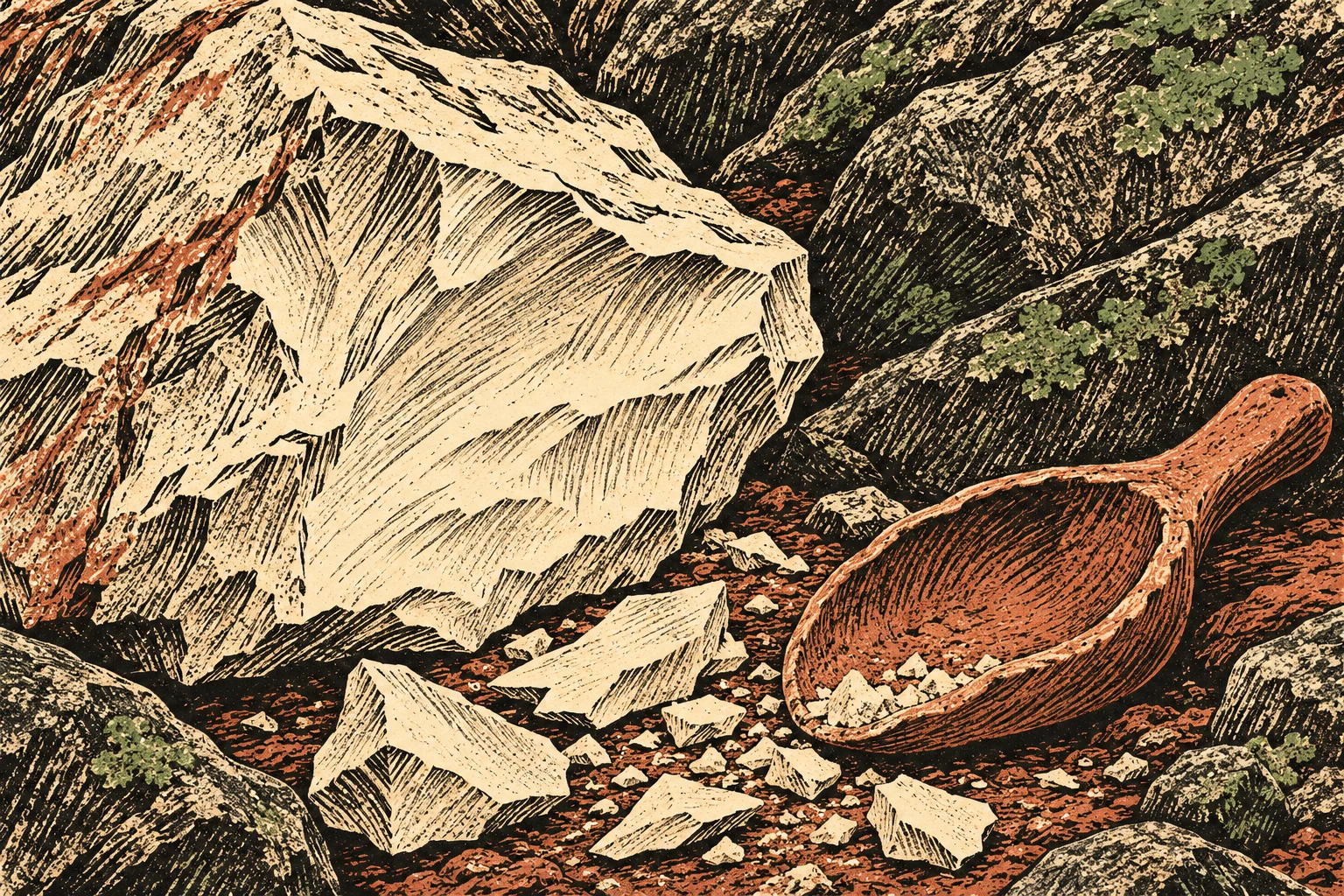
Then the glaze. The Deqing potters appear to have used wood ash high in lime and low in potash, and probably washed it first, the 2011 study found. Lime in Zhejiang glazes rose over the centuries, from about 6 to 10 percent by weight in the Xia and Shang to 17 to 18 percent by the Warring States, according to the Fudan data. Two Piaoshan glazes, at 4.92 and 7.08 percent, were in that team’s words “the earliest attempt of applying artificial calcium-based glaze.” At Liaotianjianshan the 2018 study identified high-calcium glazes made to two recipes.
And the kiln. A dragon kiln climbs a slope, usually at 10 to 16 degrees, so the hill itself draws the draft, and firing starts at the bottom and moves up, according to a summary of the type. Shang-period examples at Shangyu in Zhejiang ran about 5 to 12 meters. By the early 12th century some were more than 135 meters long, and later kilns could reach 1,400 degrees. Kuzhaikeng’s, at three to four meters, are smaller than the Shangyu kilns. The Qianshu kiln in Yixing, the only one in Jiangsu still fired with wood in the traditional way, runs 43.4 meters and holds about 8,000 pieces, China Daily reported last year.

Fujian’s next chapter was dug in the Wuyi Mountains. At Zhulinkeng, excavation of Kiln No. 1 began in 2025, and radiocarbon dates put the site’s work about 3,000 years ago, in the early to middle Western Zhou, China Daily reported. Tests by Nanjing University gave firing temperatures of about 1,220 degrees for the proto-porcelain and 1,190 for the stamped hard pottery fired with it. The older of the excavated kilns, IY4, is 7.8 meters long. Its successor, IY1, at 9.4 meters, added twin flues and a larger fan-shaped vent. “The larger the exhaust vent, the stronger the updraft,” said Yang Zelin, deputy director of the Fujian Provincial Institute of Archaeology and the lead excavator, who described the larger shift this way:
From pottery to protoporcelain was a true technological revolution in the history of porcelain.
Chemical fingerprinting tied much of the early to middle Western Zhou proto-porcelain found at Zhouyuan in Shaanxi and Liulihe in Beijing to Zhulinkeng, according to the China Daily account. No other kiln from that period is known in China. Mr. Zheng, now a professor at Fudan, said the gap had been “as if a complete history of ceramics was missing its central chapter.”
Three thresholds for porcelain
Chinese usage draws its line between tao, low-fired earthenware, and ci, high-fired ware, a category that covers both what Europeans call stoneware and what they call porcelain, in Smarthistory’s account. In the West porcelain is generally defined by translucency and in China by its ring when struck, according to Britannica. By the ci standard, glazed high-fired ware appeared in more than one southern center by the late Xia, Fujian among them, with one unexplained glazed fragment far to the northwest.
The second threshold is mature celadon, with a fully fired body and a glaze bonded to it. The usual date is the late Eastern Han, in the second century A.D., in Zhejiang. A sherd from that era’s Xiaoxiantan kiln in Shangyu was estimated to have been fired at 1,310 degrees, plus or minus 20, the 2022 celadon study reported, though the Yue-ware sherds its authors compiled ranged from 980 to 1,310 degrees and averaged 1,141. The Asia Society’s ceramics glossary starts porcelain at 1,280 degrees and puts stoneware at 1,150 to 1,280, and Western sources normally class individual celadon pieces as stoneware.
The third threshold, the white, translucent body Europe meant by porcelain, moves the answer north and later. Shan Huang’s 2021 doctoral thesis at University College London traced a sixth-century turn in North China, from dark lead-glazed earthenware at the end of the fifth century to celadon and porcelain by the end of the sixth, after southern celadon technology was carried north and adapted to northern raw materials. Early white porcelain came from kilns at Xingtai, Anyang and Gongyi, and while some of the finest pieces meet the European standard, many do not, Dr. Huang and Ian Freestone wrote in a later paper on experimental white stoneware from Luoyang.
The university’s archaeological science group posted about the early results in November 2017.
Shan Huang has found possible evidence for the pathway to white porcelain through analysis of early material from North China. #porcelain #ceramicanalysis
The southern line kept going. Dehua, in the same hills as Kuzhaikeng, became a white-porcelain center, and Fujian’s potters used porcelain stone alone, without the kaolin Jingdezhen added, according to Aziatische Keramiek. Surveys have found 42 Song and Yuan kiln sites at Dehua, and 783 of 3,042 pieces recorded in early surveys of the Nanhai I, a ship that sank in or soon after 1183, were Dehua-style, according to a 2024 paper in Antiquity whose authors include Mr. Yang.
What comes next
In 2020, Mr. Zhang said only kilns had been found at Kuzhaikeng, with no workshops, settlements or graves, so how the wares were made, where they went and who used them were unknown. Surveys and test pits from 2018 onward have counted more than 30 kilns across about two square kilometers and more than 10 kilns or settlement areas of the same period, the Antiquity paper reports. A survey in November 2016 had already found 13 more kiln sites around Liaotianjianshan and Kuzhaikeng, and Fujian Museum researchers have said older kilns may yet turn up.
Mr. Yang made the regional case to China Daily in June.
Fujian’s contribution to pre-Qin civilization has often been overlooked.
Jiefu township still lives on clay. Its kaolin reserves exceed 50 million metric tons, and its more than 80 tea-set makers turn out over 200,000 sets a day, about 30 percent of the national market, Lin Wenyong, the township’s Communist Party secretary, said in 2020. The master plan for an archaeological park at Kuzhaikeng runs through 2030.