
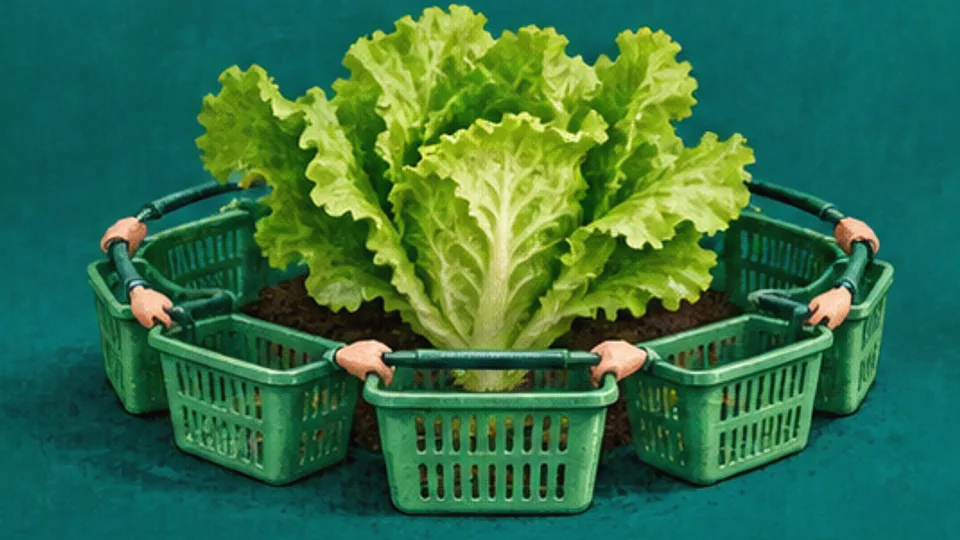
Amy Rubin paid $1.75 for a head of lettuce recently and did a double take. “There are lots of things that are much, much cheaper — to the point that sometimes I do a double take,” she told CBC News. The lettuce came from Fiddlehead Market Co-op, the grocery store her hometown opened for itself in July.
Bear River sits in Nova Scotia’s Annapolis Valley and is home to about a thousand people. The co-op already has 130 members — not bad arithmetic for a village. It stocks fresh fruit and vegetables, meat, dairy, dried goods, pantry staples, bulk products and cleaning supplies, plus a few takeout options. Anyone can shop there. A $100 share buys membership: a vote in how the co-op runs and a say over any surplus profits. People who would rather not pay can volunteer instead and join the same way.
The store exists because the alternatives wore people down. The nearest full-size grocers are fifteen minutes away in Digby or twenty-five in Annapolis Royal — real barriers in a community with no public transportation, for anyone without a car. Then there was what arrived after the drive. “The prices are, you know, inhumane,” said resident Drew Tozer, who now chairs the co-op’s board. “You’re getting produce that has been rotting on the trucks for 48 hours … It’s like half-spoiled because Nova Scotia is at the end of the food supply chain.” Rubin put it as a question to herself at the till: “You see your bill, like, oh, is that how much money I’m really giving this giant grocery store that doesn’t seem to be holding our best interests in mind?” In recent years, as CBC notes, the country’s biggest chains have faced backlash over rising prices, labelling, weighing practices, price discrimination and anti-competitive conduct.
So Bear River held meetings, wrote a business plan and a grant proposal, found local suppliers and painted a storefront. The co-op sources locally as much as it can, Tozer said, which keeps food fresher longer, keeps money near home instead of sending it to head offices in other provinces or countries, and — the lettuce — keeps some prices below the big boxes. Bear River’s small size is no impediment, she figures; it is the whole mechanism. “People have a really strong sense of pride and ownership over the endeavour. It’s not just a place where they’re getting groceries. People come in here and it makes them really emotional.”
The village already had food on offer — a convenience store selling hot meals, a gas station, a seasonal biweekly farmers’ market — and the co-op, Tozer said, worked with those businesses to fill gaps rather than compete. Rubin frames the store against wider uncertainty: “We’re living in times when things are pretty uncertain in terms of tariffs and in terms of trade. To be already building a sustainable source of things that we need is very comforting and it feels really good ethically.” For member Aly Coy, the draw is plainer: “My favourite thing is just seeing the people that you know and that you can just check in on and have good talks and build that resilient community.”
Nothing much is wasted. Food past selling goes to farmers as animal feed; imperfect produce is cooked into grab-and-go meals; the rest lands in the community kitchen or the community cupboard. And the idea is travelling — Tozer says someone on the South Shore has already asked about opening one. Her advice to other towns is uncomplicated: “You don’t need to fix the grocery store systems.… You can just create your own. And having the power as a community to govern your own grocery store and choose your prices and choose the suppliers and having that control over your food system is so inspiring and powerful.” It also, on the evidence of one head of lettuce, rings up at $1.75.