
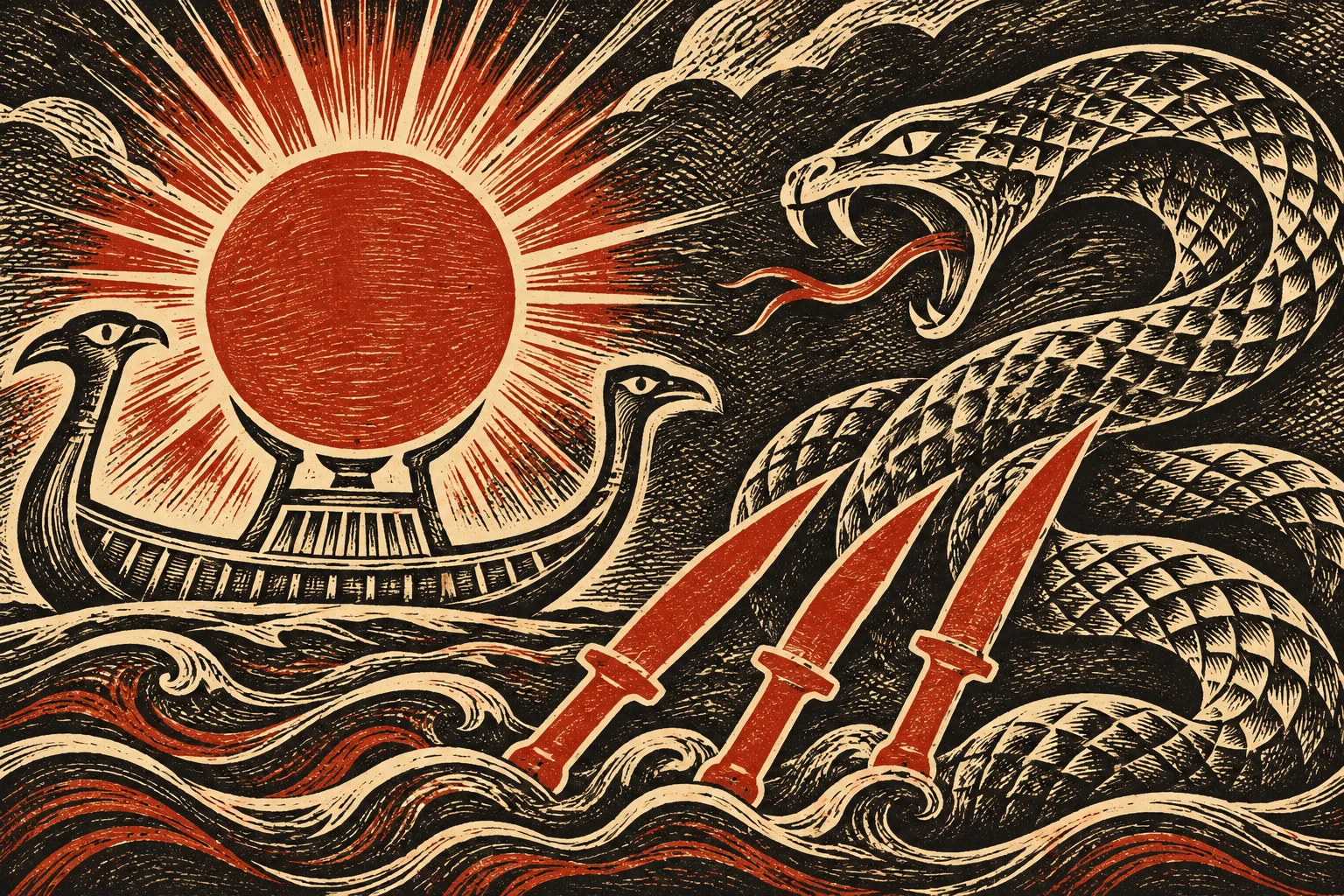
Each night, the Egyptians believed, the sun had to fight for its life. Ra crossed the underworld in his solar barque, and somewhere in the dark the great serpent Apophis, also called Apep, waited for him: chaos with a body. Dawn meant Ra had won. But the war never ended. The next night the serpent would be waiting again, and the priests would have to help the god again.
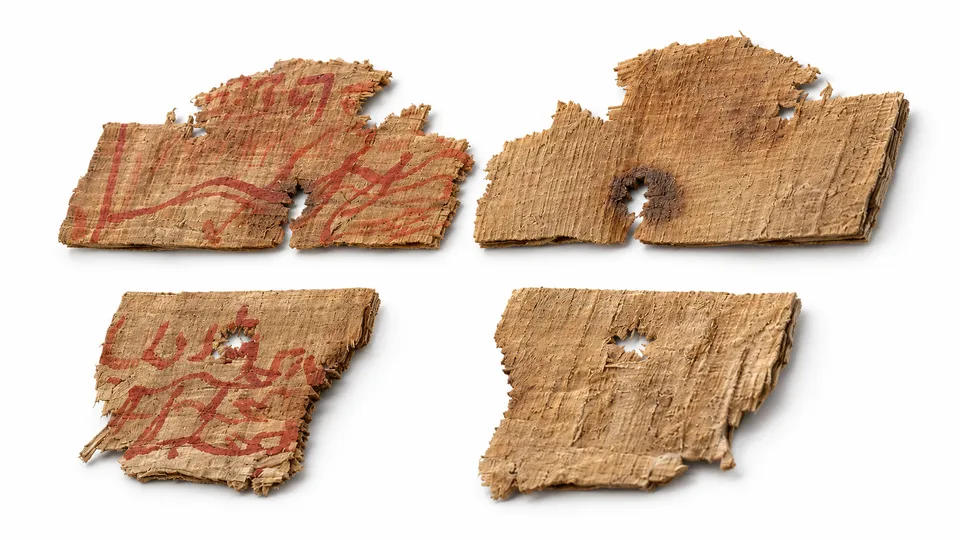
That help, it now seems, came in bulk. As Arkeonews reported, around 40 burned papyrus fragments from the mortuary temple of Pharaoh Thutmose III, on the west bank of the Nile near modern Luxor, are the earliest known direct evidence of a rite called the Overthrowing of Apophis. They are about 3,400 years old. The Egyptologists Fredrik Hagen of the University of Copenhagen, Carina Kühne-Wespi of Heidelberg University and Myriam Seco Álvarez of the University of Seville describe them in a paper, “Cursing Apophis: Text and Material Culture of an Egyptian Execration Ritual”, in the Zeitschrift für Ägyptische Sprache und Altertumskunde.
Behind the northern wall
An international archaeological and restoration project has worked at the temple since 2008. Between 2014 and 2025 its excavators pulled groups of papyrus fragments out of a rubbish dump outside the northern enclosure wall. The heap ran about 75 metres long and 10 to 20 metres wide, and in places it went three metres deep. Pottery found with the papyri tentatively dates the deposit to somewhere between the middle or late 18th Dynasty and the early 19th. The researchers think priests probably swept up what was left after ceremonies inside the temple and carried it out to be dumped.
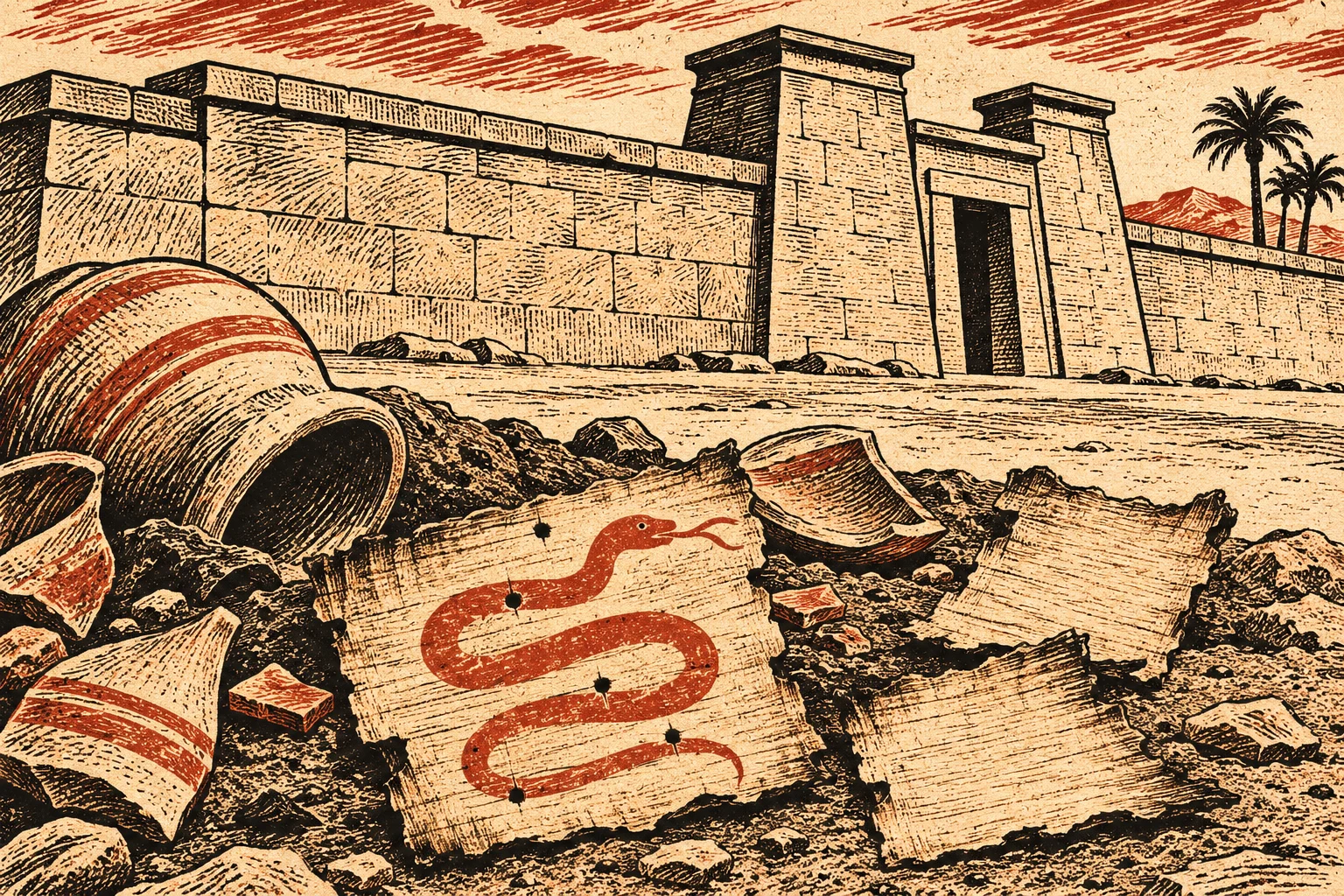
One reflection is hard to avoid. Pharaohs carved the version of themselves they wanted remembered into stone. The rubbish they threw over the wall tells you how the place was actually run.
Spit, trample, pierce, burn
Saying the words was only part of the rite. Participants spat on images of Apophis, stamped on them with the left foot, stabbed them with weapons and then burned them. The fullest set of instructions to survive is the Bremner-Rhind Papyrus, which dates to around 305 BCE and is now in the British Museum. Until now, that late manual was the main witness to the ritual.
The Theban fragments match it. Their edges are charred, and several have holes that may have been made by deliberate stabbing during the ceremony. The fragments “show signs of having been pierced and charred, which matches the ritual instructions remarkably well,” Hagen said, according to Phys.org. The fire was supposed to destroy them completely, so “we are extremely fortunate to have found any of them” in a state anyone can recognise.
One well-preserved scrap shows the serpent with three knives cutting into his body. A line of hieratic names him with two traditional epithets, “the Roarer” and “the Terrifying-of-face.” The same two names turn up in the Bremner-Rhind Papyrus, written down more than a thousand years later. Across ten centuries the enemy kept the same titles.
Chaos, cut to size
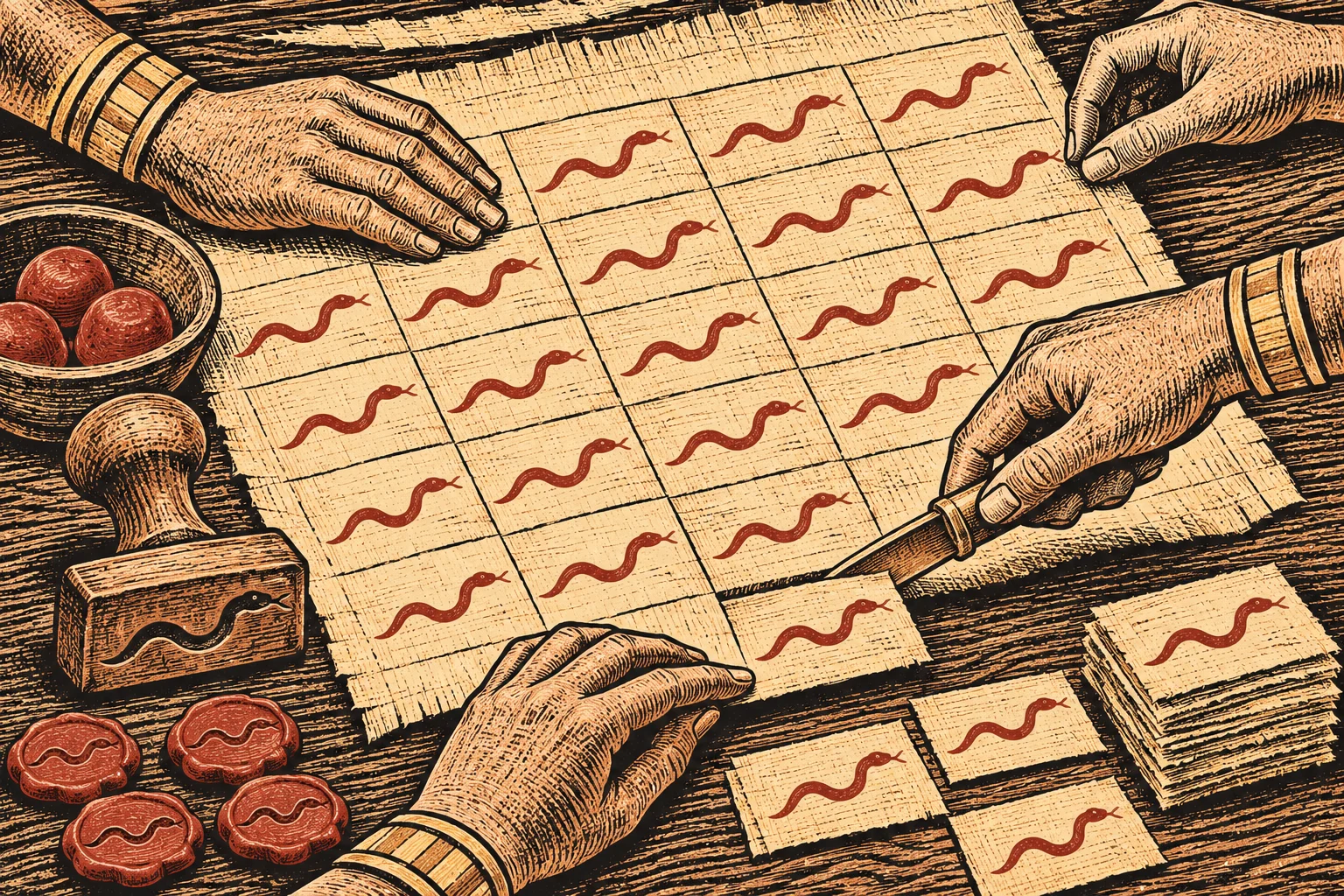
Twelve of the fragments show Apophis. Fourteen show the “Children of the Rebel,” mythological beings linked to the serpent. The rest are too damaged to identify with confidence. Scribes drew the images in red ink on fresh papyrus. Dividing lines on several pieces show that the images were drawn in rectangular compartments on larger sheets and then cut apart, into pieces roughly three to four centimetres by two to three centimetres. The University of Copenhagen puts each one at no bigger than half a postage stamp. The handwriting and drawing styles differ, so several scribes probably worked on them.
So the force that threatened to swallow the sun was answered with sheets of paper, ruled into boxes and divided among several clerks. The state that faced cosmic chaos dealt with it the way states usually do, by producing documents.
How often the rite was performed is still an open question. If each ceremony used one image of each kind, the fragments could stand for at least 20 separate rituals. The authors stress, Archaeology Magazine noted, that both the number and the regularity of performances remain uncertain.
Later material shows how the same method was used in other periods. A papyrus in the Metropolitan Museum of Art, catalogued as MMA 28.3.113, shows how scribes laid out such images before cutting them apart. Its reverse carries mirrored inscriptions, the only known systematic example of ancient Egyptian mirror writing in hieratic script. The researchers also suggest that priests may have made wax figures of the enemy with stamps or moulds. A relief at Philae Temple from around 110 BCE shows such a stamp.
Not only for the gods
The rite was about more than the cosmos. Egyptian religious texts also tied it to protecting the pharaoh from his enemies and helping ordinary people overcome threats in their own lives. Some instructions advised performing it during storms to keep bad weather away. Other inscriptions suggest that related spells may have been used to treat venomous snakebites and scorpion stings.
Magic was not reserved for the priesthood. “We know that literate people, including those who were not priests, had access to magical rituals,” Hagen said, and “people approached scribes for help in performing magic, both for protection and for attacking others.” Anyone who could write could, in principle, sell a curse. Anyone with a grudge, or a fear, could buy one.
In his view, the find shows that the ritual “was a regular part of temple life” in the New Kingdom and a “common feature of Egyptian culture more broadly.” Because papyrus and wax rarely survived being burned, the Theban scraps may be only a small fraction of a once widespread practice. They survived partly because, in Hagen’s words, “few people have paid much attention to such rather unglamorous trash dumps.”
Other papyrus scraps from the same ground come from the temple’s administrative archive and shed light on its economy and the logistics of its offerings. The curses and the accounts ended up in the same heap behind the northern wall.