
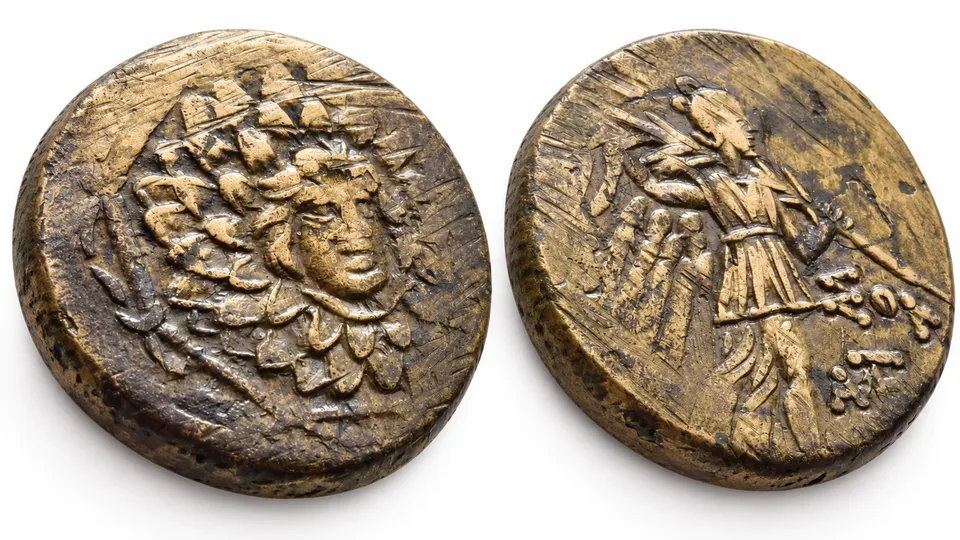
The coin is bronze, struck roughly 2,100 years ago in ancient Anatolia. On one side, Perseus stands over the headless body of Medusa, her severed head in one hand and a curved sword in the other. On the reverse sits Athena, the goddess who made the kill possible. A study by Şengül Dilek Ful of Tokat Gaziosmanpaşa University, reported by Arkeonews, reads the scene as more than mythology: a political message issued by King Mithradates VI of Pontus, one of Rome’s most formidable enemies.
The king who fought Rome three times
Mithradates VI ruled Pontus, a Black Sea kingdom, from approximately 120 to 63 BC — a reign of about 57 years in which his armies fought three major wars against Rome and tied down Roman commanders in a prolonged struggle for control of Anatolia. He sought to present himself as a champion of communities threatened by Roman domination, and his political messaging traveled not by speech but by coin, circulating through the cities and fortresses under his authority.
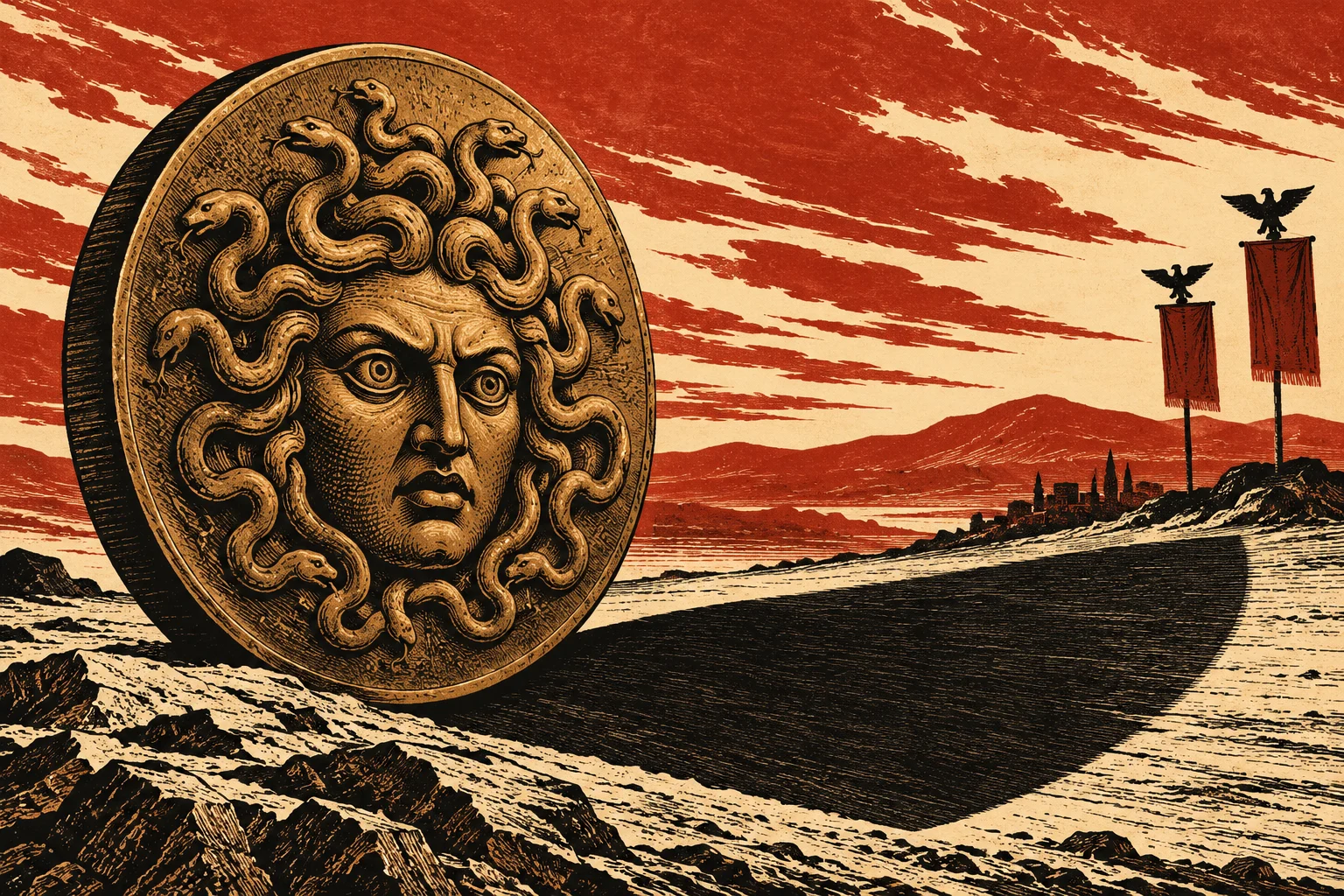
Ful examined coins minted in three ancient cities — Kabeira, Komana and Taulara, all within present-day Tokat Province in northern Türkiye — and compared them with sculptures, funerary monuments and smaller objects held in the Tokat Museum, tracing one mythological figure’s changing roles over several centuries.
Two coin types carry the argument. One shows Athena on the front and Perseus holding Medusa’s severed head on the reverse. The other places Medusa’s head on a shield or aegis, with Nike, the winged goddess of victory, carrying a palm branch on the opposite side. The myth needs little setup: Medusa was the only mortal among three monstrous Gorgon sisters, anyone who met her gaze turned to stone, and Perseus killed her only with divine assistance — then kept the head, whose power outlived its owner. For a ruler confronting Rome, the mapping was direct. Perseus was the hero who beat a nearly unbeatable opponent; the head was a weapon to turn on enemies. Ful, drawing on earlier studies of Pontic coinage, interprets the imagery as part of Mithradates’ broader political propaganda, legible to Greek and other Anatolian populations. A campaign poster small enough to spend at market.
Three cities, one message
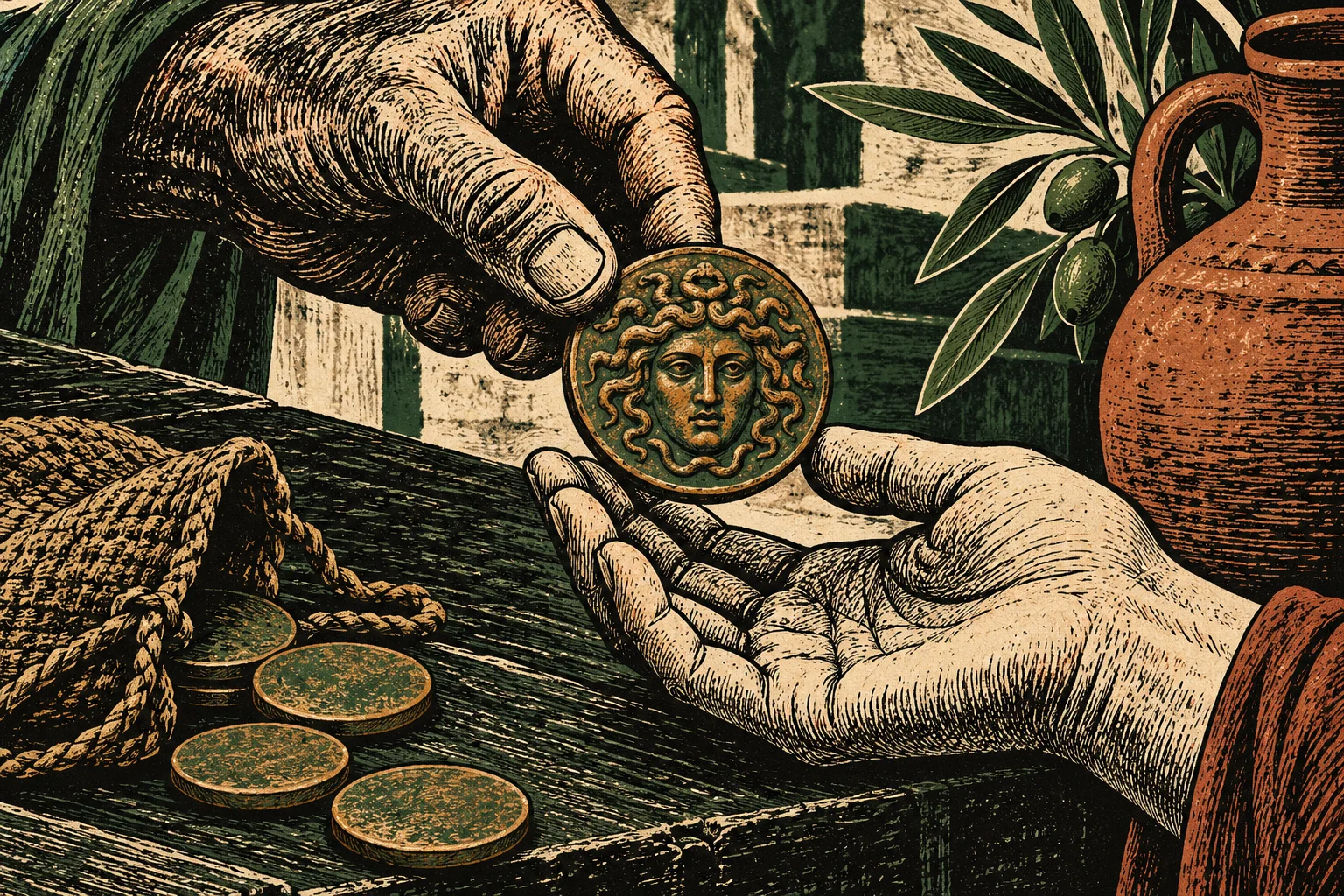
The repetition across mints is the telling detail. Kabeira and Komana both issued the Perseus-and-Medusa composition and the Medusa-and-Nike pairing. Taulara, a fortress associated with Mithradates’ royal treasury, issued coins showing Perseus displaying the severed head. The audiences differed — Komana was an important religious center, Kabeira held a prominent place in the kingdom, and Taulara’s treasury connection put the image inside the state’s own money apparatus — but the designs were shared, forming what Ful describes as a recognizable visual language of divine protection, heroic achievement and victory. Mithradates’ mints did not introduce an unfamiliar symbol; they borrowed a story Greek-speaking populations already knew, which is exactly what gave it political force: a mythical triumph needed no explanation.
Guardian of the dead
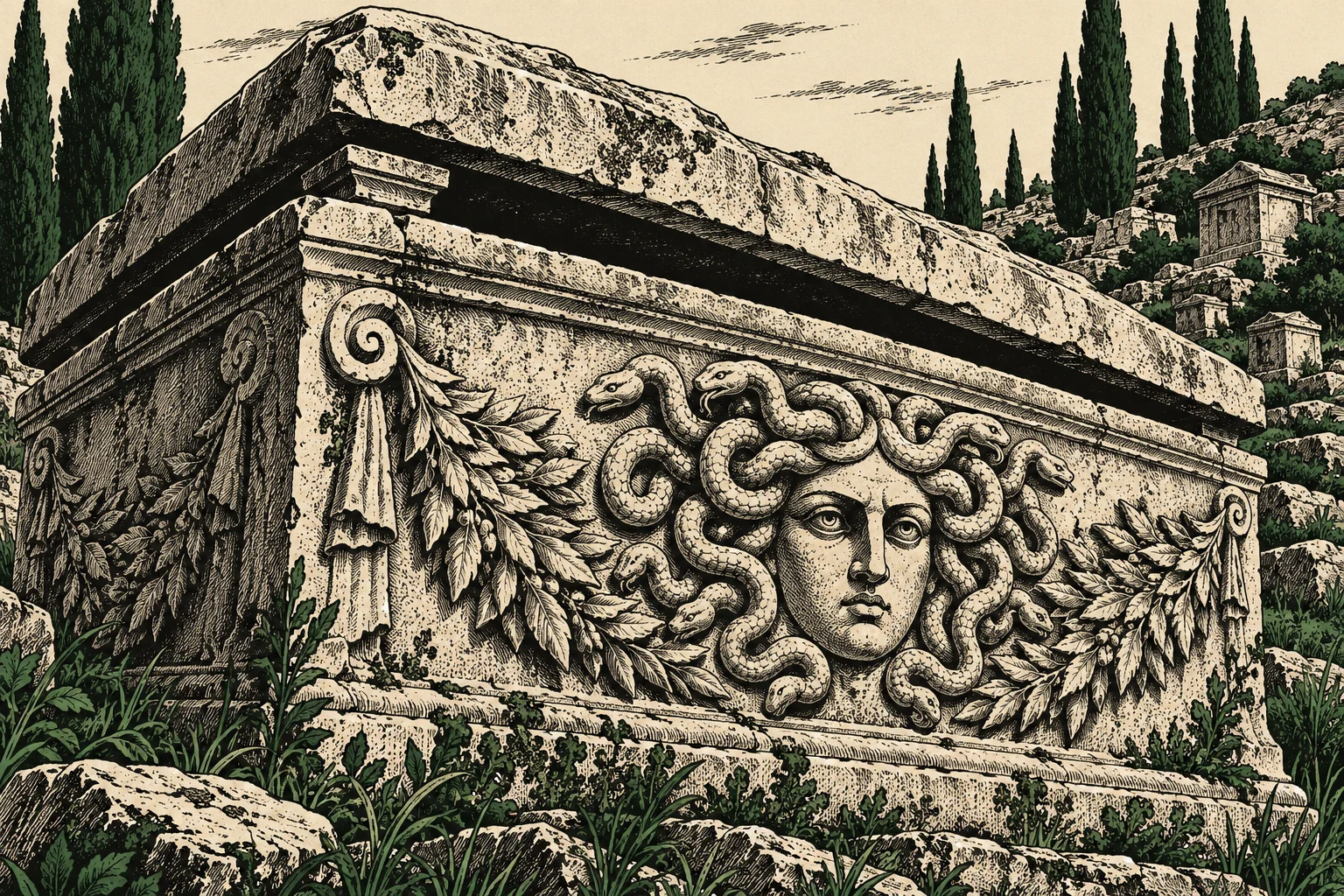
Medusa’s career in the region outlasted the kingdom that weaponized her. A marble sarcophagus fragment in the Tokat Museum, decorated with garlands, two Medusa heads and a nude Eros, was originally classified in the museum’s inventory as Hellenistic; Ful argues its stylistic features instead place it in the second century AD. A basalt funerary stele from the Niksar Leylekli Bridge necropolis, recovered in rescue excavations in 1982, dates to the third or fourth century AD and bears a six-line Greek inscription beneath a carved Medusa head. To ancient viewers, that face could reassure rather than terrify: archaeologists call such an image apotropaic, meaning an object believed to ward off evil. The same gaze that petrified enemies in myth made Medusa a suitable guardian of tombs, warning off intruders and protecting the dead from harmful forces.
When the monster became beautiful
Roman artists changed her face. Instead of snake hair and a grotesque mask, Medusa acquired the features of a beautiful young woman — rounder, calmer, framed by thick flowing hair, with small wings on her forehead left as the clue to her identity. The softer image did not necessarily strip the protective meaning; it could serve as elegant ornament while keeping its association with supernatural power. A terracotta plaque found in 2017 during excavations of a Roman bath at Sebastopolis shows the type: abundant wavy hair, small wings, and a channel on the reverse indicating it was built to be attached to another surface. Circular terracotta plaques and bronze appliques in the Tokat Museum carry similar faces. Objects of these kinds could decorate military equipment, horse harnesses, furniture and architectural fittings — though the precise original uses of the individual Tokat pieces remain uncertain. What the variety of materials shows is diffusion: Medusa had moved from royal coinage and monumental buildings into small objects in ordinary social and domestic settings.
The tail of the record is long. A Medusa relief on an architrave-frieze from Sebastopolis dates stylistically to the Antonine period of the second century AD, and a decorated orthostat block in the Tokat Museum is attributed to the middle of the fourth or the beginning of the fifth century AD — more than four centuries after Mithradates died in 63 BC. Ful does not claim an uninterrupted cult or a single meaning preserved across that span; the coins, tombstones, carvings and ornaments show successive generations finding new uses for a familiar face. The open question sits in the museum’s cases: what the small portable Medusas were actually fixed to, and for whom.