
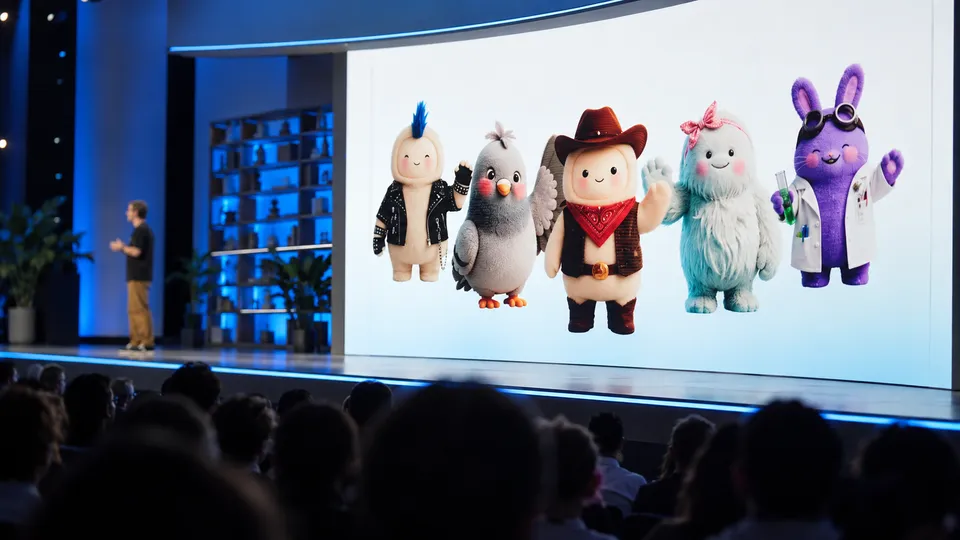
A year ago, Meta was the pupil at the back of Silicon Valley’s AI classroom, the one everyone gently agreed was falling behind. Now it has one of the industry’s hottest products. Its personal AI assistant, Muse, has shot to the top of the App Store, Meta’s stock is up more than 20% since launch, and this week’s Connect conference was essentially a festival in its honor. Alexandr Wang, the 29-year-old AI chief who has spent the week posting risqué memes of Muse’s mascot, called the app a “banger.”
According to employees who spoke to Business Insider, none of this was preordained. The project began life codenamed “Hatch,” and since September 2025 it has been led by Nat Friedman, the former GitHub CEO who heads the superintelligence unit’s Products and Applied Research team. “Muse is busy working for millions of people because of the hard work of a bunch of people at Meta — and we’re still cooking,” a Meta spokesperson said.
The inside story is less triumphant than the App Store ranking. As recently as two weeks before launch this month, the chatbot struggled with speaking good English, a person directly familiar with the matter said, and its eventual pass marks on coherence tests were met with enormous relief. Earlier this year some of Meta’s top AI employees tried it and came away worried: it felt like just another chatbot, one told Business Insider, but with a worse underlying model and extra steps.
The rescue operation involved tens of thousands of Meta employees testing Muse for months and generating the use cases that taught the agent to do actual errands — booking meetings, cancelling plane tickets — the grinding process Silicon Valley calls “hill-climbing.” The team also trained Muse in tact, so it would not, for instance, cheerfully inform your colleagues you skipped a meeting because you were hungover, and drilled it on smoothly using internet tools it had never touched before. “Our researchers did a ton of work teaching agents how to choose the right tool for a job,” Wang said at Connect.
Friedman himself arrived via a deal in which Meta bought a stake in his venture fund, NFDG, and last year he and Wang cowrote a memo sketching a “superintelligent personal sidekick” that would act as trusted friend and adviser. Internally he is described as opinionated and proud of it; communications chief Andy Stone recently dubbed him “Nat the Truthteller” after he dismissed a report about Muse’s security as written by “dummies.” His personal website states the philosophy plainly: “slow is fake” and “it’s important to do things fast.” He has pushed Meta’s AI staff off slow internal tools and onto faster outside ones like Vercel.
When the independent AI agent OpenClaw became the hit of the winter — beloved by developers, baffling to everyone else — Friedman moved quickly to build a more accessible version from scratch, circulated a two-page internal memo titled “The Claw Is The Law,” and bought hundreds of Mac Minis for the superintelligence team to run the agent on.
Making Muse consumer-ready took “months of blood, sweat, and tears,” the person familiar said, and a “long ass time.” The result, Wang later posted, is something anyone’s “grandma can use.”
Meta also went on an agentic-AI hiring binge, acquiring the Dreamer startup’s cofounders David Singleton and Hugo Barra along with their whole team; Singleton, who joined in March, posted on X that he helped design the core technology letting Muse store sensitive information securely. Meanwhile OpenAI pulled off its own coup by hiring OpenClaw’s creator, Pete Steinberger, earlier this year. Meta’s team had braced for a large competitor to upstage it and was, the person familiar said, shocked as the months passed without one; the viral agent Instinct upstaged Meta early on, but Muse rode the company’s built-in audience across its apps — reaching people who had never used an AI agent at all.
Wall Street likes the plot. Zuckerberg told Alex Heath’s Sources earlier this month that he wants people shopping and saving money on Muse, with Meta taking a small cut of each transaction. “We see the Meta bull case increasingly playing out,” Mizuho Americas analyst Lloyd Walmsley wrote. Users praise the setup, or rather its absence: RevelAi cofounder Hadi Javeed said his father saw a Muse ad in his Facebook feed, downloaded it, and promptly bought shoes. “They completely deleted all the setup that was required,” Javeed said.
Javeed also flagged, as others have, the privacy arithmetic: an app like Muse requires broad access to your accounts to function, and by design creates new risks, such as buying things without the user’s permission. Bank of America analysts called privacy and trust key roadblocks to wider adoption. Zuckerberg has said the launch was held back over safety and product-liability concerns, and that he and Friedman personally recruited Signal creator Moxie Marlinspike to co-design Muse’s security architecture. The company remains one where employees have endured mass layoffs, employee surveillance and low morale — which is why, employees said, a hit is a morale boost.
More is promised: a new AI model called Watermelon, which Meta says has already caught up with OpenAI, plus other ideas “just as big” as Muse. “The kitchen is just getting warmed up,” Wang posted on X.
It took months, thousands of employees and a small fleet of computers to teach a machine not to say why you really missed the meeting. Corporations take longer to learn such discretion, and they rarely score well on coherence tests.