
An outpost is a settlement that hasn’t been legalized yet. The distinction matters only on paper: under international law every Israeli settlement in the occupied West Bank is illegal regardless of status, and under Israeli domestic law an outpost is simply a settlement built without the government’s prior sign-off. The gap between the two gets closed later, usually with money. In 2024, settlers founded 62 new outposts backed by 75 million shekels ($20m) in government funding, and the Israeli watchdog Peace Now has tracked at least 100 million shekels ($30m) more in state transfers for roads, vehicles, drones, cameras and electric gates at outposts and the “farms” attached to them, as Al Jazeera reported.
The pace has accelerated since the end of 2022. The research group ACLED, drawing on Peace Now’s outpost registry, counted 32 new outposts in 2023, 61 in 2024, 92 in 2025, and 74 more in the first eight and a half months of 2026 alone — a cumulative 259 since January 2023, of which 186 were “farm” outposts, livestock operations that let a handful of settlers claim grazing rights over land far beyond any fenced perimeter, according to ACLED’s report. Peace Now and the land-use group Kerem Navot put the land these outposts now effectively control above 1 million dunams (100,000 hectares), roughly 18% of the West Bank and about a third of Area C, the zone under full Israeli control — four times the area outposts held before the current government took office in December 2022.
| Farm outposts (outposts) | Other outposts (outposts) | |
|---|---|---|
| 2023 | 24 | 8 |
| 2024 | 43 | 18 |
| 2025 | 62 | 30 |
| 2026 (to Sep 11) | 57 | 17 |
Source: ACLED, using Peace Now data
Legalization comes in batches. On March 25, Israel’s security cabinet approved 34 new settlements — 24 entirely new sites, 10 of them existing outposts granted retroactive legal status — a decision kept confidential for two weeks, which Peace Now said was to avoid angering Washington during the Israel-Iran fighting, before it surfaced in press reports in April, according to Peace Now’s account. It was the largest single legalization of unauthorized outposts in Israel’s history and brought the current government’s total approvals to roughly 102–103 settlements since 2022, a 78% jump over the total Israel had approved in the 30 years between the Oslo Accords and this government taking office, during which only six settlements were formally approved. By July, declassified budget lines put 1.3 billion shekels ($434m) toward moving settlers and expediting the process, plus another 1 billion shekels for infrastructure — a scale that led the IDF’s chief of staff, Lt. Gen. Eyal Zamir, to warn lawmakers the army lacked the manpower to secure it.
The olive harvest is where the funding and the violence meet the ground. The UN’s humanitarian coordination office, OCHA, recorded 199 settler attacks tied to the harvest between September 1 and October 12, killing one Palestinian, injuring 124 and damaging more than 2,500 olive trees and saplings — about 80% of those incidents in the final two weeks of that window. By October 20, the UN’s deputy spokesperson put the running total above 200, already past the 185 attacks OCHA documented across the entire 2025 harvest season, a season that itself ran roughly twice as long. This year’s attacks have also spread into Areas A and B, nominally under Palestinian Authority control, where previous harvests saw comparatively little settler activity. As rews reported, the 2026 season broke last year’s full-season record before October was over.

Musa Bani Shamsa, 57, from Beita southeast of Nablus, found that out on October 14. Masked men carrying pistols, knives, pipes, sticks and a hammer surrounded him and his 17-year-old son in their own grove. The beating ran roughly 20 minutes; Shamsa lost consciousness and bled on the ground, and he told Al Jazeera he believed the attackers left only because they thought both of them were dead. Three days later his son still could not speak. Shamsa identified the attackers as coming from a nearby outpost. He intends to keep harvesting — residents in Beita now start at 5am, block access roads with stones, post lookouts with binoculars on rooftops, and finish the picking after dark by phone light, because the alternative is giving up the olives, and sometimes the land, outright.
How a tent becomes a legal claim
The mechanism Shamsa fears is not paranoia; it’s codified. Israel administers West Bank land titles through a patchwork of Ottoman, British Mandate and Jordanian law layered with Israeli military orders, and one surviving Ottoman provision lets the state claim as its own any land left uncultivated for a set number of years. Khalil Tafakji, a cartographer who has tracked settlement expansion for decades, told Al Jazeera that a single tent, flag or livestock pen is often the opening move: it establishes a presence that, over time, converts into control of the surrounding farmland and pasture, frequently sited to link two existing settlements. Tafakji called the pattern “a process of uprooting and replacement,” and noted that even a Palestinian landowner who wins a court case over disputed title can still lose the land afterward if a military governor declares it a closed military zone. Shamsa said settlers had already demolished a tent he kept on his own plot for roughly six years; he fears that if fear keeps him off the land too, the state could eventually treat the grove itself as abandoned.
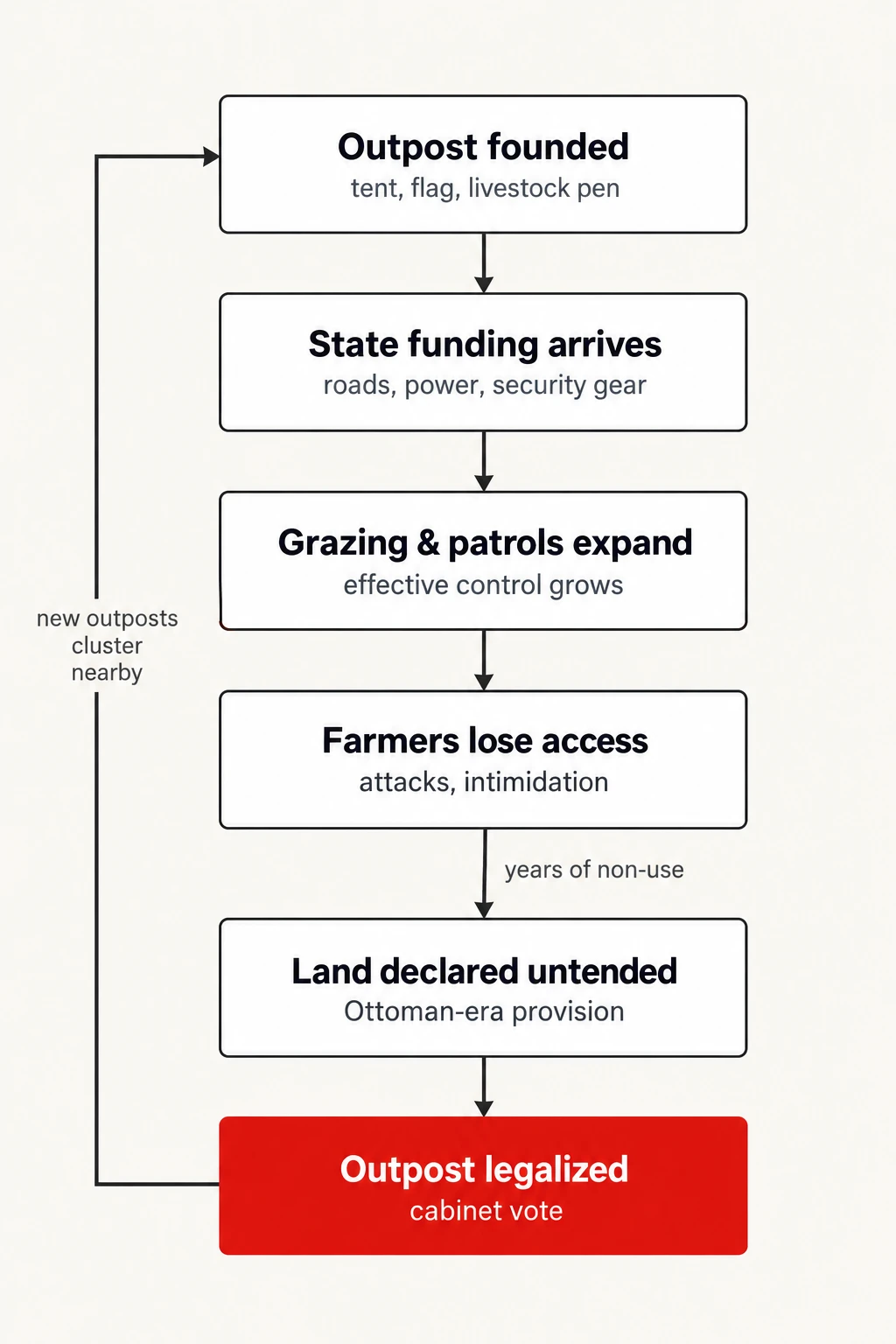
| From | To | How |
|---|---|---|
| Outpost founded (tent, flag, livestock pen) | State funding arrives (roads, power, security gear) | |
| State funding arrives (roads, power, security gear) | Grazing & patrols expand (effective control grows) | |
| Grazing & patrols expand (effective control grows) | Farmers lose access (attacks, intimidation) | |
| Farmers lose access (attacks, intimidation) | Land declared untended (Ottoman-era provision) | years of non-use |
| Land declared untended (Ottoman-era provision) | Outpost legalized (cabinet vote) | |
| Outpost legalized (cabinet vote) | Outpost founded (tent, flag, livestock pen) | new outposts cluster nearby |
Based on Peace Now; Al Jazeera reporting
Beita has already run the loop once. Evyatar, an outpost on land belonging to Beita and the neighboring village of Qabalan, was first put up in 2013, repeatedly dismantled, rebuilt in 2021, and legalized as a settlement by the cabinet in June 2024. Residents told Al Jazeera that three smaller outposts have since sprung up around it. Rabee al-Sharafa, who lives on Beita’s edge, described the sequence to Al Jazeera as a “string of prayer beads that comes apart”: in March, ten masked men armed with machetes and axes threatened one family until it fled; a second house emptied in June; a third family has had its water and power cut since early October. He said settlers typically draw power illegally from nearby lines first, and “the electricity company comes and extends it to them” afterward — infrastructure legalizing itself alongside the land.
Impunity by the numbers
Accountability for the violence that enables this has been close to nonexistent for two decades. The Israeli group Yesh Din has tracked 1,701 police investigation files into Israeli civilian offenses against West Bank Palestinians opened since 2005; of the cases it monitored through 2024, 93.8% closed with no indictment, 109 led to an indictment (6.4% of the total), and only 53 produced a full or partial conviction — about 3% of every file Yesh Din has tracked, according to the organization’s own 2005–2024 data sheet. Most closures, Yesh Din found, trace to police failing to name a suspect or gather usable evidence — not to insufficient evidence of a crime having occurred. Separately, in documented 2024 incidents, 66% of Palestinian victims declined to file a complaint at all, which Yesh Din attributes to distrust in a system whose own numbers justify it.
| Cases (cases) | |
|---|---|
| Investigations opened | 1,701 |
| Indictments filed | 109 |
| Convictions (full/partial) | 53 |
Source: Yesh Din
Shamsa’s own question to Al Jazeera was rhetorical in form but not in substance: who exactly is a Palestinian farmer supposed to complain to, when the people with arrest power are the same army that Beita residents say stands by during attacks and intervenes only once they’re over. The funding figures, the outpost counts and the conviction rate are all numbers the Israeli state’s own watchdogs and the UN’s own monitors publish; none of them are in dispute. What’s unmeasured is the next harvest season, and whether the 74 outposts founded by September 2026 will, by this time next year, be the ones a cabinet vote is legalizing.