
You might think the hard part of catching a burglar would be noticing the burglar. Human cells take a lazier and rather cleverer route: they listen for the sound of their own furniture smashing. A study published Aug. 18 in Proceedings of the National Academy of Sciences shows that when an enveloped virus slips into a cell, the cell detects the intruder not by recognizing it, but by finding its own DNA lying in the wrong room.
Researchers studying enveloped viruses — the kind wrapped in a fatty coat, like herpes simplex virus — have known for years that a cell fires its interferon defenses within an hour of a virus arriving. They also knew the alarm protein: cGAS, which detects loose DNA floating in the cell body. Two things stayed mysterious. Where does that DNA come from? And how could RNA viruses, which have no DNA at all, set off the same alarm? A popular theory held that some virus particles burst early, before reaching the nucleus; the alternative, that the spilled DNA was the cell’s own, raised the awkward question of why it would leak.
Experiments led by first author Nicolás Romero, then a postdoctoral fellow at Harvard Medical School and now at Tufts University, filled in the gap. Using human cell cultures and a herpesvirus modified so it could not replicate, the team found that when the virus fuses its envelope with the cell’s outer membrane, the entry sets off turbulent contractions in the actin microfilaments — the scaffolding that gives a cell its shape. Those tremors crack the membrane around the nucleus, and fragments of the cell’s own DNA are expelled into the cytoplasm. There, cGAS spots them, sounds the alarm, interferon is recruited, and protective molecules move in to block the infection.
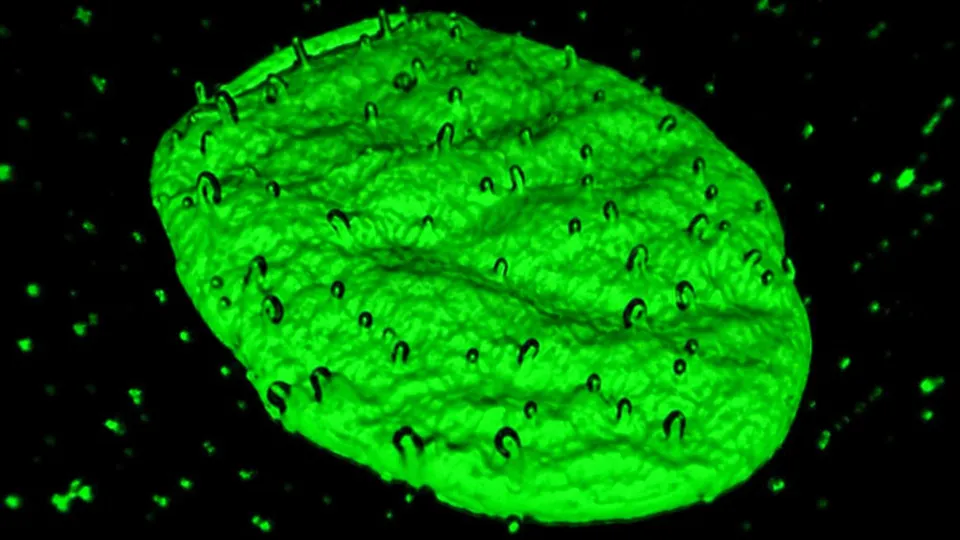
The team confirmed the sequence with light microscopy, transmission electron microscopy and immunogold labeling, using Harvard Medical School’s MicRoN core and Electron Microscopy Facility. The images matter, because “the nucleus broke and the DNA fell out” is the kind of claim you want to see rather than be told.
Crucially, the mechanism is not a herpesvirus quirk. Follow-up experiments found that any enveloped virus entering by membrane fusion — including parainfluenza virus and others of real concern to human health — triggers the same response. Two non-enveloped viruses, which cells admit through the ordinary transport process of endocytosis, caused neither the DNA spill nor the interferon. Entry method, not viral species, is the whole story: fusion shakes the house; the house trips.
“It’s important to understand the details of how viruses and the body’s immune system interact, because those details give us a better idea of how we can use the same techniques to build better medicines,” said senior author David Knipe, the Higgins Professor of Microbiology and Molecular Genetics in the Blavatnik Institute at Harvard Medical School, who has spent decades studying the cellular contest between herpesvirus and the immune system.
The payoff, Knipe said, could reach vaccines, gene therapies and oncolytic viruses — engineered viruses that infect and kill cancer cells. An engineered oncolytic herpesvirus is already licensed against melanoma, designed to exploit immune mechanisms to target tumors; similar work has been used to damp innate immune reactions when inactivated herpes simplex serves as a gene therapy vector, and to tune vaccines.
“By understanding how cells and viruses operate, we can crank up the immune response or dampen it, depending on how we want the virus and the body to behave,” Knipe said. “It may sound far-fetched, but it’s already starting to happen.”
He is also candid that the result came from curiosity rather than a product roadmap. “Answering chains of puzzling questions without obvious, immediate utility enables us to engineer unexpected mechanisms we wouldn’t have been able to conceive of otherwise,” he said. That is a polite way of stating the oldest bargain in basic science: you fund the puzzle, and occasionally the puzzle hands you a medicine. In this case, the cell’s ingenious tripwire — a little self-vandalism as a security system — turned out to be worth understanding on its own terms.