
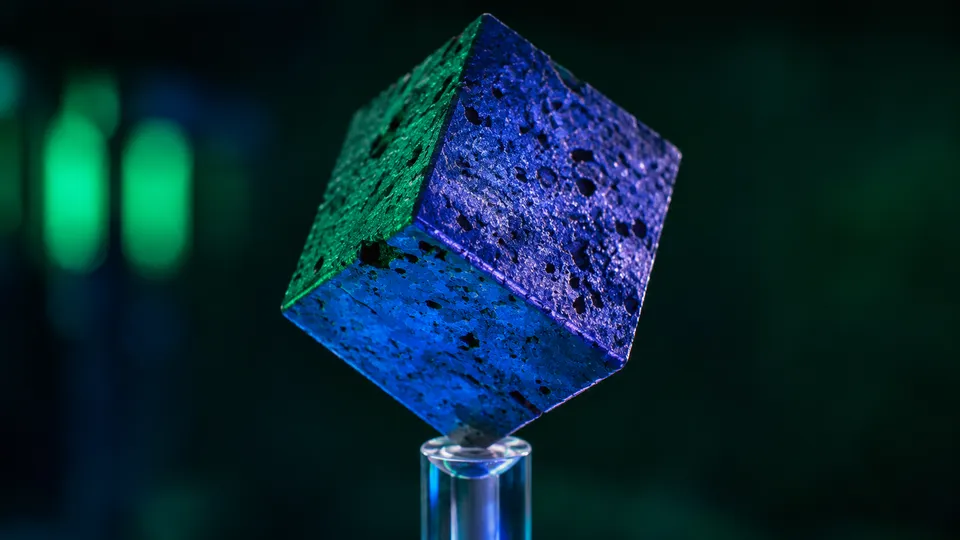
Werner Heisenberg’s last wartime reactor fell short of a self-sustaining chain reaction by a factor of roughly two on uranium and 2.2 to 2.3 on heavy water, not the small margin he claimed after the war. That is the headline number from a new reconstruction of the B8 pile, the reactor experiment Heisenberg’s team built in a rock cellar under a church in Haigerloch in April 1945, published in PNAS Nexus and first reported in English by Ars Technica’s Jennifer Ouellette. The authors — Patrick Park, Brittany Robertson, Miriam Hiebert, Jason Zhao, Ciara Sivels and Timothy Koeth — rebuilt the pile’s physics from two of the roughly fourteen surviving uranium cubes known today, cross-checked against German wartime measurements and archival records.
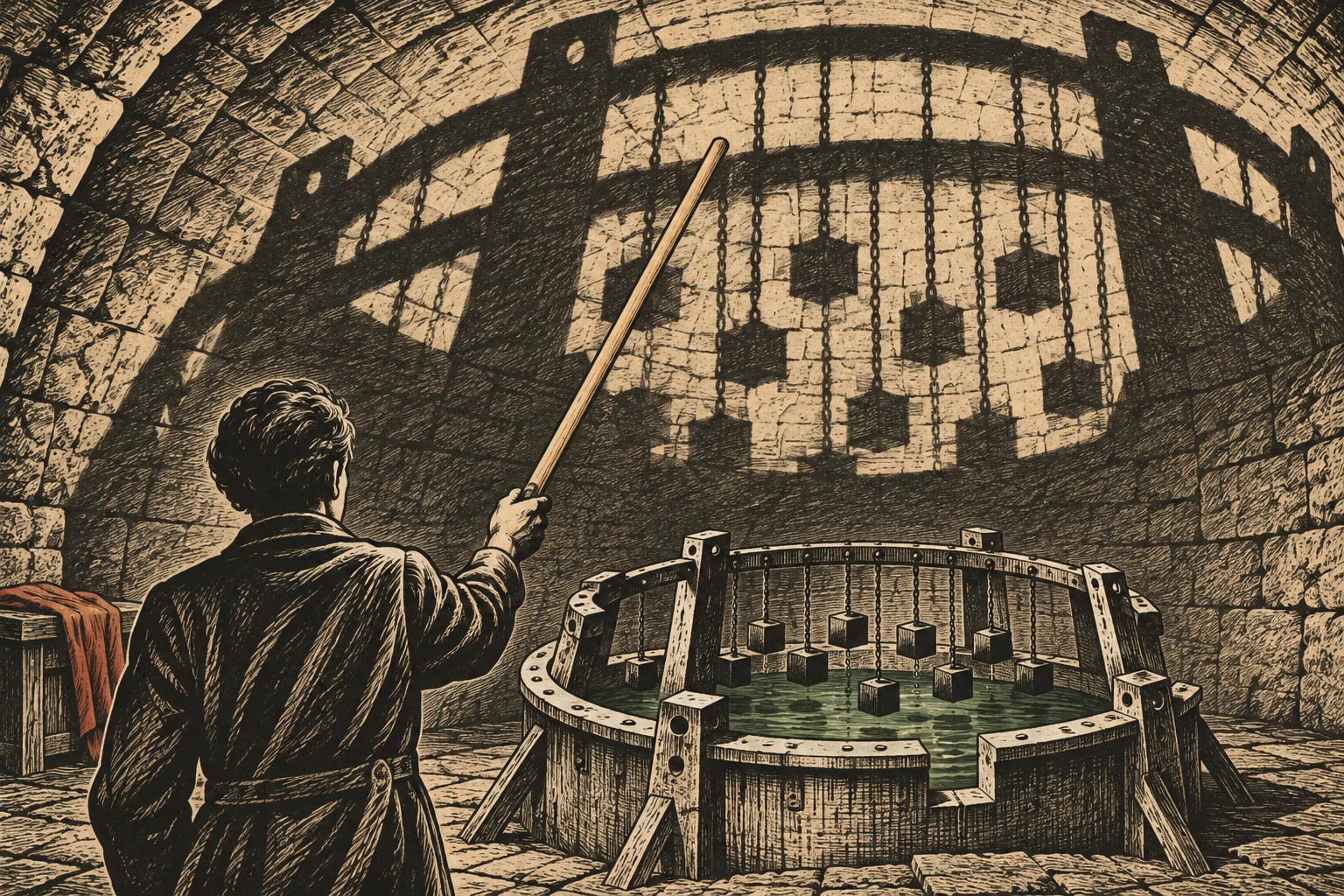
B8 was 664 natural-uranium metal cubes, each 5 cm on a side, strung on chains in five concentric rings and lowered into a tank holding about 1,400 liters (1,549 kg) of heavy water at 96.8% purity, wrapped in a graphite reflector. Total uranium mass: 1,538 kg. It never went critical. Heisenberg’s own account, published in Nature in 1947, put the miss at the edge of rounding error: “The material available at Haigerloch, however, was just insufficient to attain [criticality]. A relatively small amount of uranium would in all probability have sufficed.” That sentence shaped the postwar story of a near-miss German bomb program for most of eight decades.
How a pile goes critical
A reactor goes critical when its multiplication factor, k-effective, hits 1.0: each generation of neutrons produces exactly as many fissions as the one before. Below 1.0, the reaction dies out; above 1.0, it runs away. The German team in 1945 measured two related numbers for B8 — an infinite-lattice factor k∞ of 1.11 and a multiplication factor Z of 6.7 — and used them to argue they were close. The new paper built a Monte Carlo neutron-transport model of the actual geometry in MCNP6.2, tuned it until it reproduced those same historical measurements (it got k∞ = 1.11594 and Z = 6.465, within a few percent of 1945’s numbers), and then ran the model forward: how much more material would it have taken to cross 1.0? The as-built pile’s k-effective came out to 0.94252 — about 6% short, not a rounding error.
Closing that gap took between 1,292 and 1,775 cubes, depending on how the lattice was packed, against the 664 actually loaded into B8. Germany’s entire wartime cube inventory, split across Heisenberg’s Berlin group and Kurt Diebner’s rival effort at Gottow, came to roughly 1,110 cubes (2,572 kg) — more than B8 used, but still short of even the low end of what criticality required. Pooling every cube and every liter of heavy water the country had, the model’s k-effective only reaches about 0.96. Still subcritical. That finding reverses the same team’s own earlier published conclusion — reported in Ars Technica’s account of their prior work on the roughly 400 Gottow cubes found in declassified archives — that the combined German stockpile would have been more than enough to go critical. The correction came from better data: actual density and boron measurements on surviving cubes, not estimates.
The heavy-water shortfall is the larger of the two. B8 used 1,549 kg of 96.8%-pure D₂O; getting to criticality needed 2.2 to 2.3 times that, on the order of 3,400 to 3,560 kg. Germany’s total 1945 stock was 1,836 kg — about half of what was required. The sole wartime source was Norsk Hydro’s plant at Vemork, Norway, whose chief engineer later put total wartime output at roughly 2,840 kg of pure-equivalent heavy water, per the plant’s own postwar accounting. Even that gross figure, before losses, falls short of the amount the paper says B8 needed — and losses were substantial: the February 1943 Gunnerside commando raid destroyed roughly 500 kg of stock on hand and cost another 400 kg of future production, and the February 1944 sinking of the ferry SF Hydro sent about 679 kg to the bottom of a Norwegian lake. Those losses largely explain the gap between Vemork’s lifetime output and what Germany actually had in hand — but closing that gap would not have been enough regardless.
Why graphite wasn’t an escape route
The Manhattan Project avoided heavy water entirely, using ordinary graphite as the neutron moderator instead. Germany tried, and the same paper explains why it couldn’t have worked. Graphite moderates neutrons by slowing them down without absorbing many of them — but only if it’s free of boron, a trace contaminant that is a potent neutron poison, soaking up neutrons that would otherwise sustain the chain reaction. American reactor-grade AGOT graphite measured about 1.4 parts per million equivalent boron content (EBC). German industrial (Siemens) electrographite from 1941 measured about 6.6 ppm EBC, roughly 4.7 times dirtier; the graphite actually used in the B7/B8 reflector is estimated at 3.4 ppm EBC. The difference traces to feedstock: American graphite was made from petroleum coke, nearly boron-free. The Royal Navy’s blockade, tightened in January 1940, cut Germany off from that supply, forcing its graphite industry onto metallurgical coke from the Ruhr, carrying roughly twice the impurities. American scientists had the same problem until they located an unusually low-boron coke source in Pennsylvania; German industry never found an equivalent. The paper’s conclusion, tested across every lattice spacing its model ran: no natural-uranium, graphite-moderated pile could have gone critical with graphite of the purity available to Germany, at any density. This was a materials-science ceiling, not a quantity problem that more coke would have fixed.
The two surviving cubes the team physically analyzed added smaller findings to the larger numbers. Measured density came in at 18.53 g/cm³ against uranium metal’s nominal 19.01 g/cm³ — a roughly 2.5% shortfall, likely from casting voids in wartime production, meaning each cube held slightly fewer uranium atoms than its size implied. Measured uranium-235 fraction was 0.7242%, within the noise of natural abundance, confirming the cubes were never secretly enriched — a question the chain-of-custody work on these objects had left open until now.
A program too fragmented to add up
Germany’s uranium research split into competing, secretive teams: Heisenberg’s group in Berlin and then Haigerloch, Diebner’s rival effort at Gottow, and a smaller Leipzig program. They did not pool uranium or heavy water. Earlier work by the same researchers had treated that fragmentation as the explanation for failure — reasoning that unified stockpiles would have been enough. The new, more carefully measured model says otherwise: even perfect cooperation between every German nuclear group would have left the pooled pile short of critical. Germany’s broader wartime industrial position — contested steel and coal supplies, an Allied blockade on key feedstocks, transport bottlenecks from sustained bombing — made a Manhattan Project–scale uranium or heavy-water program implausible regardless of how the existing material was divided up.
That leaves Heisenberg’s 1947 framing looking less like understatement and more like a different kind of error. His own postwar calculations were approximate, done after a last-minute relocation of the whole effort from bombed-out Berlin to a cave in rural Haigerloch, and he never had the boron-impurity data or a validated neutron-transport model to check them against. The new paper’s authors treat that as understandable, not dishonest — approximate math, done under wartime conditions, that happened to understate the gap by a factor of two. It still shaped eight decades of argument over how close Nazi Germany actually came.
Where the cubes went
The physical evidence behind this paper exists because of a separate, decade-long chain-of-custody project by Koeth and Hiebert, described in a feature by Physics Today. As Germany collapsed in 1945, B8’s cubes were buried in a field; the Alsos intelligence mission, which included physicist Samuel Goudsmit, recovered 659 of the 664 and shipped them via Paris to the United States under the Combined Development Trust. Many never reached Oak Ridge for processing — some apparently ended up as informal mementos among Manhattan Project staff. Koeth traced his own cube to Robert Nininger, a Manhattan Project properties officer, via a note and a chance secondhand-book find; nine more turned up in US collections including the Smithsonian and Harvard. Fourteen cubes are publicly known today, out of roughly 1,110 that existed in wartime Germany.
Gamma-ray spectroscopy on the two cubes used in this study found no cesium-137 or other fission products, confirming neither was ever part of a critical chain reaction — consistent with the paper’s central finding that no cube in Germany’s wartime inventory ever could have been. The open number is how many of the roughly 1,100 others are still sitting uncounted in museum drawers, private collections and basements, and whether the same nondestructive forensic method gets applied to them before they do.