
On Sunday 15 November the castaway on BBC Radio 4 was a mathematician. The format of Desert Island Discs is old and simple: a guest picks eight recordings to take to an imaginary island, and the records become a way of telling a life. Hannah Fry is 42. According to the Press Association account carried by RTÉ, she is Cambridge’s first professor of the public understanding of mathematics and a fellow of Queens’ College, and was formerly president of the Institute of Mathematics and its Applications and professor of the mathematics of cities at UCL. Over the hour, Lauren Laverne drew out of her a life that, in the BBC’s own summary of the programme, starts with a boy who had polio and ends up in a hospital bed during lockdown.
Scales without music
Before any of that, she had a complaint about how schools teach her subject. “I don’t think people are just scared,” she told Laverne, “I think they’re traumatised.” She said it was like “learning scales without ever getting to listen to music”, a method that “just sucks all of the joy out of it” and leaves people convinced that mathematics lives “in a dusty textbook that’s got nothing to do with people’s lives.”
To her it is “totally glorious, joyous, insightful”. Her work has been to give people a reason to care. In a TEDx talk she once used her own dating life to show how mathematical strategies might improve her odds in love. “I’m now divorced,” she added, laughing.
Hydraulic lifts and a bishop
Her father had polio as a child and left school with no qualifications. He was out of the house by six every morning, fitting hydraulic lifts to lorries, to support his wife and daughters. He did not think of himself as clever. His daughter does: “he was smarter than half of the professors that I’ve ever met.” She said he could build things “out of whatever scrap metal he found lying around.” He spoke rarely, and when he did, she said, “it would be so insightful”.
Her mother came over from Ireland looking for work and met him at a dance. Fry calls her the most Catholic person she has ever met. “I’ve met a bishop as well,” she said. “She trumps them by a long way.” She is “a really, really good human”, always helping others, and also “deeply, deeply suspicious of any sort of fun or enjoyment”. The only men the girls had any contact with were their father and the priests. For a daughter drawn to car racing and engineering, there was, in her words, “no pocket of woman-ness that matched who I was.”
The same mother produced the mathematician. One summer, when Hannah was about 10 or 11, she got hold of a maths textbook and ruled that a page had to be done each day before the garden was allowed. “Obviously I hated it.” Back at school the work was suddenly easy. She sees the same pattern among colleagues now: “They’re no smarter than anybody else, really. They’re just people who are really, really obsessed with the subject.”
Six weeks in Formula One
After a PhD in fluid dynamics she got the job she had dreamed of, in Formula One. It lasted six weeks. The work was dull, “running code and picking the picture with the least amount of blue in it”, and she was the only woman. “When I was in the building, the disabled toilet became the girls’ toilet.”
Big institutions tend to say they cannot find talent. Her diagnosis is plainer. “I think that there is talent everywhere,” she said, “but if you design an environment for one particular type of person, it’s such an uphill battle for anybody else.”
She had been content to become “a normal bog-standard academic in a windowless room with a chalkboard”. Then a friend asked her to do some maths stand-up. She said yes, worked hard on the set, and it led to broadcasting. Sharing a strange way of seeing the world, she said, is like having good gossip, and “if you do that enough times, eventually you end up in Celebrity Traitors.” She took part in the show’s second season, was exposed as a Traitor and was banished in the fourth episode. She still cannot quite explain why she was there: “pop stars there, movie stars there, megastars there… and she’s a mathematician in the corner.”
Four nodes
In 2020, during the Covid lockdown, Fry was 36. She had put off a cervical screening for months. When she finally had it, cancerous cells were found. Her GP called her back for another test, then a biopsy. What mattered next was arithmetic, and she knew it. If no lymph nodes were affected, she said, “the odds were in my favour”. One affected node meant a survival chance of about 60 per cent, two meant 40. “Any more and you are really seriously in trouble.”
After her hysterectomy she asked the surgeon what he had seen. “He said four of them were enlarged… like it’s not good news really.”
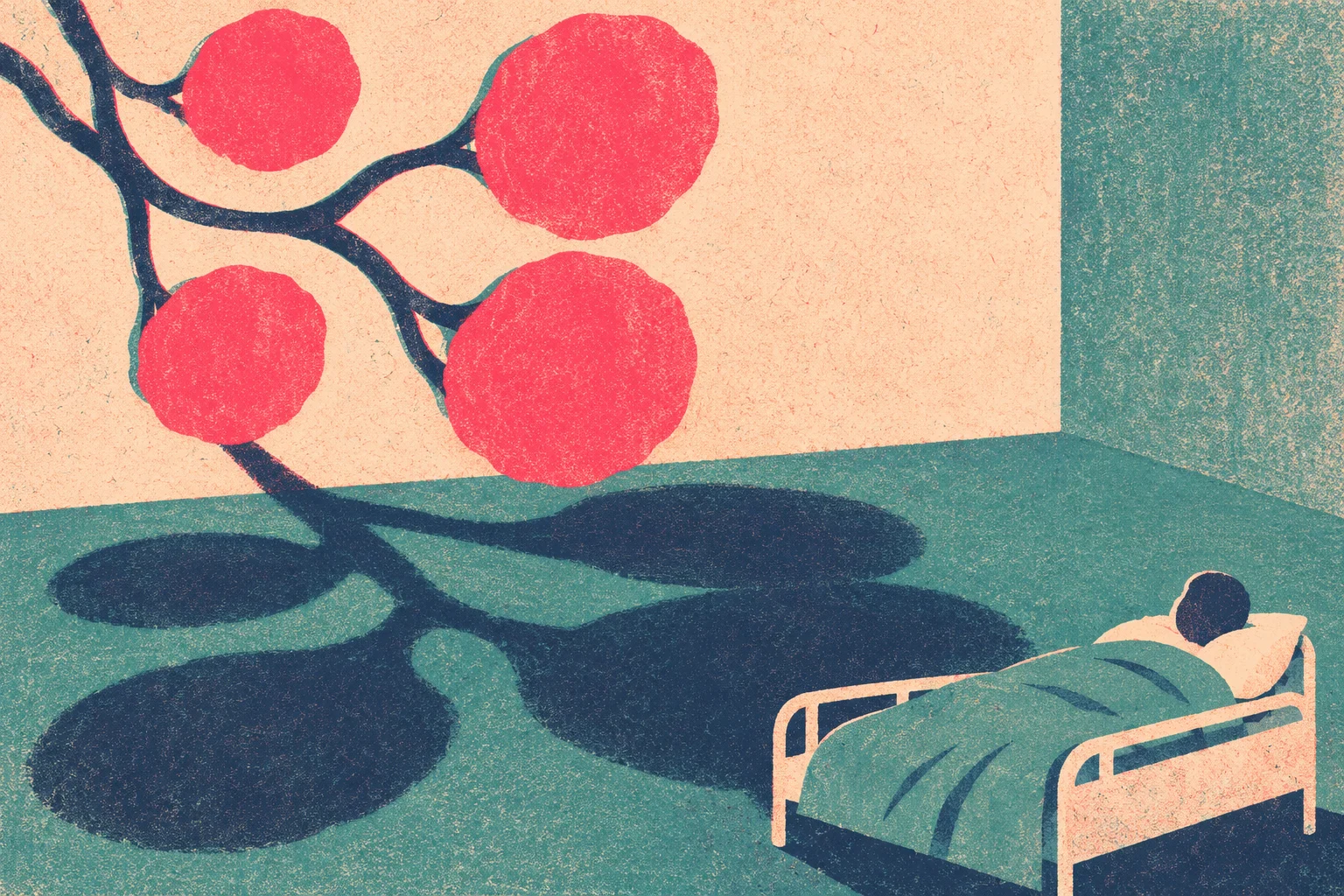
Hospitals had shut their doors to visitors. In the fuller version of her words reported by the Press Association, she said: “I was in this hospital bed on my own and no-one could come and visit me for over a week with nothing but the sheer terrifying drop of the end of my existence in front of me – it was horrific.” She felt too sad to ring family or friends. She asked her then-husband to set up FaceTime in a corner of the room “like I was CCTV”, so she could watch her two young daughters play without them seeing her. “I didn’t want them to see me, it was too much.”
Through those days she played one piece again and again: part of Spring from Vivaldi’s Four Seasons, recomposed by Max Richter. It was her sixth disc. “I can’t hear it without crying,” she said. “It’s like the ecstasy of what being alive should feel like.”
She has now been clear of cancer for five years. “I feel so unbelievably lucky,” she said. Her experience, she said, “had a full stop at the end of the sentence”, and it was “such a gift to have that experience when you’re 36 and then come out the other side of it.” She is trying to hold on to what it taught her, though she admits the lessons are fading a little.
The engine of doubt
Statistics gave her those survival figures, and at the end she spoke for the thing statistics is built to measure. People in power usually sound sure of themselves, and people tend to follow whoever sounds sure. Fry warned against exactly that:
People are very bad at accepting the amount of uncertainty there is. And I think that we can confuse confidence with certainty, and we can end up going down routes that are not good because we are denying the uncertainty. In a lot of ways science is actually the ultimate engine of uncertainty.
“It’s only by having doubt,” she said, “and using that as a way to continually test your own assumptions that progress really happens.”