
A cold hit in a DNA database is a lead, not a warrant. That is why, in January 2024, two undercover Everett, Washington, police officers knocked on Mitchell Gaff’s door posing as researchers running a chewing-gum flavor survey, got him to chew and spit out several sticks, and carried the samples straight to the Washington State Patrol crime lab. Gaff’s genetic profile had already surfaced two months earlier, in November 2023, when cold-case detectives resubmitted the cords used to bind Judy Weaver’s wrists in her 1984 murder and got a match against his profile in CODIS, the FBI’s national offender database. A database match on old, partially degraded evidence is not enough on its own to charge someone with murder; investigators wanted a direct reference sample, collected in a way that would hold up in court, before they moved.
The ligatures that produced that 2023 hit had sat in an evidence room for 39 years. Weaver, 42, was tied up, sexually assaulted and strangled in her Everett apartment on June 1, 1984, after walking home alone from the bar she had just sold, and her killer set the bedroom on fire on his way out, according to detective Susan Logothetti’s account to CBS News’ 48 Hours. The fire destroyed the room; it did not destroy the ligatures, the cut clothing or the pillowcase investigators pulled from the scene, because DNA typing of the kind used in 2023 did not exist as a police tool in 1984. For four decades the case’s only suspect was Weaver’s fiancé, Bill Richards, who died in 1994 still unconvicted and unexonerated. Richards’ DNA was not on the ligatures. Gaff’s was.
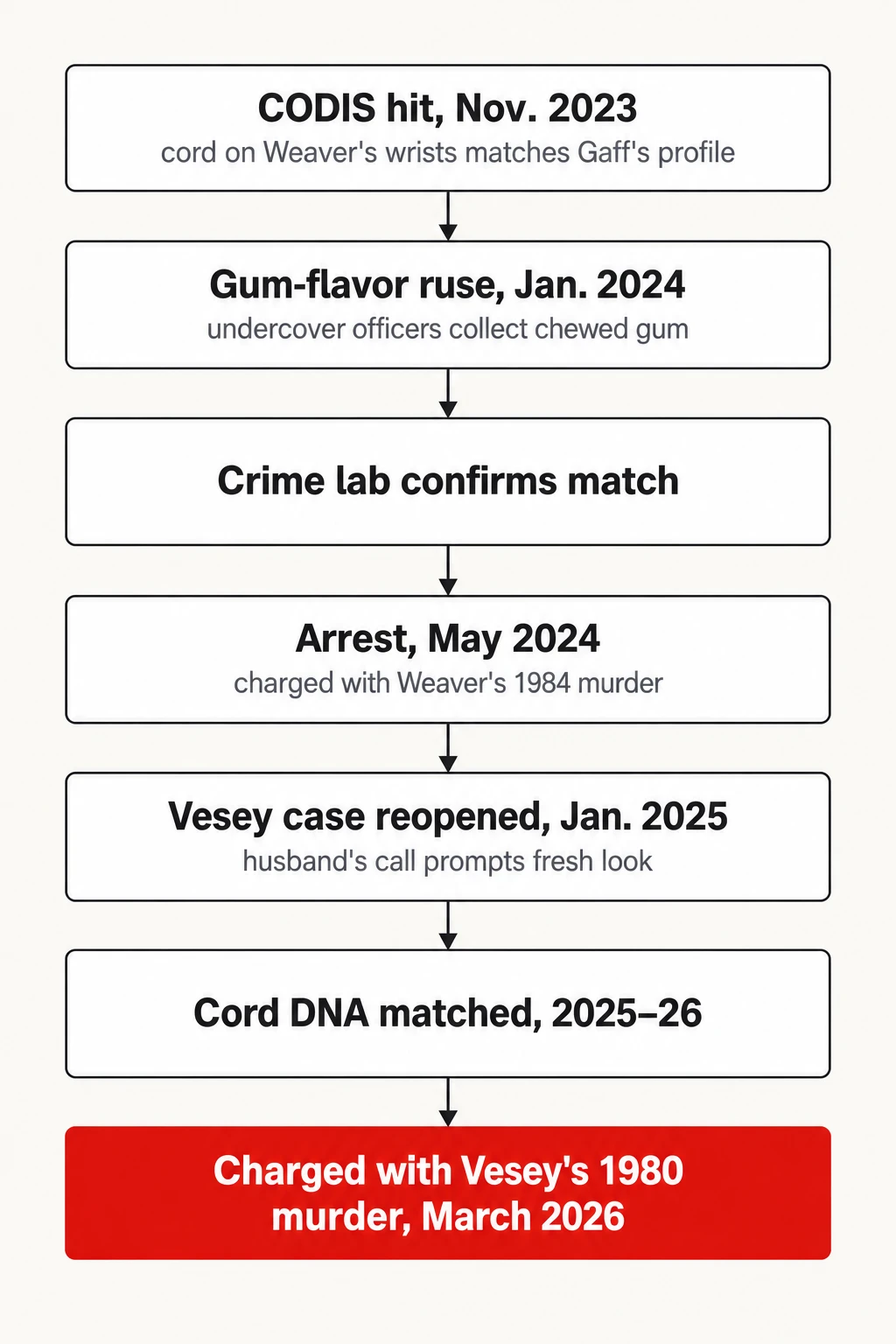
| From | To | How |
|---|---|---|
| CODIS hit, Nov. 2023 (cord on Weaver's wrists matches Gaff's profile) | Gum-flavor ruse, Jan. 2024 (undercover officers collect chewed gum) | |
| Gum-flavor ruse, Jan. 2024 (undercover officers collect chewed gum) | Crime lab confirms match | |
| Crime lab confirms match | Arrest, May 2024 (charged with Weaver's 1984 murder) | |
| Arrest, May 2024 (charged with Weaver's 1984 murder) | Vesey case reopened, Jan. 2025 (husband's call prompts fresh look) | |
| Vesey case reopened, Jan. 2025 (husband's call prompts fresh look) | Cord DNA matched, 2025–26 | |
| Cord DNA matched, 2025–26 | Charged with Vesey's 1980 murder, March 2026 |
Based on CBS News, HeraldNet
Gaff, now 68, had been in the system since long before anyone called it CODIS. The national database only began nationwide operation in 1998; Gaff’s sample entered it after his February 1985 conviction for breaking into an Everett home and raping two teenage sisters, ages 14 and 16, for roughly two and a half hours — an attack that happened about three months after Weaver’s murder, while he was still on probation for a 1979 assault. News accounts of that 1985 sentence disagree on its length: several, including CNN and Fox News, report 21 years; other accounts put the rape sentence itself at 11.5 years, with the larger figure likely folding in the civil commitment that followed. Two separate juries, in 1994 and 2000, found Gaff met Washington’s legal standard for a sexually violent predator and ordered him held at the state’s McNeil Island special commitment center for the state’s highest-risk sex offenders. Court-ordered supervision over him ended in 2018. He had five years at large before the 2023 cord re-test connected him to Weaver.
The 1979 case is the near-miss in the record. Gaff attacked a 29-year-old Everett police officer, Jackie Brown, in her own garage, pistol-whipping her before she fought him off with a knife wound to her palm and ran screaming into the street. Officers detained a man near the railroad tracks minutes later; Brown looked at him and said that wasn’t the attacker. He was eventually charged anyway with assault and burglary and got five years’ probation and one year of work release — a sentence that did not stop him from raping two teenagers three months after killing Weaver, while still on that probation.

A second murder, found by accident
Susan Vesey, 21, was raped and strangled on July 12, 1980, the day after her birthday, inside her Everett home while her two-year-old daughter and infant son slept in another room; Gaff had hidden in a closet and bound her with drawstrings and electrical cord. Her husband, Ken Vesey, found her body after his night shift. For decades the case’s working suspect was Gerry Vesey, the victim’s brother-in-law. In January 2025, after Gerry died, Ken Vesey called Logothetti, by then working the Weaver case, to ask why his wife’s murder had never been solved. Logothetti recognized what court filings describe as “startling similarities” between the two killings and sent Vesey’s binding cords for testing. The state crime lab reported in April 2025 that the DNA on the cord gave “strong support” for a match to Gaff; a full match followed in March 2026, and Snohomish County prosecutors charged him with aggravated and first-degree murder on March 13, 2026 — Everett’s police chief, Robert Goetz, noted the charge came “almost 50 years later,” and Mayor Cassie Franklin credited the department’s use of newer DNA-analysis techniques.
Fifty years to life
Gaff pleaded guilty on April 16, 2026, to two amended counts of first-degree premeditated murder, one for each victim. Because both killings predate Washington’s 1984 Sentencing Reform Act, he was eligible only for the older indeterminate-sentencing scheme — a minimum term followed by a maximum of life, with parole-board review rather than a fixed release date. Prosecutors asked Snohomish County Superior Court Judge Edirin Okoloko for a minimum of more than 61 years, calling it effectively a life sentence; the defense asked for a 20-year minimum, citing Gaff’s age and his history of sex-offender treatment. On May 13, 2026, Okoloko sentenced him to a minimum of 50 years and a maximum of life, telling the courtroom that Weaver’s and Vesey’s families had waited 42 and 46 years, respectively, for the sentence to reflect it.

He is the bump in the night that should make people aware.
That line, from Snohomish County prosecutor Craig Mattheson, was aimed at a defendant who described himself in court as having been “a runaway train through the lives of everyone I came in contact with.” Weaver’s daughter, Cathy Myers, told the court her wish was that Gaff “never gets to just carry on with his life again.” Defense attorney Heather Wolfenbarger argued Gaff is “not the same person” he was during the crimes, a claim the court record does not test against anything beyond his own account and his treatment history.
What the record does show: a man flagged by two separate juries as a sexually violent predator, held under state supervision for 24 years between his 1994 and 2018 release dates, was free for five years before a routine resubmission of 1984 evidence to a modern DNA assay put a name on it. Detectives told 48 Hours that Gaff has acknowledged additional, uncharged assaults beyond the two murders and the 1984 rape of the sisters. Snohomish County has not said whether any of that disclosure has opened new cases.