
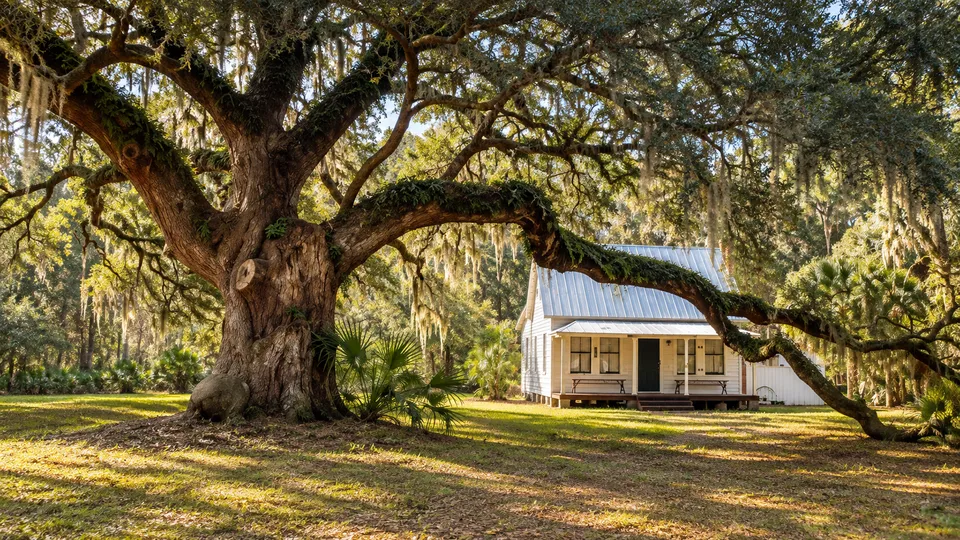
On Oct. 12, a roughly 500-mile strip of the southeastern American coast will mark 20 years since Congress designated it the Gullah Geechee Cultural Heritage Corridor, a National Heritage Area preserving a culture and a language rooted in West Africa and found nowhere else on Earth.
The corridor runs from North Carolina to southern Florida, taking in the sea and barrier islands where the descendants of enslaved Africans built free, largely isolated communities. About one million people in the United States claim Gullah Geechee heritage today, among them the singer Darius Rucker and former First Lady Michelle Obama.
The culture’s roots lie in the late 17th and 18th centuries, when planters in the Carolina Lowcountry sought out people from Central Africa and West Africa’s Rice Coast for their knowledge of cultivating rice, indigo and Sea Island cotton. The conditions were brutal. The same isolation that made the work punishing let the enslaved and their descendants hold on to African practices and adapt them.
They survive in the food, for a start. Lowcountry red rice, cooked with tomatoes, spices and smoked pork, is often compared to jollof rice from the Senegambia region. West African coiled basketry carried on in sweetgrass, bulrush, palmetto and pine. And the ring shout, a ritual in which participants move counterclockwise in a circle, stomping, clapping and singing in call and response, recalls West African musical and spiritual practice.
They survive, too, in the language. Gullah grew from the need to communicate with slave owners and with Africans who spoke other tongues. Colonial English supplies most of its vocabulary, but African-derived words hold on: oona for you all, nyam for eat, cooter for turtle, goober for peanut. Where the name itself comes from, nobody is sure. “Gullah may derive from Angola or from the Gola people of West Africa,” Luana Graves Sellars, a cultural preservationist and founder of the heritage organization Lowcountry Gullah, told the BBC. “Geechee may come from the Kissi people or Geechee from Georgia’s Ogeechee River.”
On Hilton Head Island, the corridor holds the site of Mitchelville, the first self-governed town of free Black people in the United States. After Union forces took Port Royal Sound in 1861, hundreds who had escaped slavery sought refuge behind Union lines, and in 1862 Gen. Ormsby Mitchel began building a freedman’s town on the former Fish Haul Plantation. The town declined after Union forces withdrew, was largely abandoned by the early 1880s, and the Great Sea Island Hurricane of 1893 devastated what remained.
Writing in the BBC, Dexter Strong described taking his 18-month-old son to Fish Haul Beach at low tide and then, during a Juneteenth visit to nearby Bluffton, stumbling on a ring shout at Martin Family Park. “One voice called. The others answered,” he wrote. His son stomped and clapped along. “Understanding the Gullah Geechee language is about understanding that everything we do speaks,” Ms. Sellars told him.
The food still speaks, in dishes like shrimp and grits, purloo and gumbo. “For us, food represents a way of living,” Alex Brown, a fifth-generation Gullah resident and a Hilton Head councilman, told the BBC. “Our historic culture of bartering is what produces these dishes. Someone may have some okra. Someone, rice. Someone else, shrimp. But together, suddenly we have okra gumbo.”
For Mr. Brown, the corridor’s anniversary is about more than preservation. “Our people are an important part of America’s story,” he said. “The story of American democracy cannot be told in full without mentioning Gullah sites like Mitchelville. Folks know Williamsburg. Folks know Jamestown. They have got to get to know Mitchelville.”